Fiction notice: The following story is a work of fiction inspired by an imagined wildlife rescue scenario. Its characters, locations, and events are not presented as a real news report.
The River Entered Before Dawn

Rain had fallen for six days before the river crossed the road into Vila Esperança. By dawn, brown water had swallowed the sidewalks; by noon, it was floating chairs through kitchens where families had eaten hours earlier.
Emergency crews had evacuated nearly every resident during the night. Buses carried children and older people to a school on higher ground, while volunteers moved pets into fishing boats and pickup trucks. Yet nobody trusted the silence left behind. In floods, rescuers knew, silence could hide an injured person, a frightened animal, or someone who had refused to leave.
João Ribeiro, a municipal rescue officer, stood in a shallow aluminum boat with rain dripping from his helmet. Beside him were veterinary volunteer Camila Alves and firefighter Marcos Leal. They had checked twenty-three houses since sunrise. At each gate, João called out. Marcos looked through windows, and Camila listened for scratching, crying, or movement beneath the roofs.
They were preparing to leave the final street when a sharp bark rose above the rain.
Everyone in the boat froze.
The bark came again, faint but urgent, from somewhere behind a blue house almost submerged to its windows. João turned the motor off, and the current pulled them sideways. Marcos grabbed a fence post to steady the boat. For several seconds, they heard nothing. Then the barking returned, followed by the splash of something falling into the water.
“Backyard,” Camila said. “There is something alive back there.”
A Bark Behind the Blue House
The passage beside the house was too narrow for the boat, so the rescuers tied it to a balcony and entered waist-deep water. Furniture drifted past as a metal roof groaned nearby.
Using the rope between them, the rescuers pushed through the passage until they reached the backyard. There, a mango tree rose from the flood like a small island. Its lowest limbs had disappeared beneath the current, and broken furniture circled the trunk. High among the rain-darkened leaves, João finally saw the pale shape from which the desperate barking had suddenly come.
The bark came again.
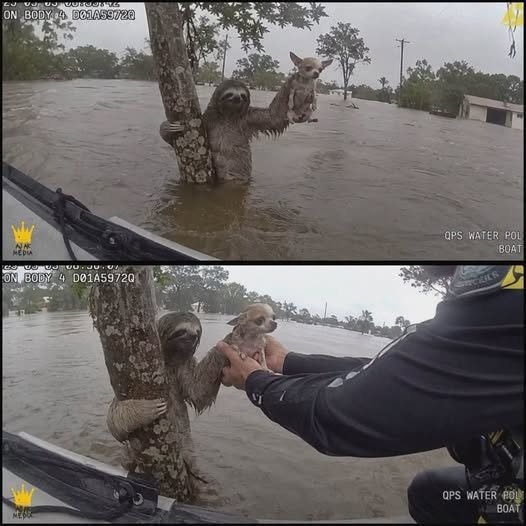
On a narrow branch four meters above them, a tiny white-and-tan Chihuahua trembled. His soaked fur clung to his body, one hind leg hanging awkwardly as he dug his claws into the bark.
But the dog was not alone.
Behind him, hidden by wet leaves, a brown-throated sloth clung to the branch. One long arm curved around the dog’s chest while the other gripped the tree, holding the trembling Chihuahua against its thick fur.
“Are you seeing this?” Marcos whispered.
Camila lifted her helmet visor. “The sloth is holding him.”
The dog tried to shift his weight, and the branch dipped. Instantly, the sloth tightened its arm and drew him closer. The Chihuahua stopped struggling. He pressed his face against the animal’s chest as another surge of water struck the trunk below.
The Dog Named Pingo
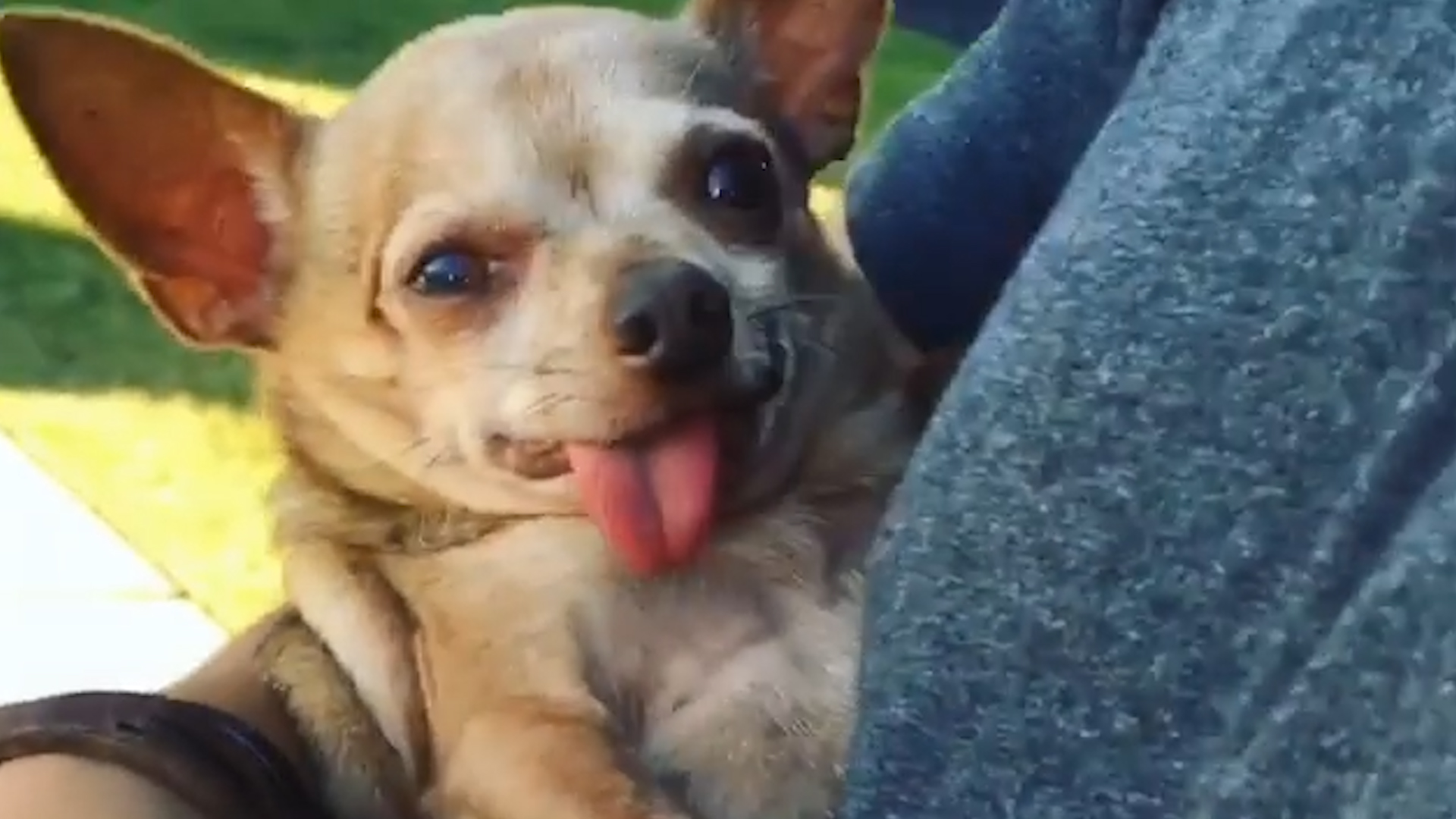
At the evacuation shelter, Dona Rosa had spent the morning asking about her Chihuahua, Pingo. During the nighttime evacuation, a shattered window frightened him. He escaped her arms and vanished behind the house before rising water forced volunteers to carry Rosa away.
Marcos secured a climbing line around the tree while João requested a wildlife specialist by radio. The nearest team was helping at a collapsed bridge and might need two hours to arrive.
The branch bent again.
They did not have two hours.
Through binoculars, Camila saw that the Chihuahua was exhausted and possibly injured. The sloth’s grip remained stable, but higher branches were thinner. If the dog fell, the current could drag him beneath the nearby roof within seconds.
“We take the dog first,” Camila said. “If the sloth releases him.”
That was the question none of them could answer.
The Impossible Rescue Plan
The rescuers built a platform from a ladder, two floating doors, and ropes tied to nearby trees. It gave Camila enough height to reach the canopy while Marcos controlled her safety line and João waited below with a net.
Camila climbed one careful step at a time. Pingo began barking wildly. The sloth turned its head toward her but did not retreat. When she came within arm’s reach, she stopped and lowered her eyes, avoiding a direct stare that might seem threatening.
“Easy,” she whispered. “I am here for both of you.”
She extended a towel. Pingo snapped at it, then buried his face against the sloth again. Camila waited as rain struck the platform and made the ladder tremble beneath her mud-covered rescue boots.
After several minutes, Pingo lifted his head. Camila moved one hand beneath his chest. At that moment, the sloth’s curved claws shifted.
Marcos held his breath.
Instead of pulling the dog away, the sloth slowly loosened its arm. It kept one hand against Pingo’s back until Camila had a firm grip. Then it withdrew, allowing her to wrap the Chihuahua in the towel.
The dog whimpered but did not fight. As Camila lowered him toward João, the sloth reached forward once more and touched the edge of the towel. Its movement was so deliberate that everyone below fell silent.
“Now you,” Camila said.
She offered a padded pole designed for handling wildlife. The sloth ignored it. It climbed upward, moving with surprising purpose through the rain.
The Guardian Climbed Away

The higher the sloth climbed, the less secure the branches became. Camila could not follow without risking a fall. She descended while João contacted the wildlife team again. They agreed that the animal was safer in the tree than in the flooded yard, provided the trunk remained stable.
The rescuers carried Pingo back through the passage. At the boat, Camila examined him beneath a waterproof sheet. His leg was badly bruised but not broken. He was cold, dehydrated, and frightened. Yet when João opened the bag slightly, the Chihuahua twisted around, looking toward the backyard.
He barked once.
The sloth had settled against the trunk above the highest flood mark. It seemed calm, but João could not accept leaving it behind. The river was still rising, and forecasts promised more rain. A weakened tree could fall without warning.
Camila called Pingo’s number; Rosa’s voice broke with relief.
“He is not alone,” Camila added. “Another animal kept him safe.”
Rosa did not understand. Neither did Camila, not completely. Wild sloths do not think like human rescuers, and she refused to turn animal behavior into a fairy tale. Perhaps the Chihuahua had pressed against the sloth for warmth. Perhaps the sloth had simply gripped whatever was near when the branch shook. But Camila had seen it loosen its arm only after she secured the dog.
Whatever the explanation, Pingo had survived because he had not faced the flood alone.
A Promise Made in the Rain
At the school shelter, Dona Rosa sat on a folding chair with a gray blanket around her shoulders. When João placed Pingo in her arms, she kissed his wet head again and again. The Chihuahua collapsed against her, too tired even to bark.
“I saw that sloth before,” she said. “It lived in the trees near the river. Pingo barked at it every afternoon.”
The idea almost made João laugh. The tiny dog had apparently spent months scolding the quiet animal that would one day share its branch. Rosa said the sloth sometimes crossed the roof at dusk. Pingo would run beneath it, furious at the slow stranger invading his territory.
No one could know what happened when the water arrived. Pingo might have climbed fallen furniture to reach the tree. The sloth might already have been there, trapped when its route to the riverbank disappeared. Fear, current, and chance had placed them together.
He returned to the rescue station and promised Rosa they would bring the second survivor out too.
The Longest Night
Darkness fell before the wildlife team reached Vila Esperança. Biologist Helena Costa arrived with transport crates, climbing equipment, and fresh ropes. The rain had intensified, turning the backyard into a black, moving lake. Powerful lights revealed the sloth still clinging to the mango tree.
Helena examined it from the roof of the neighboring house. The animal appeared alert, and tranquilizing it would be dangerous. A sedated sloth could lose its grip and drown. Instead, the team created a rope bridge between the mango tree and a dry upper balcony. At the balcony end, they attached fresh branches and leaves inside an open crate.
Then they waited.
Shortly after midnight, the mango tree gave a sharp crack.
The sloth lifted its head.
Another crack rolled through the trunk. Helena brushed leaves along the rope bridge, making a continuous path. Slowly, the sloth reached toward it. One claw closed around the rope, then another. The bridge swayed, but the animal continued. Nobody spoke as it crossed above the flood.
When it reached the balcony, Helena guided it toward the leafy crate. The sloth entered without resistance. Only after the door closed did the rescuers cheer.
Seconds later, a large section of the mango tree broke away and crashed into the water.
When Pingo Saw the Sloth Again

The flood began retreating two days later. Wildlife officials examined the sloth and found no serious injuries. Helena planned to release it in protected forest far from roads and damaged houses. Before leaving, she stopped at the school to speak with Dona Rosa.
Pingo was awake and walking with a small bandage around his leg. When Helena carried the covered crate through the courtyard, the Chihuahua lifted his ears. He pulled gently at his leash and made a soft sound unlike his usual sharp bark.
Helena raised the cover, and the animals watched each other.
There was no dramatic embrace, no proof that either understood what had happened. The sloth did not reach through the crate, and Pingo did not behave like a dog greeting an old friend. Yet he did not bark. The little dog who had once challenged the animal every afternoon simply lowered himself onto the ground and rested his chin between his paws.
Dona Rosa wiped her eyes.
“He remembers the branch,” she said.
What the Flood Left Behind
Weeks later, Vila Esperança was covered in mud, but its residents were rebuilding. They repaired walls, replaced doors, and planted a new mango tree near the blue house. Children painted a small wooden sign showing a sloth and a Chihuahua sitting together above blue waves.
The photograph taken by João traveled through shelters and volunteer groups, not as evidence of a miracle, but as a reminder to keep searching after evacuation. Animals frightened by disasters can hide in roofs, trees, drains, and abandoned rooms. One faint bark had led rescuers to two lives.
Pingo recovered and returned home with Dona Rosa. He still watched the treetops at dusk, though he no longer barked at every moving shadow. The rescued sloth was released into a forest reserve, where it climbed a tall tree and disappeared into green leaves without looking back.
João often thought about the moment Camila reached for the Chihuahua. The sloth could have tightened its grip or climbed away with the dog trapped beside it. Instead, it had released Pingo only when human hands were ready to hold him.
During the worst hours of the flood, when streets became rivers and familiar homes vanished beneath brown water, a tiny dog found safety against an unlikely body. A sloth held on while the branch shook. Then, when help arrived, it allowed the smallest survivor to leave first.
Nobody could prove that the sloth intended to save Pingo.
But everyone who entered that flooded yard knew one thing: it had refused to let him fall.