PART 1
When I agreed to marry Adrian Kessler, I didn’t care whether he was innocent.
That’s the ugliest sentence I’ve ever had to write, so I’m putting it first. I want you to understand exactly who I was when this started, because nothing that happened later makes sense unless you know how little I believed in anything back then.
I was twenty-seven years old. I worked breakfast shifts at a diner on Route 9 and cleaned office buildings downtown four nights a week. My mother had died two winters earlier, and my father had stopped being a real person in our lives long before that, which left me and my little brother, Danny, in a one-bedroom apartment with a radiator that clanked like a ghost dragging chains and a landlord who taped notices to our door in bright orange paper.
FINAL WARNING. PAST DUE.
Danny was fourteen. He slept on the pullout couch and did his homework at the kitchen table under a lamp we’d found on the curb. He was smart, smarter than me, and he had asthma that flared every time the weather turned. His inhalers cost sixty-two dollars each. I knew that number the way some people know their own birthday.
One of the buildings I cleaned at night belonged to the Kessler Family Foundation. Thirty floors of glass and polished stone, with a lobby that smelled like lilies. I vacuumed the executive suite every Tuesday and Thursday, and that’s how Margaret Kessler found me.
She was standing in her office at nine at night when I came in with my cart. Silver hair cut sharp at the jaw, a cream-colored suit, reading glasses on a thin gold chain. I apologized and started to back out. She told me to stay.
She watched me work for a full ten minutes. Then she asked me my name, my age, whether I was married, and whether I had any family to support.
I thought I was about to be fired for something. Instead, a week later, I was sitting across from her in that same office with a cup of tea I was too nervous to drink, and she was explaining the most insane offer anyone had ever made me.
“My son is in prison,” she said, folding her hands on the desk. “Perhaps you saw the news three years ago.”
I had. Everyone had. Adrian Kessler, thirty-one, heir to one of the oldest family fortunes in the state, convicted of embezzling four million dollars from his own family’s charity. The newspapers had loved it. The Prince Who Robbed the Poor. He’d been sentenced to twelve years.
“His attorneys are preparing a petition to reduce his sentence,” Margaret went on. “Judges look favorably on stability. On family ties. On a man who has someone waiting for him.” She slid a folder across the desk. “I need him to have a wife.”
I actually laughed. I couldn’t help it.
She didn’t.
“Two thousand dollars a month,” she said. “Deposited on the first. You visit him twice a month. You write him letters. You appear at hearings when his attorneys ask. You sign a prenuptial agreement waiving any claim to his assets. And when he is released, whenever that is, you file for divorce within thirty days, and I pay you a final fifty thousand dollars.”
“Why me?” I asked.
She looked at me over her reading glasses. “Because you need it. People who need things are reliable.”
There was one more condition. She said it lightly, the way you’d mention parking instructions.
“I’d like you to tell me what he talks about. His mood. His plans. Whether he’s still obsessing over his case. My son has never handled disappointment well, and I worry about him.”
I should have heard what she was really asking. Maybe part of me did. But two thousand dollars a month was rent, groceries, Danny’s inhalers, and the electric bill, with something left over. It was the difference between drowning and floating.
I said yes before my shame could catch up with me.
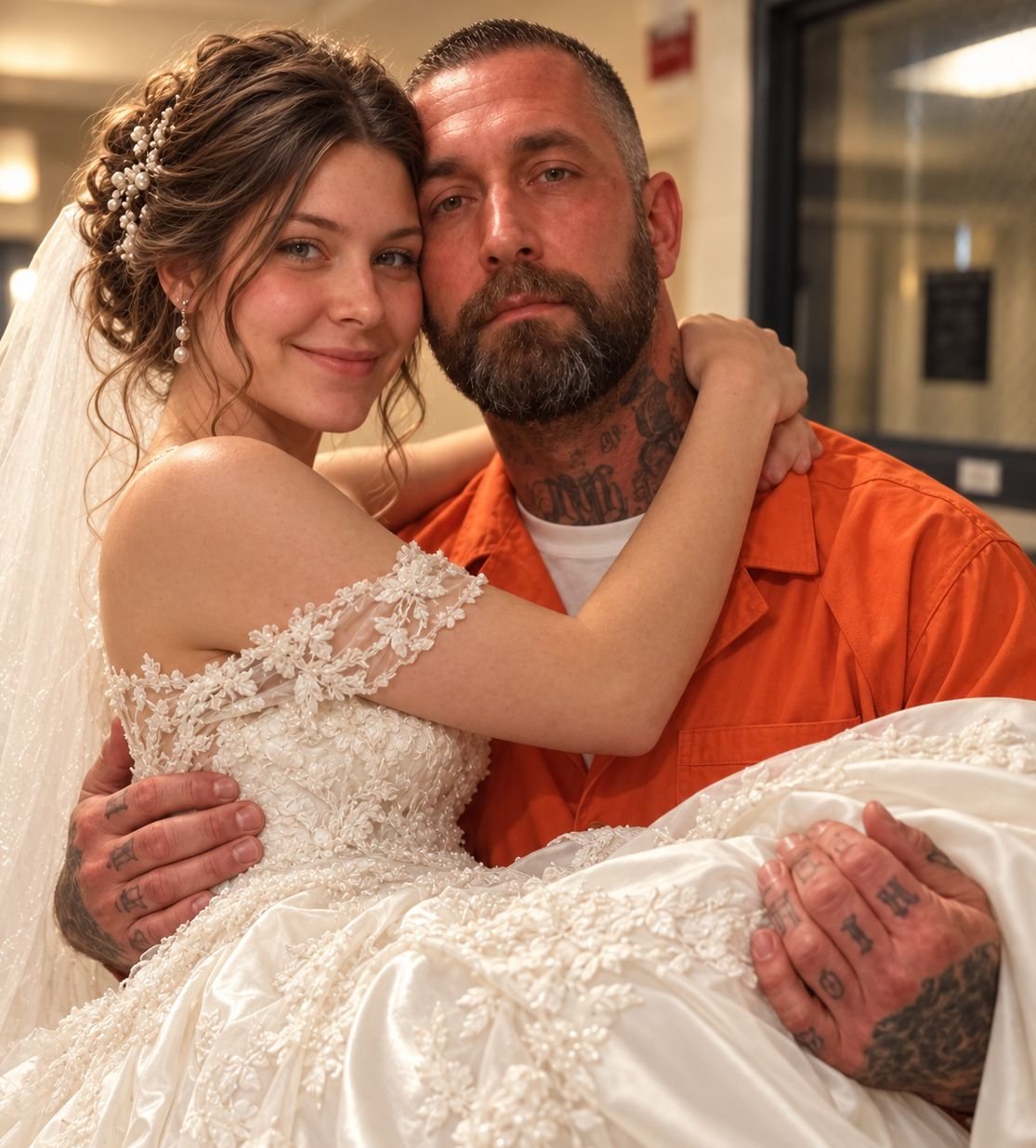
Our wedding took place on a Wednesday afternoon in the visiting room of the state correctional facility, behind a sheet of scratched plexiglass, with a chaplain reading from a laminated card and a guard checking his watch.
I wore a blue dress from a thrift store. Margaret’s attorney, a thin man named Mr. Weller, handed me a plain gold band through the slot in the partition, and I slid it onto my own finger, because nobody was allowed to touch.
I’d prepared myself for the man in the newspapers. Cold. Entitled. Bitter. Maybe cruel.
Adrian Kessler was none of those things.
He was tall and too thin for his prison khakis, with dark hair cut short and gray eyes that seemed to take in everything at once. When the chaplain asked if he took me as his wife, he looked at me for a long moment, not at the chaplain, not at the guard, at me.
“I do,” he said. Then, so quietly only I could hear through the speaker, “I’m sorry it’s like this. You deserve a real one someday.”
That was the first surprise.
The second came two weeks later, when his first letter arrived.
It was three pages long, written in neat, slanted handwriting. He didn’t talk about his case. He asked about Danny. He asked whether the diner was busy. He described the one tree he could see from the yard, a crooked maple that had just started turning red. In the margins, he’d drawn small pencil sketches: the maple, a coffee cup, a little cartoon of a radiator with angry steam coming out of it, because I’d mentioned ours on my first visit.
I laughed out loud at my kitchen table. Danny looked up from his homework and asked what was so funny.
“Nothing,” I said. And I folded the letter and put it in my coat pocket, where I could feel it all day.

At first, I acted like I cared.
I visited on the first and third Saturdays. I wrote back every week. And every month, I sat in a coffee shop near Margaret’s office and gave her my report. He seems calm. He’s reading a lot. He asked about the appeal process once, but he didn’t push it.
She’d nod, write something down, and hand me nothing but a cold smile.
Then, somewhere around the sixth month, I stopped acting.
I don’t know the exact day. Maybe it was the visit when Danny had a bad asthma attack the night before, and I came in with no makeup and swollen eyes, and Adrian spent the entire hour asking me questions about Danny’s medication and his doctor and whether the school nurse knew his triggers, as if nothing else in the world mattered. Maybe it was the letter where he wrote, You don’t have to pretend to be happy when you come here. I’d rather see you tired and real than smiling and gone.
Maybe it was just that no one had asked me if I’d eaten in two years, and he asked every time.
All I know is that one night I came home from cleaning the Kessler building, sat down at the kitchen table, and read his case file for the first time.
Mr. Weller had given me a copy months earlier, “for appearances,” in case a reporter ever asked me questions. I had shoved it in a drawer without opening it.
I opened it at one in the morning and didn’t stop until the sun came up.
I’m not a lawyer. I didn’t even finish community college. But I’ve spent my whole life reading bills, notices, and fine print, looking for the trick that would cost me money, and I know when numbers don’t line up.
These didn’t line up.
There were transfer authorizations signed by Adrian on dates when, according to the hospital records attached to his own sentencing report, he had been in a recovery ward after a serious car accident. There was a witness, an accountant at the foundation, who had testified against him and then moved out of state two weeks after the trial. There were signatures on some documents that looped differently from the ones on others, and nobody had seemed to notice.
In the margin of one page, someone had written a bank routing number in pencil and then partially erased it.
I stared at that erased number for a long time. Then I got up, found Adrian’s last letter, and looked at the sketch in its margin: a little row of birds sitting on a telephone wire. Nine birds. Some with their heads up, some with their heads down.
I told myself I was imagining things.
I wasn’t.
For the next two years, I fought for my husband with everything I had.
I took the case file to every legal aid clinic in the county. I sat in waiting rooms for hours. I stood outside the courthouse with a folder pressed against my chest and stopped attorneys on the steps until a security guard told me to move along. I spent money I didn’t have on copies, on postage, on bus fare to the state archives.
Most people laughed at me. One public defender told me, kindly, that every wife thinks her husband is innocent.
Then I met Harold Price.
Harold was seventy-three, retired from thirty-five years of appellate work, and bored half to death. He read the file in his kitchen while I sat across from him drinking terrible instant coffee. When he got to the hospital records, he set down his glasses.
“Who else has seen this?” he asked.
“Nobody seems to care.”
“Well,” Harold said, “I care now.”
He took the case for free. It took him fourteen months, three motions, and a subpoena for bank records that Adrian’s trial attorneys had never requested. But when the records came back, they showed exactly where the four million dollars had gone.
Not to Adrian.
To his cousin, Grant Kessler, the foundation’s chief financial officer. Grant had moved the money through a chain of consulting firms, forged Adrian’s signature on the authorizations while Adrian was in the hospital, and then let him take the fall.
Grant was arrested in March. The accountant who’d fled the state was found in Arizona and recanted her testimony within a day.
On a gray morning in April, three years after our wedding behind the glass, a judge vacated Adrian’s conviction and ordered his immediate release.
There was one more thing that happened before that day, and it matters more than anything else in this story.
Two weeks before the hearing, I sat across from Adrian in the visiting room, and I told him the truth.
I told him his mother had paid me. Two thousand dollars a month. I told him about the reports. I told him about the fifty thousand dollars waiting if I divorced him within thirty days of his release. I told him I’d stopped giving her anything real more than two years ago, that every report since then had been invented, but that I had still taken her money, every single month, because Danny needed it.
I cried so hard the guard came over to ask if I was all right.
Adrian didn’t look angry. He didn’t even look surprised.
He just pressed his hand flat against the glass, and after a moment, I pressed mine against the other side.
“I know,” he said quietly.
“How long have you known?”
He was silent for a moment. “Thank you for telling me,” was all he said. “That took courage. I won’t forget it.”
The day Adrian walked out of the facility, I was waiting by the gate with Danny and Harold. I thought he’d run to me. I thought there’d be some movie moment.
Instead, he stopped just outside the doors and stood very still in the April wind, and his face tightened, as if freedom itself had bruised him. As if the sky was too big.
Then he walked to me, took my hand for the first time in our marriage, and said, “Come home with me.”
He didn’t mean the Kessler estate. He’d made it clear he wasn’t setting foot there. He meant my tiny apartment with its clanking radiator, where Danny gave up the pullout couch without being asked and slept on an air mattress in the hallway like it was a camping trip.
For seven days, I believed we had survived the worst of it.
Adrian made pancakes every morning, badly. He walked Danny to the bus stop. He fixed the radiator with a wrench and a YouTube video. At night, we sat on the couch with our knees touching and talked until two in the morning, and when I fell asleep against his shoulder, he didn’t move for hours.
Margaret called me three times that week. I didn’t answer.
On the eighth night, after Danny had headed downstairs to sleep over at his friend Marcus’s apartment, Adrian came out of the bedroom carrying something I had never seen before.
It was a box. Matte black, heavy-looking, about the size of a shoebox, with a small brass combination lock on the front. He set it down in the middle of the kitchen table with a soft, solid thunk.
“Where did that come from?” I asked.
“Harold’s safe. I picked it up this afternoon.”
“What’s in it?”
He sat down across from me and folded his hands on top of the lid. For the first time since he’d come home, he looked exactly the way he had looked behind the glass. Careful. Measured. Like a man who had rehearsed something for a very long time.
“Two weeks ago, you told me your secret,” he said. “Now it’s my turn to be honest.”
I tried to smile. “Adrian, you’re scaring me.”
He didn’t smile back.
“I know,” he said softly. “But I have to. Because when you married me, Tessa, you agreed to something far bigger than a name on a piece of paper. And my mother is about to find out exactly how big.”