Thanks for coming from Facebook. We know we left the story at a difficult moment to process. What you’re about to read is the complete continuation of what this experienced. The truth behind it all.

It was too much.
Everything was always too much.
By the time she turned toward home, the sky had flattened into a dull gray lid over the city. The wind cut harder as afternoon sank toward evening. Lila lowered her head and dragged the cart through slush, one boot leaking, the other stiff with salt. Home was a single room above an old repair shop whose owner had stopped asking for rent after Evelyn got sick enough that pity finally outweighed profit.
The building was narrow and tired. The stairwell smelled like damp wood, rust, and forgotten winters. Each step creaked as Lila hauled the cart upward one stair at a time, pausing twice to catch her breath, then pushed the door open with her shoulder.
The room was dim except for the weak light coming through the window. A narrow bed sat against one wall. A hot plate balanced on a crate near the sink. A chair with one loose leg held folded laundry that had never quite finished drying. The air carried that strange mixture Lila had come to know too well: cold fabric, cheap medicine, and illness.
Her mother lay on the bed beneath two blankets that did not seem to warm her.
Evelyn Monroe was only thirty-two, but sickness had carved years into her face. Once, she had been the kind of woman who laughed with her whole body. Lila knew this because there was one old photograph taped to the mirror, taken long before she was born. In it, Evelyn stood in summer sunlight wearing jeans and a yellow blouse, smiling beside a river, one hand on her hip, the other lifted against the glare. In that picture, her eyes looked fearless.
In the bed, they looked tired.
But when she heard the door, they softened immediately.
“You’re back early,” Evelyn said, her voice thin from exhaustion but warm in the places that mattered.
Lila parked the cart carefully in the corner and crossed the room. “Not early,” she said. “Efficient.”
Evelyn managed a laugh, then winced from the effort. “Efficient? That’s a big word.”
“I heard it at the pharmacy,” Lila said proudly as she climbed onto the bed beside her. “The lady told another lady the machine was not efficient.”
“That sounds exactly like a pharmacy.”
Lila tucked the blanket around her mother with small determined hands. Then she pulled the folded prescription from her pocket, smoothed it flat, and laid it on the blanket as carefully as if it were a holy thing.
“I’m going to get this tomorrow,” she said. “I got more bottles today. And wire.”
Evelyn’s eyes moved to the paper, then back to her daughter’s face. Something fragile passed through her expression. Love, certainly. Gratitude, yes. But also guilt, the sort that grows in mothers who are forced to watch childhood bend around suffering.
“Baby,” she whispered, “you don’t have to carry all of this.”
“I know.” Lila lifted her chin. “I want to.”
That was the part Evelyn could never answer.
Because what could a mother say to a child who was trying to keep her alive?
Instead she touched Lila’s cheek with shaking fingers. “Come here.”
Lila curled into her side, careful of the pain she could not name but had learned to work around. She listened to Evelyn breathe. Every breath sounded like it had to persuade the body to continue. That frightened her more than the cold, more than hunger, more than the men who stared too long when she passed alleys at dusk.
When Evelyn drifted to sleep, Lila stayed there a while, counting each rise and fall of her chest. Then, because there was nothing else in the cabinets except a dented can of peas and half a sleeve of crackers turned soft with age, she slipped off the bed and filled a pot with water.
“I’m making soup,” she announced quietly to the sleeping room.
The room did not argue.
That night, after Evelyn slept, Lila waited until the breathing was steady before putting her coat back on. Her stomach had been growling for so long it no longer sounded like hunger. It sounded like something else, something mechanical and tired. She knew which dumpsters behind the bakery were best on Tuesday nights and which deli sometimes threw away sandwiches that were stale but still safe in the middle.
Behind the repair shop, the alley was darker than the street, but Lila knew every cracked brick and warped trash lid by touch. She found a half-wrapped sandwich and brushed snow off the wax paper before taking a bite. The bread was hard at the edges, but the center still held softness. She closed her eyes when she swallowed. Not because it tasted good. Because it tasted like enough.
She saved half in her pocket for her mother.
“Tomorrow,” she whispered into the cold, “I’m going farther.”
The wind moved through the alley, low and lonely.
Tomorrow came without mercy.
The morning sky over Detroit looked like sheet metal. Lila pulled her cart beyond the blocks she usually worked, past the stores that sometimes left boxes near the curb, past the church where old women handed out soup twice a week, past the bus stop where a driver once let her warm her hands by the heater for sixty seconds before telling her she couldn’t stay.
Today she went to the municipal dump.
The place smelled like rot, chemical runoff, and forgotten things. Mountains of refuse rose in warped hills, patched with snow and gull tracks. Steam lifted in pale threads from places where decomposition created a fever beneath the surface. Lila hesitated at the edge, one hand gripping the cart handle.
In her mind she could hear Evelyn coughing through the night.
That was enough.
She stepped forward.
The wheels of the cart sank into mud mixed with ice. She moved slowly, scanning for wire, glass, metal, anything she could trade for coins. Ten minutes passed, maybe twenty. Then she saw it.
A black suitcase.
It was lying half-buried beside a torn garbage bag, too clean for its surroundings, the leather unscarred, the handle intact. In a place where everything was broken, it looked almost arrogant.
Lila stopped.
Her first thought was not money. It was useful.
Maybe someone had thrown away a suitcase with wheels that still worked. Maybe she could sell it. Maybe she could use it instead of the cart. She looked around. The dump offered no answers. Only crows and wind.
She gripped the handle and pulled. The suitcase came free with a sucking sound from the slush. It was much heavier than she expected. Her arms jolted.
“Maybe it’s full of books,” she muttered.
The locks clicked open.
Inside were stacks of cash, bundled tight and clean. Rows and rows of bills, crisp-edged, untouched by filth, like something from television had been dropped into the ugliest corner of her world by mistake.
Lila forgot to breathe.
The wind seemed to vanish. The dump, the mud, the cold, the ache in her toes, all of it receded behind the impossible sight in front of her. She had never seen that much money in her life. She didn’t know how much it was. She only knew it was more than medicine money. More than rent money. More than food money. It looked like the sort of money that ended problems.
Her heart began to pound.
She shut the suitcase fast, as though the money might leap at her.
Then she sat down on an overturned crate because her knees had suddenly become uncertain things.
The suitcase rested at her feet like a test.
For one long, trembling minute, she let herself imagine.
A warm apartment with real heat.
A doctor who did not lower his eyes when talking about cost.
Medicine filled the same day the prescription was written.
Soup with chicken in it.
Clean socks.
A bed where her mother did not curl inward all night trying not to cry.
And then, because temptation is never satisfied with one dream, her mind offered more. A winter coat that fit. Boots without holes. Toys. Books. A Christmas that looked like the ones in storefront displays.
Her fingers touched the lid again.
“If I take it,” she whispered, “Mom could get better.”
The sentence hung in the freezing air.
But another picture pushed in, unwelcome and vivid. Somewhere, someone opening drawers, checking pockets, panicking. Someone searching with both hands. Someone saying no, no, no under their breath. Someone grieving a loss that hadn’t even been their fault.
Lila squeezed her eyes shut.
Once, before illness took the strength from her, Evelyn had told her something after returning a wallet she found in a grocery parking lot. Lila had been confused then. They could have used the cash inside. Evelyn had knelt in front of her and said, “Anything you keep that isn’t yours leaves a shadow in the room. You may eat with it. You may pay bills with it. But the shadow stays.”
Now the memory came back so clearly it felt as if Evelyn were beside her in the dump.
The suitcase did not look like salvation anymore.
It looked like a shadow big enough to swallow them both.
Lila locked the latches again. Her hands were shaking so badly she had to try twice.
“I can’t,” she whispered, though no one was there to hear it. “I’ll be scared forever.”
So she stood.
She took the handle.
And she began walking.
The police station was far, nearly an hour away by foot if the sidewalks were clear. They were not clear. Snow thickened as she moved, and the suitcase fought her with every yard. Her arms burned. Her shoulders throbbed. Twice she nearly slipped. On a busy road, a car sent slush across her coat and didn’t slow down.
She kept going.
People stared. A little girl dragging a heavy black suitcase through the Detroit winter was spectacle enough to earn glances, jokes, mild surprise. It was not enough, apparently, to earn help.
Halfway there, beneath a flickering streetlamp, she had to stop. Her fingers were numb. Her breath came in sharp bursts. She leaned the suitcase against the pole and blew into her hands.
That was when she noticed the footsteps behind her.
A man stood on the opposite corner, hood low, hands in his pockets. He was not moving toward a bus stop. He was not waiting for anyone. He was watching her.
Lila’s stomach tightened.
She grabbed the handle again and started walking.
The footsteps resumed, unhurried.
“You shouldn’t carry something like that alone,” the man called.
Lila did not answer. Her mother had rules. If a stranger spoke to you and your bones told you danger, do not stop to be polite. Fear is not rudeness. Fear is information.
She turned onto a narrower street.
The footsteps followed.
“I can help you,” the man said. “You probably don’t even know what’s in there.”
Lila’s throat closed. She tightened both hands on the handle and moved faster. The suitcase banged against her shin. Tears blurred her vision, but she refused to let go. At the next corner, she saw a busier road ahead with traffic lights and pedestrians. She ran.
It was not the graceful sprint of a carefree child. It was desperate, stumbling, awkward. But it was enough. When she burst into the crowded sidewalk near a diner and a pharmacy, the man slowed. By the time she looked back, he had melted into the shadows.
She didn’t stop again until she saw the police station.
Warm air rushed over her when the automatic doors opened. The fluorescent lights seemed painfully bright after the gray outside. Conversations died. A radio crackled somewhere behind the front desk. Two officers looked up.
A child.
Alone.
Dragging a suitcase.
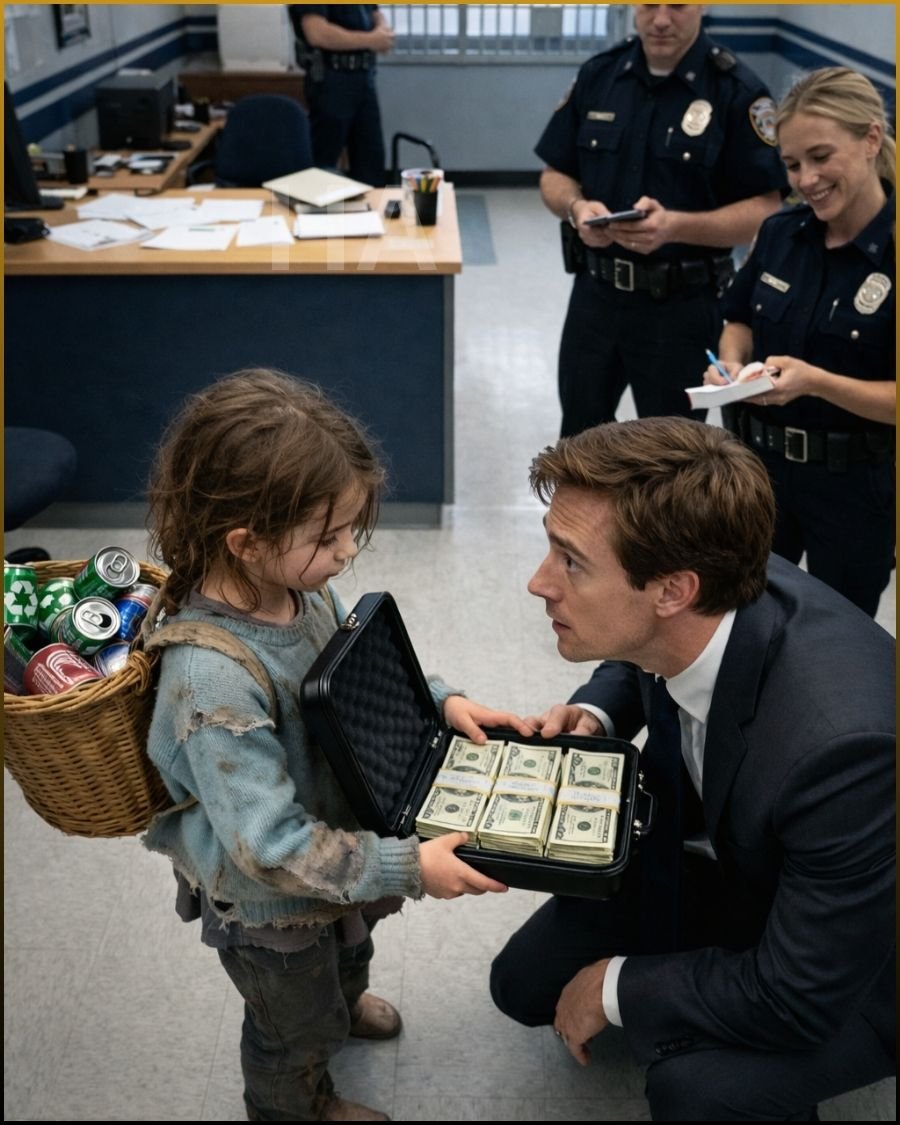
Lila crossed the room and lifted the handle with both hands. The suitcase landed on the counter with a heavy thud that made everyone in earshot turn.
“I found this,” she said, voice small but steady. “At the dump.”
One officer, broad-shouldered with tired kind eyes, stepped forward carefully. “Where are your parents, sweetheart?”
“My mom is sick.”
He opened the case.
The room went silent.
Money filled the suitcase, packed in orderly stacks. Not a handful, not a fortunate find, but enough cash to make every trained instinct in the room sit upright.
Lila swallowed hard. “I didn’t take any. I promise.”
The officer closed the lid at once and crouched down so they were eye level. “I believe you,” he said. “What’s your name?”
“Lila Monroe.”
“And how old are you?”
“Five.”
He exhaled slowly, perhaps because the answer struck him harder than the money had. “I’m Officer Daniel Brooks. You did the right thing, Lila.”
For reasons she did not fully understand, those words nearly made her cry.
Brooks wrapped a blanket around her shoulders, brought her hot cocoa from the vending area, and sat with her while another officer ran the serials and made calls. Lila told him about the dump, the walk, the cold. She did not mention the man who followed her. Not because she forgot. Because fear sometimes stays trapped behind the ribs where language cannot reach.
Ten minutes later, the atmosphere shifted.
The officer at the computer turned toward Brooks with a face that had gone unexpectedly pale. Brooks crossed the room, read the screen, then read it again.
“What is it?” another officer asked.
Brooks lowered his voice. “The suitcase was flagged this morning.”
“By who?”
He looked at the screen once more. “Julian Cross.”
Even Lila recognized the name, though only in the vague way children know the powerful. CrossTech sponsored holiday food drives some years. Cross Medical funded a wing at one hospital. His face appeared on billboards with earnest slogans about innovation and rebuilding Detroit. He was one of the men rich enough to seem half myth, half city landmark.
Brooks stared at the little girl in the blanket and then at the case full of illicit-looking cash.
“This,” he murmured, “just got very complicated.”
Across the city, in a tower of steel and glass that seemed to belong to another planet, Julian Cross stood before a window on the forty-second floor of Cross Tower and watched snow fall between buildings like static.
At thirty-eight, Julian had the composed face of a man who had spent years in rooms where looking rattled could cost millions. He was tall, controlled, clean-lined in a navy suit. Newspapers called him visionary. Business magazines called him disciplined. Employees called him fair, which in corporate America was a kind of sainthood.
But the moment Officer Brooks mentioned a black suitcase full of cash, something inside him went very still.
“That suitcase,” Julian said carefully, “was not supposed to leave my building.”
Brooks heard the shift in his tone. “Sir, it was turned in by a child. Five years old. She walked it here herself.”
Julian closed his eyes.
Not because of the money.
Because if the case had been removed, then one of two things was true. Either his internal finance controls had been breached, which was bad enough, or someone inside CrossTech had moved off-ledger cash without his knowledge, which was far worse.
“Is she all right?” Julian asked.
Brooks glanced toward Lila, who was holding the cocoa cup with both hands like something sacred. “Cold. Exhausted. Honest.”
Julian ended the call and remained staring at the snowy skyline long after the line went dead. His executive assistant, Mark Hale, appeared in the doorway.
“You look like the building just spoke,” Mark said.
Julian turned slowly. “A suitcase from private finance was found at the Detroit police station.”
Mark blinked. “Which suitcase?”
Julian’s gaze sharpened. “Exactly the question I’m asking.”
An hour later he was climbing the stairs to a decaying building above a repair shop, following Brooks through a narrow hall that smelled of damp plaster and time. He had insisted on seeing the girl himself. At first he told himself it was gratitude. Then curiosity. By the second-floor landing, he knew that was not the whole truth. Something about the story bothered him at a level deeper than business.
The door opened before Brooks could knock.
Lila stood there in the oversized coat, her hair still damp at the edges where snowmelt had dried in curls. She looked smaller indoors somehow, as though the city itself had been holding her upright outside.
Julian knelt almost instantly.
“You’re Lila,” he said.
She nodded, one hand gripping the doorframe.
“Thank you,” he said, and the words surprised him with their roughness. “For bringing it back.”
Lila studied him, as children do, without concern for manners or status. “Are you the sad man?” she asked.
Brooks nearly coughed.
Julian blinked. “I suppose I might be.”
She considered that. Then she stepped aside and pointed toward the bed. “My mom is sleeping.”
Julian entered.
The room hit him harder than the police call had. The poverty was not theatrical. It was ordinary, which made it more brutal. A chipped mug near the sink. A hot plate. A towel rolled at the bottom of the window to keep out the draft. A medicine bottle with only one tablet left. On the bed, Evelyn Monroe lay pale and still, every breath thin but stubborn.
Julian had built companies, cut deals, survived hostile takeovers, and buried his father. Yet something cracked inside him at the sight of that room.
“She’s sick,” Lila said, as if explaining a mess she should have cleaned faster. “I’m trying to get her medicine.”
Julian looked at the folded prescription on the crate by the bed.
“How long has she been like this?” he asked softly.
Brooks answered for her. “Long enough.”
Julian turned away before either of them could read too much in his face. Outside in the hall, he spoke to Brooks in a low urgent voice.
“She needs a hospital. Now.”
Brooks nodded. “Ambulance is already coming.”
Julian pressed a hand to the bridge of his nose, then another thought returned, colder than the stairwell. “Officer, that suitcase did not end up in a dump by accident.”
Brooks met his eyes. “You think someone dumped it?”
“I think someone wanted it gone.”
Back at Cross Tower, Julian locked himself in his office and pulled internal records. Temporary cash movement logs. Executive clearance entries. Subsidiary ledgers. He cross-checked the serial numbers from Brooks’s report with the records in CrossTech’s finance system.
They did not match.
The bills in the suitcase had never been officially logged.
He called Mark in. “Who has authorization to move unregistered cash?”
Mark hesitated. “Top-level treasury clearance.”
“Names.”
“You. Me for implementation. And Vincent.”
Julian’s jaw tightened.
Vincent Cross.
His cousin. His CFO. The man who had helped him grow CrossTech from a risky industrial software startup into a national empire spanning logistics, medical devices, security systems, and clean energy partnerships. Vincent was brilliant with numbers and charming with people. Investors adored him. Board members trusted him. Julian had trusted him most of all.
“Bring me all off-ledger activity for the last quarter,” Julian said.
Mark swallowed. “Julian, if this is what it looks like…”
Julian did not let him finish.
The office door opened without permission.
Vincent Cross entered in a charcoal overcoat dusted with snow, immaculate as always, carrying warmth in his smile and danger in his timing.
“Cousin,” he said lightly. “I hear your day got interesting.”
Julian stayed seated. “Who told you?”
Vincent shrugged. “In a company this size, news travels.”
Julian slid the printed serial report across the desk. Vincent glanced down, then up, too quickly.
“That cash wasn’t logged,” Julian said.
Vincent’s smile barely shifted. “Then someone made an accounting error.”
“A child found it in a dump.”
There. For half a second. A flicker. Not surprise. Calculation.
“How unfortunate,” Vincent murmured.
Julian’s eyes sharpened. “Unfortunate for who?”
Vincent moved toward the window. “For optics. Think about it. Poor little girl, suitcase full of money, billionaire’s company. The press would devour that story before breakfast.”
Julian stood. “You’re more concerned about headlines than the fact a five-year-old dragged a case of illegal cash through a snowstorm?”
Vincent turned back with practiced patience, as if speaking to someone temporarily emotional. “Julian, people love symbols. Children become symbols very quickly. That makes them messy.”
“Her name is Lila.”
Vincent gave a soft shrug. “And I’m sure she’s lovely.”
The cold in Julian’s spine deepened.
Before he could answer, security buzzed in from downstairs. “Sir, there’s a man here asking questions about the girl. Claims he’s company staff. Refuses to identify himself.”
The room changed.
Vincent’s expression remained composed, but Julian now understood what had been gnawing at him since the police call. The suitcase had not simply exposed theft. It had created a witness.
A child witness.
That afternoon Evelyn Monroe was admitted to a private hospital suite on Julian’s authority. Tests began immediately. Specialists were called. The diagnosis, once buried under delayed care and piecemeal treatment, finally emerged in full: a severe autoimmune neurological condition that had worsened because medication and rehabilitation had been inconsistent for months. Treatable, one doctor said carefully. Not easily. But treatable.
When Evelyn woke properly for the first time, clean sheets beneath her and warmth around her, she panicked at first, searching the room.
“Lila?”
“I’m right here,” Lila said from the chair beside the bed, clutching a stuffed bear Julian had brought her from the gift shop.
Evelyn sagged with relief. Then she noticed Julian standing near the window.
Her eyes narrowed faintly, confusion clouded by exhaustion. “Who are you?”
Julian stepped closer. “Someone your daughter chose to trust before I deserved it.”
Evelyn looked from him to Lila. “What happened?”
So he told her. Not everything at once. Enough. The suitcase. The police. The hospital. Not the laundering yet. Not the threat circling them. She was too weak for the full architecture of danger.
When he finished, Evelyn’s eyes filled. She turned toward her daughter. “You found all that money and brought it back?”
Lila nodded.
“Why?”
The little girl looked honestly surprised by the question. “Because it wasn’t ours.”
Evelyn closed her eyes and wept without sound.
That night, as snow glazed the hospital windows, a woman with sharp dark eyes and a federal badge walked into Julian’s office.
“Special Agent Maya Rios,” she said. “Financial Crimes Task Force.”
Julian let her in.
She placed a folder on his desk. Inside were suspicious activity reports, shell-company maps, vendor inflation patterns, and quiet federal notes that had been accumulating for months around CrossTech’s finance channels.
“We’ve been looking at your company,” Rios said. “Not you, officially. But the pattern suggests laundering. Layered transfers. Inflated consulting fees. Temporary cash movement through unregistered channels.”
Julian stared at the documents. “You think Vincent built this?”
Rios held his gaze. “I think someone with intimate access to your trust did.”
He told her about the suitcase. About the false employee at the hospital. About Vincent’s oddly calm concern for optics. When he finished, Rios’s face had hardened into certainty.
“The child is in danger,” she said plainly. “Which means the case just became easier to prove and harder to control.”
Julian looked out at the city lights. Somewhere in that sprawl was the dump, the alley, the room above the repair shop. Somewhere in that same city his cousin was deciding what to do next.
“What do you need from me?” he asked.
Rios did not blink. “Cooperation. Access. And a trap.”
The trap required theater.
Julian had to convince Vincent he was tired, frightened of scandal, and ready to bury the problem for the sake of the company. He had to perform loyalty long enough for Vincent to move again.
It was a foul task, made fouler by blood.
The private meeting took place two nights later in a lounge beneath Cross Tower where the walls were thick and the lighting soft enough to flatter liars. Vincent poured himself a drink and leaned back with the ease of a man who thought the game had returned to his board.
“You look exhausted,” Vincent said.
“I am,” Julian replied, letting the fatigue show. “I told the police the suitcase was a misunderstanding. I told legal to stop pushing. I’m done with this becoming a spectacle.”
Vincent smiled. “Finally. You’re thinking clearly.”
Julian let silence ripen between them. Then he added, “The girl’s mother is getting treatment. Quietly. I won’t have some tragic story tied to my company.”
“Practical,” Vincent said approvingly.
He slid a folder across the table. Inside were authorizations, temporary movement requests, vendor acknowledgments, and signature lines prepared for Julian’s approval. It was framed as cleanup. Formality. Housekeeping.
But it was more than that. It was Vincent stepping forward, believing the floor beneath him was still solid.
“You want me to sign?” Julian asked.
“Just regularize the process,” Vincent said. “Family handles family business.”
Julian picked up the pen.
He signed.
The paper accepted the ink. Vincent relaxed, satisfaction loosening his shoulders. He did not notice the invisible tracing powder embedded in the page corners. He did not notice the microdot marker hidden in the folder binding. He did not know Agent Rios was watching the live feed from two floors away with a team prepared to move the instant the marked transfer began.
By dawn, federal agents were inside Vincent’s penthouse and CrossTech’s finance offices.
Servers were seized. Files were bagged. Off-site storage facilities were raided. Marked cash appeared where it should never have been. Under pressure, two mid-level operatives flipped within hours. One admitted he had been ordered to dispose of the suitcase when an intermediate handoff failed. Another identified the man who followed Lila from the dump.
Vincent was arrested in cufflinks.
At arraignment he looked less afraid than offended.
At trial he looked afraid.
The prosecution built its case brick by brick. Shell companies. Phantom vendors. Unlogged cash pools. Witness intimidation. Surveillance. Recorded conversations. Expert tracing of layered funds. Julian testified without looking at his cousin. Not out of cruelty. Out of finality.
When asked why he had cooperated fully against a member of his own family, Julian paused.
Because the truth deserved better than my comfort, he thought.
But what he said aloud was simpler.
“Because a five-year-old girl found a fortune in the middle of winter, needed it more than anyone in that courtroom, and still returned it. After that, silence would have been cowardice.”
The courtroom went still.
Vincent was convicted on multiple counts including money laundering conspiracy and witness intimidation.
As marshals led him away, he turned once toward Julian. There was rage there, but also disbelief. As if betrayal by family were somehow more criminal than the crimes that caused it.
Julian did not look back.
Spring came to Detroit the way healing often does: slowly, suspiciously, through setbacks and almosts.
Evelyn Monroe began physical therapy. At first she could sit only for minutes. Then longer. Her hands steadied. Color returned to her face in quiet installments. Lila discovered that hospitals had pudding cups, television channels for children, and nurses who smiled before they pitied. She also learned something harder: safety felt strange when you had lived without it too long.
Julian visited often.
At first he told himself he was checking on their security.
Then he told himself he was making sure the treatment plan was funded correctly.
Then one afternoon he walked into Evelyn’s room and found Lila teaching her stuffed bear how to read a cereal box, while Evelyn laughed hard enough to cry, and he stopped lying to himself. Somewhere between the police station and the federal case, these two people had crossed the guarded distance around his life and settled inside it.
One warm afternoon in April, Evelyn stood.
Only for a moment.
Only with support.
But she stood.
Lila gasped so sharply the therapist flinched. Then she burst into tears and laughter all at once, hugging her mother around the waist as if she could anchor her upright by sheer love.
“You’re taller now,” Lila whispered into her gown.
Evelyn laughed through tears. “No, baby. I’m just vertical.”
From the doorway, Julian turned his face slightly because emotion, when it comes too fast, still surprises the men who have spent years bargaining with the world instead of feeling it.
Months later, once the case had closed and the danger had thinned to memory, there was another courtroom.
Smaller this time. Softer. Sunlight across polished wood. No reporters. No financial exhibits. Only a judge with kind eyes, Evelyn in a blue dress, Julian in a dark suit, and Lila swinging her feet above the floor in shoes that still looked too new for her.
The judge smiled at the little girl. “Lila, do you understand why you’re here?”
Lila nodded solemnly. “Yes, ma’am.”
“And why is that?”
Lila looked at Julian, then at Evelyn, then back to the judge. “Because families can choose too.”
The judge’s expression gentled even further. “And how do you feel about that?”
Lila thought carefully, because she had always taken important questions seriously.
“It means,” she said at last, “I don’t have to be brave by myself anymore.”
No one in the room was untouched by that sentence.
The adoption was granted with Evelyn’s full consent and joyful tears, not because she was surrendering motherhood, but because life had carved out an unusual shape and love had decided to fill it honestly. Evelyn would remain what she had always been: Lila’s mother, first and forever. Julian would become something else the child had made room for, not a replacement but an addition. Protection. Home. Chosen fatherhood.
That evening, in a house with warm floors and windows that held back the wind, Lila unpacked her things into a room painted pale green. Her belongings fit into one small suitcase Julian had bought her.
At the very bottom she placed her old winter coat.
Julian noticed. “You know you don’t need that anymore.”
“I know.”
“Then why keep it?”
Lila folded it carefully, smoothing the torn cuff with her palm. When she looked up, there was still childhood in her face, but there was also something flinty and wise that winter had forged too soon.
“So I remember,” she said, “what cold feels like. And what I didn’t take when I was hungry.”
Julian knelt beside her.
For a moment, he could not speak. There are victories that feel loud, triumphant, cinematic. Then there are victories that kneel quietly in a child’s bedroom and realize that wealth, law, and power all arrived late to a lesson honesty taught first.
He gathered her into his arms.
Outside, Detroit moved through evening traffic, through construction noise, through thawed sidewalks and the long repair of spring. Somewhere beyond the city, steel doors still closed each night on Vincent Cross. No money followed him there. No influence softened concrete. The empire he tried to feed with secrecy had devoured only him in the end.
But in one bright room, a little girl who once searched trash bins for bottles went to sleep warm without listening for her mother’s breathing in fear.
And in the room beside hers, Evelyn Monroe slept with medicine in her bloodstream, strength returning to her body, and the astonishing relief of knowing that the child she had taught to live honestly had not merely survived the lesson. She had transformed lives with it.
In the years to come, people would tell the story badly at first. They would call it a miracle. A scandal. A human-interest headline. The day a poor scrap girl returned a billionaire’s fortune.
But the real story was quieter than that, and more dangerous.
It was the story of a child who stood at the edge of desperate need and refused to let suffering decide her soul.
It was the story of a man powerful enough to hide the truth who, because of that child, chose instead to expose it.
It was the story of a mother who had almost nothing left to give except one stubborn moral sentence, and discovered that sometimes one sentence is enough to outlive corruption.
If it doesn’t belong to you, it will never bring you peace.
Lila Monroe had believed that in the coldest hour of her life.
Because she did, spring came to more than one home.
THE END
𝑫𝒊𝒔𝒄𝒍𝒂𝒊𝒎𝒆𝒓: 𝑶𝒖𝒓 𝒔𝒕𝒐𝒓𝒊𝒆𝒔 𝒂𝒓𝒆 𝒊𝒏𝒔𝒑𝒊𝒓𝒆𝒅 𝒃𝒚 𝒓𝒆𝒂𝒍-𝒍𝒊𝒇𝒆 𝒆𝒗𝒆𝒏𝒕𝒔 𝒃𝒖𝒕 𝒂𝒓𝒆 𝒄𝒂𝒓𝒆𝒇𝒖𝒍𝒍𝒚 𝒓𝒆𝒘𝒓𝒊𝒕𝒕𝒆𝒏 𝒇𝒐𝒓 𝒆𝒏𝒕𝒆𝒓𝒕𝒂𝒊𝒏𝒎𝒆𝒏𝒕. 𝑨𝒏𝒚 𝒓𝒆𝒔𝒆𝒎𝒃𝒍𝒂𝒏𝒄𝒆 𝒕𝒐 𝒂𝒄𝒕𝒖𝒂𝒍 𝒑𝒆𝒐𝒑𝒍𝒆 𝒐𝒓 𝒔𝒊𝒕𝒖𝒂𝒕𝒊𝒐𝒏𝒔 𝒊𝒔 𝒑𝒖𝒓𝒆𝒍𝒚 𝒄𝒐𝒊𝒏𝒄𝒊𝒅𝒆𝒏𝒕𝒂𝒍.