Thanks for coming from Facebook. We know we left the story at a difficult moment to process. What you’re about to read is the complete continuation of what this experienced. The truth behind it all.

Two more men hauled a third person from the boat.
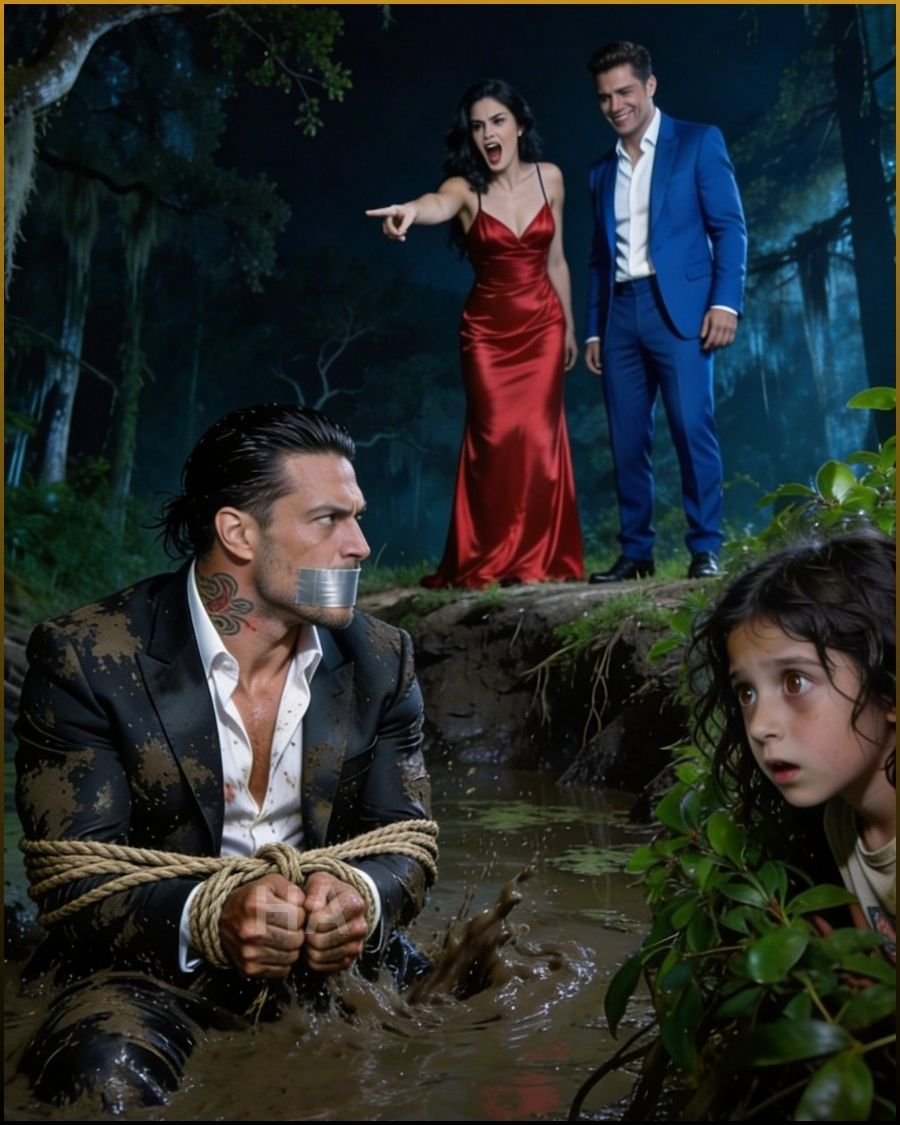
This one had his hands tied behind his back. Blood darkened one shoulder of his white shirt. His face was bruised, one eye swollen nearly shut, but when they forced him to his knees in the mud, he did not beg. He did not thrash. He lifted his head and looked at the woman with such steady, sharpened stillness that Rosie felt a strange chill move through her, as though the marsh itself had gone quiet to listen.
The woman stepped closer.
“I’ve waited a long time for this moment, Gabriel.”
Rosie locked the name into memory at once. Gabriel.
The man on his knees smiled, though it barely looked human. “My wife,” he said, voice ragged but level. “Do you really think he’ll treat you better than I did?”
Wife.
The word struck harder than the sight of blood.
Rosie’s gaze flicked to the suited man standing just behind the woman. He rested a hand on her shoulder with casual possession, not the nervous greed of a new affair but the practiced confidence of a man who had been welcomed there many times.
The woman gave a bitter laugh. “Better? No. Smarter. He sees me.”
Gabriel said nothing.
That silence became more frightening than shouting would have been. It was the silence of a man memorizing every word for later.
The suited man took one step forward. “Fifteen years, Gabe. Fifteen years I handled the mess you were too important to touch. I took bullets for your empire, buried bodies for your reputation, watched your back while you built yourself into a king. And what did I get?”
Gabriel turned his head slowly toward him. “A brother’s trust, Julian.”
Julian’s mouth twisted. “No. I got your leftovers.”
The woman’s eyes glittered. “And I got your life as a museum piece. Smile here, stand there, speak only when it flatters you. Do you know what it is to be dressed like royalty and treated like furniture?”
“I gave you everything,” Gabriel said.
“You gave me things,” she snapped. “Not respect.”
The reeds trembled lightly in the wind. Rosie held her breath so long her chest hurt. She understood almost none of their world, but this much was simple enough for any hungry child in any forgotten place: two people had decided a third no longer deserved to live.
Then Gabriel moved, just once, almost invisibly.
His hands were bound behind him, but his fingers shifted with practiced precision against his pocket. Rosie saw the faintest glint of a phone. He had activated something. A recorder, maybe. Even half dead, he was collecting the truth.
Julian kept talking, drunk on his own cruelty. “Two years, Gabriel. Two years in your house, on your sheets, under your roof. Every trip you took. Every late meeting. Every time you thought your world was standing still, I was already inside it.”
Rosie saw the hit land then. Not on Gabriel’s face, because his expression barely changed, but somewhere deeper. A man could swallow rage. He could even swallow humiliation. Betrayal from the two people closest to him settled into the bones.
The woman straightened, smoothing her hair. “Take him deeper.”
Julian looked at her once, and she finished in a voice so cold it seemed carved from ice.
“Somewhere nothing floats back.”
The two other men dragged Gabriel upright. He staggered, then found his balance. Even with his wrists bound and blood running down his sleeve, he refused to fold. The woman turned first, picking her way back toward the speedboat. She did not look behind her. Julian yanked Gabriel by the collar and pulled him farther into the marsh.
Rosie should have gone.
She knew that even while she remained frozen in place.
She should have crawled back through the reeds, returned to her shack, shut her ears against whatever happened next. She was thirteen. Invisible. Alone. Men like these belonged to a world of weapons and money and police who listened when they spoke. If they found her, nobody would come looking.
But then she remembered her mother.
Not clearly, because grief dulls faces over time, but clearly enough to hear the last words spoken from a fever-soaked bed while rain drummed on tin overhead.
“You don’t need to be rich to do what’s right, Rosie. You only need to decide.”
A gunshot cracked through the bayou.
The sound snapped the morning in half.
Rosie flinched so hard her teeth clicked together. Birds exploded from nearby branches. Then the marsh returned to silence, heavier than before.
Minutes later, footsteps and ugly laughter approached again. Julian and the two gunmen passed within yards of her hiding place. None of them looked toward the reeds. They climbed into the speedboat where the woman already sat, face set like stone, and the boat sped away.
Rosie did not move.
One minute. Two. Five.
Only when the engine had vanished completely did she rise on shaking legs and run toward where the gunshot had come from.
She found him near a black pool ringed with cypress knees, half in the water, half in the mud. At first she thought he was dead. His white shirt was red at the shoulder, his face colorless beneath bruises, his body unnaturally still.
Then she saw the faint rise of his chest.
Alive.
The relief startled her. She had not known until that second how fiercely she had wanted him not to be dead.
She did not waste time on fear. There was too much blood. The rope around his wrists had to come off first. She found a jagged shard of bottle glass near a rotten stump and knelt in the mud beside him, sawing through the bindings with short, urgent strokes.
The rope gave.
His arms dropped, and with them a cracked phone and a heavy gold watch slid from his pocket into the muck. Rosie snatched both before they vanished into the sludge, stuffed them into her satchel, then tore a strip from her own shirt and pressed it hard against the wound.
Gabriel came awake like an animal springing from a trap.
His hand shot out and seized her wrist with startling strength. His one clear eye locked onto hers, feral, ready to kill.
Rosie did not scream.
“If I wanted you dead,” she said, breathless but steady, “I wouldn’t be stopping the bleeding.”
For a moment they remained locked like that, his hand around her wrist, her palm against the wound, both of them testing whether the other was real.
Then his grip loosened.
“Who are you?”
“Rosie. Just Rosie.”
“Who sent you?”
“No one.” She nodded toward the dark water. “I live here.”
He studied her properly then. Mud on her face. Hair tangled. Clothes worn to threads. Eyes too old.
Rosie pulled the phone and the watch from her satchel and placed them by his side. “These fell in the mud when they dragged you. I think they’re yours.”
His gaze dropped to the watch first. Recognition flickered. Then he looked back at her, and something in his expression shifted almost imperceptibly. In his world, she guessed later, nothing of value was ever returned without a price attached. But Rosie had no room in her life for games. A thing was either yours or it wasn’t.
She tightened the makeshift bandage. He hissed through his teeth.
“You can stand?”
“With help.”
The journey to her shack was not far as birds flew. Through waist-deep water, sucking mud, and roots slick as bones, it might as well have been another country. Gabriel leaned heavily on her by the end, though he clearly hated needing to. More than once his boots nearly disappeared under the marsh’s pull. More than once Rosie had to stop him from collapsing into water that would have drowned a weaker man outright.
When her shack finally emerged through the reeds, he halted.
It was barely a structure. Scrap wood tied together with wire. Tin roof riddled with holes. One mat on the dirt floor. Three cans. A jug of collected rainwater. No stove, no bed, no electricity, no walls thick enough to keep out winter.
Gabriel ducked inside in stunned silence.
Rosie sat him down on the mat and found the little bottle of cheap liquor she kept for cleaning cuts when fishhooks went wrong. “This will hurt,” she warned.
Then she poured it over the wound.
He went rigid all over, jaw clamped so hard the muscles stood out in his face, but he made no sound. She respected him for that. Not because pain should be hidden, but because he seemed to understand dignity the same way she did: as the last possession you never surrendered willingly.
She cleaned and bound the wound with the cleanest cloth she had left. When she finished, she handed him rainwater in a can.
“Drink,” she said. “You’ll need strength if you want to live.”
He drank, then looked around the shack again as if seeing a country he had never believed existed inside the borders of his own city. “You live here alone?”
“Since I was eight.”
“Your family?”
“My mother died. My father left before that.”
He lowered the can slowly. “You survived this long by yourself?”
Rosie shrugged because she did not know what else to do with a question whose answer had already happened. “The marsh teaches fast.”
Night came down thick and wet. Gabriel’s fever began after midnight.
At first it was only trembling. Then heat rolled off him in waves. His skin burned. Sweat soaked the mat. He muttered fragments of words Rosie could not understand until one sentence came clear enough to pierce the darkness.
“Father… don’t leave yet.”
The voice was not a king’s voice then. It was a child’s. A lost one.
Rosie sat beside him through the whole night, changing the cloth on his forehead, dripping water between his lips, checking again and again to make sure his chest still moved. She had done this once before for her mother and failed. She would not fail now if stubbornness alone could keep a person alive.
Near dawn he whispered again, tears leaking from the corners of his shut eyes.
“I kept my promise.”
Rosie did not know to whom.
When sleep finally took her, it came suddenly, her head falling against her arm beside him. Gabriel woke later to find her curled on the dirt floor, one hand still holding the damp rag she had been using on his fever.
He watched her for a long time.
When she stirred, he said quietly, “Thank you.”
It was the first soft thing she had heard from him.
Two weeks altered the shape of their silence.
Gabriel healed slowly. The infection threatened him once, then retreated. Rosie brought fish, crabs, salvaged bread when luck favored her, and herbs Wade Brennan, the reclusive veteran deeper in the marsh, quietly gave her without questions. Gabriel learned the rhythm of her life. She learned his.
He told her, eventually, that his full name was Gabriel Castellano.
Wade was the one who filled in the rest.
“This is not just some rich businessman,” Wade said the day Rosie brought Gabriel to his cabin for access to a radio. “This is Gabriel Castellano. The man who controls half the southern criminal economy.”
Rosie turned to Gabriel in disbelief. “You’re mafia?”
He did not deny it. “Yes.”
Wade folded his arms, wary. “His reputation is not the worst sort. No drugs. No trafficking. Keeps order where the law fails. But he’s still dangerous.”
Rosie absorbed that. The marsh outside clicked and hummed with insects. Inside, two grown men waited for a child’s judgment as though it mattered.
In a way, it did.
Finally Rosie said, “I know what I saw. A man betrayed by his wife and his best friend and left to die. Whatever else he is, that is also true.”
Gabriel’s gaze sharpened on her face, not with suspicion this time but something like disbelief. She had been given a chance to withdraw and had not taken it.
Wade let out a long breath. “Then if I help, I help because of you.”
Using Wade’s old radio, Gabriel contacted Douglas Quinn, his most loyal lieutenant. The reply came fast and raw with relief. Gabriel was alive. Monica and Julian, now Rosie knew their names fully, had already begun consolidating power in New Orleans. Some men suspected. Others were waiting to see which way the blood would run.
Gabriel arranged a private meeting.
After he clicked off the radio, Rosie asked from the doorway, “Are you going to kill them?”
In the cabin’s dim light his face became unreadable. “In my world, betrayal like this is usually answered with death.”
Rosie thought carefully before she spoke. She had seen enough suffering to know that fast endings were often mercies disguised as punishments.
“My mother used to say when you kill someone, you set them free from having to face themselves. Living can be heavier.”
Gabriel looked at her for so long Wade shifted uneasily beside the stove.
“Do you believe that?”
“I know what loss feels like,” she said. “And I know shame can last longer than a bullet.”
Something moved behind his eyes then, something old and rusted beginning to turn.
Before he left the marsh, Gabriel took off the heavy gold watch Rosie had saved from the mud and placed it in her palm.
“Keep this.”
She frowned. “It’s too expensive.”
“It’s proof,” he said. “That I owe my life to someone the world never bothered to see.”
Rosie closed her fingers around the watch but answered in the calm, direct way that unsettled him more than fear ever could. “Then don’t pay me with gold. Pay me by becoming better than what tried to kill you.”
He smiled then, a small, surprised thing, like a man remembering a language he had nearly forgotten.
That should have been the end of Rosie’s part in his story.
But betrayal, like floodwater, never respects the edges people draw for it.
While Gabriel moved toward New Orleans with Wade guiding him through hidden channels, Monica sent men back into the marsh. She had learned what saved him: an orphan girl who had seen too much.
Rosie heard the engines before she saw the boats.
She did not hesitate. Rolex in pocket, she vanished into the reeds she had trusted all her life. From concealment she watched three speedboats arrive with armed men. They searched Wade’s cabin first and found nothing. Then they found her shack.
Her home had never been much to others. To Rosie it was five years of scraped-together survival, the last air her mother had breathed, the one place in the world where her own footsteps belonged.
Monica’s men tore it apart in minutes.
Boards snapped. Tin roof ripped away. Mat flung into black water. The whole fragile architecture of endurance collapsed back into garbage.
Wade found Rosie hiding later, deep in a pocket of mud no outsider would willingly enter. When he led her back to the ruins, he stood beside her in silence, expecting tears.
Rosie did not cry.
“I already lost bigger things than this,” she said quietly. “A shack is only wood.”
But Wade heard the hollowness under the words. He placed a rough hand on her shoulder. This time she allowed the comfort.
That night he radioed Gabriel and told him what had happened.
There was a pause on the other end so long Wade wondered if the signal had failed.
Then Gabriel said, each word cold enough to frost the air between them, “They touched the girl.”
Everything accelerated after that.
The meeting at the old warehouse on the outskirts of New Orleans became a war council. Douglas had gathered evidence. Financial transfers from Julian to offshore accounts. Messages from Monica to rival families offering slices of Gabriel’s territory in exchange for support. Most valuable of all, the recording Gabriel had made in the marsh before he was dragged away.
Yet even with proof, Gabriel made a choice that surprised the men who had served him longest.
“No blood unless absolutely necessary,” he said.
Douglas stared. “They tried to murder you.”
“They also hunted a child to cover their tracks.”
“That is exactly why they should die.”
Gabriel’s fingers brushed the scar beneath his shirt where Rosie’s torn cloth had once held him together. “No,” he said. “Death is quick. They gave me mud, fear, humiliation, abandonment. They can live with what they made.”
Douglas looked at him differently after that. Not as a weaker man. As a more dangerous one, perhaps, because restraint chosen by power carries its own gravity.
The confrontation came at the Castellano mansion during a gathering Monica believed would crown her.
The house blazed with chandeliers and polished marble. Men in dark suits filled the long room, the old guard and the opportunists, all waiting for the final announcement. Monica wore black silk. Julian stood at her shoulder, silver tie, practiced confidence. Together they looked like people who had mistaken theft for inheritance.
Monica raised a glass. “We have hoped and searched, but we must face reality. Gabriel Castellano is gone, and until a new order is formally established, I will oversee his affairs for the good of this family.”
The doors burst open before the last word died.
Gabriel entered alive.
The room did not merely fall silent. It seemed to stop breathing.
He wore a black suit again, but thinner now, harder in ways that had nothing to do with recovery. There was swampwater somewhere behind his eyes, and something else too, something neither Monica nor Julian recognized until it was too late: a man returned from death with less fear and more clarity.
Monica’s glass slipped from her hand and shattered.
Julian actually stepped back.
Gabriel walked forward with maddening calm. “Please,” he said, glancing around the room. “Don’t let me interrupt my funeral.”
No one laughed.
Monica found her voice first, though it trembled. “Gabriel. Thank God. We thought…”
“You thought I was bleeding into the mud where you left me,” he said. “Let’s not perform for each other.”
He took out the cracked phone Rosie had rescued and pressed play.
The room filled with the ghosts of the marsh.
Monica’s voice. Julian’s confession. The order to take him deeper where nothing would float back.
When it ended, rage moved across the assembled men like fire catching dry grass. The old loyalists turned toward Monica and Julian with expressions of naked revulsion. The newer men looked frightened, recalculating the mathematics of survival.
Gabriel nodded once to Douglas. Screens lit with financial records and copied messages. Julian’s offshore transfers. Monica’s offers to rival families. Every hidden ambition laid bare under chandelier light.
Monica broke first. She lunged toward a side exit. Two men intercepted her before she reached the door.
Julian did not run. He dropped to his knees.
It might have been pathetic if it had not been so fitting.
“Gabriel,” he said hoarsely. “Listen to me. I was angry. I was stupid. She pushed this. I can fix it. I can help you rebuild everything.”
Gabriel looked down at him without expression. “You still believe this is about business.”
Monica, held fast by Douglas’s men, threw back her head. Whatever mask she had left cracked open into desperate fury. “You never saw me! Not once. You want them to judge me for betrayal, but you made me vanish long before I ever touched another man.”
The accusation rang through the room.
Gabriel did not dismiss it.
For a few seconds he said nothing, and because he said nothing, everyone had to sit inside the truth of it. Monica had betrayed him monstrously. But Monica had also not invented all her grievances. He had made her ornamental. He had mistaken provision for love, structure for partnership, loyalty for possession.
When he finally spoke, his voice was low and unadorned.
“I failed you as a husband. That is true.” Monica’s breathing faltered. “But failure is not permission to murder. Neglect is not permission to become monstrous.”
Her face collapsed then, because even in fury she knew that was also true.
All eyes fixed on Gabriel, waiting for the sentence.
“In this room,” Douglas said under his breath, “one word from you ends them.”
Gabriel heard, and Rosie’s voice rose in memory beside the sound of frogs under a broken roof.
Living can be heavier.
He lifted his gaze to the men gathered around him. “No one kills them.”
Shock rippled through the room.
Julian stared upward, confused enough to seem almost childlike. Monica went still.
Gabriel continued, each word deliberate. “Monica Bell. Julian Mercer. From this night forward you hold no title, no access, no protection, no claim to my name, my house, or any business under my influence. Every account frozen. Every ally informed. Every door closed.”
He stepped closer to Julian. “You wanted my life so badly you crawled into my bed to steal it. Now try building your own.”
Then he turned to Monica. “You said I kept you in a gilded cage. I will not cage you now. I will do worse. I will release you into a world where your beauty buys less each year and your ambition has no platform beneath it. You will live without protection, without applause, without the comforts you mistook for power. And every morning, you will know exactly why.”
Monica made a broken sound, not quite a sob, not quite rage. Julian lowered his head to the floor.
It was over.
Not with gunfire. Not with blood on marble. With exposure. Exile. Stripping.
Gabriel watched them taken away and felt, to his surprise, no triumph at all. Only exhaustion, and beneath it, a strange clean space where vengeance had expected to live.
Months passed.
Spring came gentle over Louisiana, laying green over the same marsh that had once nearly swallowed him. Monica and Julian disappeared into obscurity in some distant town where no one cared who they had been. Gabriel restored control of his empire, but he did so differently. Men noticed. He listened more. He delegated differently. He cut ties with operations that fed on desperation. He did not become a saint. The world he ruled did not allow saints to survive. But he became more answerable to the man he wanted Rosie to believe he could be.
And then there was the other matter.
The secret buried in the Amazon.
It had surfaced because of the phone recording. When Douglas had the device forensically repaired, they recovered not only the marsh audio but encrypted voice memos Gabriel’s late father had hidden inside an old archive app, files Gabriel himself had never known existed. The recordings dated back years. In them, his father spoke of a final contingency, a ledger buried on protected land in the Brazilian Amazon under a false corporate trust. It contained decades of names, accounts, smuggling routes, bribed officials, and one more thing: proof of the single deal Gabriel’s father had always sworn he would never make.
A deal involving human trafficking through jungle corridors disguised as timber logistics.
Gabriel listened to those recordings alone and felt something collapse inside him.
His father, the man whose watch he had worn, whose approval he had chased, whose empire he had inherited like a burden and a blessing tied together, had built one hidden chamber of the family fortune on human ruin. Then, whether from guilt or paranoia, he had buried the evidence and sealed the coordinates away.
Monica and Julian had known fragments of it. That was why they had wanted power so quickly. If Gabriel died, they planned to retrieve the Amazon ledger and use its secrets to blackmail everyone named in it.
Instead, Gabriel went himself.
Quietly. With Wade, who knew how to move off-grid, and Douglas, who knew which truths had to be handled before they spread like poison.
In the heart of the Amazon, beneath a collapsed survey marker and three feet of dark earth, they found a metal case. Inside were ledgers, drives, passports, payout lists, and enough proof to blackmail senators, businessmen, and criminal syndicates across three countries.
Gabriel stared at the contents for a long time.
His old self would have weaponized it. Kept it. Ruled with it.
But a girl in the marsh had once returned a Rolex without blinking, and since then he had been unable to admire corruption simply because it was useful.
They delivered the trafficking evidence through channels that could not be traced back to them. Some names fell publicly. Some vanished. Some empires cracked without ever understanding what had struck them. Gabriel burned the rest that belonged only to extortion and inherited rot. He did not want his future built on his father’s deepest sin.
When he returned to Louisiana, he went first to the marsh.
Rosie no longer lived in a shack. He had built her a small, sturdy house on higher ground near Wade’s cabin, with clean water, real walls, books, light, and a bed that did not bend with weather. Wade had become, without ceremony, the closest thing to family she had left. Rosie now attended school in town. She came home with ink on her fingers, new words in her mouth, and the same old gaze that still seemed capable of reading the weather in people.
He found her sitting on a dock in a school uniform, shoes dangling above the water, the gold watch beside her on the planks.
“You came back,” she said.
“I said I would.”
He sat beside her. For a while they listened to the small knocks of water against wood.
Then Rosie asked, “Did you keep your promise?”
Gabriel looked across the darkening marsh. “I’m trying.”
“That means no, not yet.”
He laughed softly. “You are merciless.”
“You’re alive because I’m merciful.”
That made him laugh harder, and the sound startled both of them. It was rare enough to feel new.
After the laughter passed, he grew serious. “There was another betrayal. Older than Monica and Julian. My father buried something terrible in the Amazon. A secret that could have made me more powerful than ever.” He paused. “I destroyed the part of it that would have corrupted everything I’m trying to build.”
Rosie turned toward him, studying his face. “Was it hard?”
“Yes.”
“Good,” she said. “Easy choices don’t change anyone.”
He looked at her then, this child who had once stood barefoot in a collapsing shack and now sat with books at her side speaking truths older men spent fortunes avoiding.
“You should keep the watch,” he said quietly.
She picked it up, turning it so sunset flashed in the glass. “I don’t need a reminder that I matter.”
“No?”
She shook her head. “I know that now.”
There it was. The thing he had not realized he had come to the marsh hoping to hear.
Rosie set the watch back in his hand. “You keep it. So you remember who you wanted to become when you were nothing but blood and mud and one good choice away from dying.”
Gabriel closed his fingers around the metal. It felt heavier than before.
“I thought I saved your life,” she added.
“You did.”
Rosie glanced out over the water, where the sky had turned copper and blue. “Maybe you saved mine too. Just slower.”
His throat tightened unexpectedly. Of all the punishments, all the power, all the secrets buried in swamp or jungle or bloodline, nothing had prepared him for the tenderness of being trusted by someone who knew exactly what he was and expected better anyway.
The wind moved through the reeds with a hush like pages turning.
At last Gabriel said, “Then we keep each other honest.”
Rosie nodded as if sealing a contract older and stronger than law. “That sounds fair.”
The marsh no longer looked to him like wasted land. It looked like a place where false things sank and stubborn things survived. A place that had stripped a king down to wound and truth and sent him back remade by the smallest witness in the world.
Above them the evening settled. Somewhere beyond the trees, Wade called that supper was ready. Rosie stood, slung her schoolbag over one shoulder, and started up the dock. After a few steps she looked back.
“Gabriel?”
“Yes?”
“Don’t ever bury anything ugly again. Not in the Amazon. Not in yourself.”
He smiled, but this time there was no irony in it at all.
“I won’t.”
And for once, when he made a promise, it did not feel like something owed to the dead. It felt like something offered to the future.
That was how the swamp girl with no last name changed the man people feared across the South. Not with force. Not with gold. Not with law. With a torn shirt used as a bandage, a night of stubborn mercy, and a moral clarity sharp enough to cut through blood, betrayal, and inheritance alike.
In the end, the bayou had given Rosie what the world never had at first: a home, an education, and people who would not leave her behind. And it had given Gabriel something rarer than survival. It had given him a second chance not merely to live, but to choose what kind of man would go on living.
Some secrets stay buried forever.
The worst ones should not.
And sometimes the hand that digs them up belongs not to the powerful, but to the invisible.
THE END
Disclaimer: Our stories are inspired by real-life events but are carefully rewritten for entertainment. Any resemblance to actual people or situations is purely coincidental.