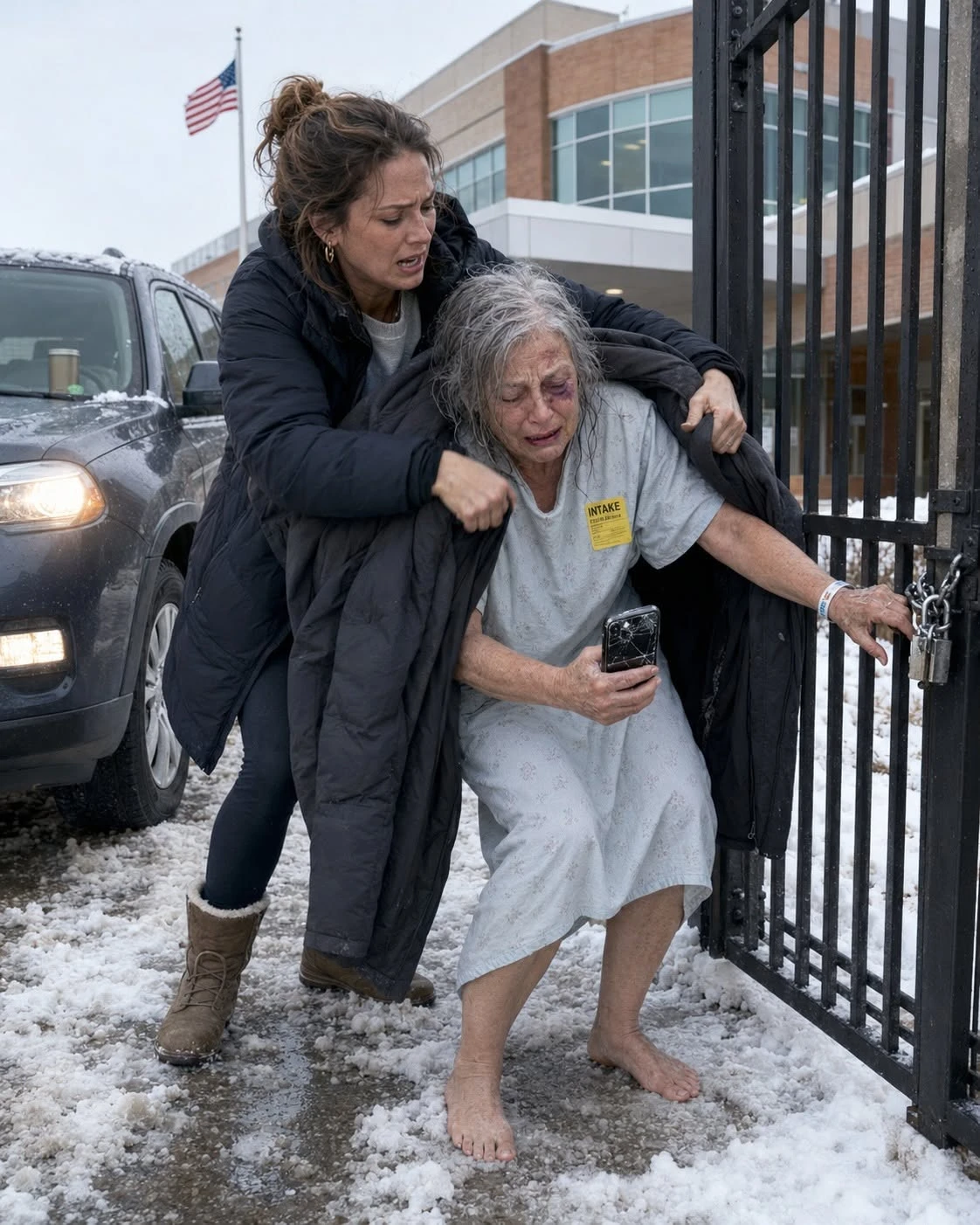
Julianne looked toward the entrance.
“What happened?”
“He said I could explain myself to strangers.”
Her voice had no drama in it.
That made it worse.
She sounded like a woman reporting weather.
Julianne cupped her mother’s cold hands between her gloves and saw the cracked phone trapped in her fingers.
The screen was spiderwebbed across the corner.
“Did you call anyone else?” Julianne asked.
Her mother’s face crumpled.
“Leo.”
Julianne closed her eyes.
Not because she was surprised.
Because a part of her had been hoping, against every piece of evidence life had ever given her, that her brother had answered when their mother needed him.
She took the phone gently and opened the call log.
Leo’s name appeared again and again between 2:31 a.m. and 2:55 a.m.
Seven outgoing calls.
No conversation.
No rescue.
No brother.
Then the phone vibrated in Julianne’s hand.
ARTHUR VANCE.
Her mother went slack so quickly Julianne had to catch her under both arms.
“Please,” she whispered. “Don’t make trouble.”
Julianne stared at the name on the screen.
Arthur was not calling to see if his wife was alive.
Men like Arthur did not call because they were worried.
They called because they felt control slipping and wanted to put their hand back around it.
Julianne answered on speaker.
Arthur breathed once, annoyed and comfortable.
“Tell your mother she can stop embarrassing herself before this gets worse.”
Julianne looked at the hospital gate, the bare feet in the snow, the bruised face tucked inside her coat, and the little flag snapping above the entrance.
“Arthur,” she said, “before you say another word, understand that I am standing beside her at the hospital gate. I am looking at what you left outside.”
There was silence.
Not guilt.
Calculation.
Then Arthur said, “She gets confused.”
Julianne’s mother made a tiny sound, almost too small to count as a sob.
Julianne felt her own anger sharpen into something colder and more useful.
“No,” she said. “You are going to stop talking now.”
She ended the call.
Then she did the first right thing.
She got her mother inside.
The automatic doors opened with a rush of warm air, and her mother cried harder at the heat than she had at the cold.
A nurse behind the desk stood so quickly her chair rolled backward.
Julianne did not have to raise her voice.
She gave the intake sticker.
She gave the time.
She gave the call log.
She gave Arthur’s name.
The nurse called for help, and within minutes, a blanket was wrapped around her mother’s shoulders, a wheelchair was under her, and someone from the hospital intake desk was printing a fresh set of forms.
At 8:19 a.m., Julianne took photographs of the cracked phone, the intake sticker, the gate, and her mother’s bare feet before the snow melted off them.
Not because she wanted memories.
Because she wanted records.
By 8:42 a.m., a hospital social worker was sitting across from them in a small consultation room with a box of tissues and a folder.
By 9:06 a.m., a police report number was written on the top corner of Julianne’s notepad.
By 9:17 a.m., Leo finally called back.
Julianne stared at his name until the second ring.
Then she answered.
“Where are you?” he asked, already irritated.
“At the hospital.”
There was a pause.
“Is Mom okay?”
Julianne looked through the glass wall at her mother, wrapped in a heated blanket, both hands curled around a paper cup of water she could barely lift.
“No,” Julianne said. “She is not okay.”
Leo sighed.
That sound did something to Julianne.
It ended a childhood hope.
“Jules, I was asleep. I didn’t know it was serious.”
“She called you seven times.”
“I figured it was another Arthur thing.”
“It was.”
“Exactly,” he said, as if that explained anything. “I can’t keep getting dragged into their marriage.”
Julianne closed her eyes.
A mother can feed a son for eighteen years and still end up begging his voicemail to become a person.
“She was barefoot outside a hospital in a blizzard,” Julianne said.
The silence that followed finally had fear in it.
“What?”
Julianne did not repeat herself.
She sent him one photograph.
The one of their mother’s hand gripping the hospital gate.
Leo inhaled sharply.
For the first time that morning, he had no clean excuse ready.
“Jules—”
“No,” she said. “You don’t get my nickname today.”
Then she hung up.
Arthur came to the hospital just after 10:00 a.m.
He arrived in a dark wool coat, polished shoes wet from the parking lot, hair combed, face arranged into concern.
He looked like a man who expected the room to believe him because he had dressed for authority.
Julianne was standing near the nurse’s station when he came through the doors.
He did not see the social worker behind her.
He did not see the officer near the hall.
He saw Julianne and smiled as if she were a problem he had solved before.
“This is a misunderstanding,” he said.
Julianne looked at his shoes, then at the plastic bag in his hand.
He had brought her mother’s slippers.
Not because he cared.
Because he had realized bare feet could be photographed.
“You can leave those with the nurse,” Julianne said.
Arthur’s smile twitched.
“I need to see my wife.”
“No.”
His face hardened.
“That is not your decision.”
The officer stepped forward then, not dramatically, not loudly, just enough for Arthur to understand that the room had changed while he was busy rehearsing.
“Sir,” the officer said, “we need to speak with you.”
Arthur looked past him toward the consultation room.
Through the glass, Julianne’s mother saw him.
Her shoulders rose around her ears.
That was enough.
Julianne moved slightly, blocking the line of sight.
Her mother did not need to prove fear to anyone.
She had already lived it.
The next hours were not cinematic.
They were forms.
Questions.
Signatures.
A hospital chart.
A police report.
A discharge plan.
A list of belongings to retrieve later with someone else present.
A family court hallway mentioned by the social worker in a careful voice.
The world does not always punish cruelty in one clean scene.
Sometimes it makes you collect paper until the truth has weight.
Julianne kept every sheet.
She photographed every page.
She wrote down every time.
When her mother apologized for the trouble, Julianne put the pen down.
“Mom,” she said, “you called me for help. That is not trouble.”
Her mother stared at her for a long time.
Then she nodded once.
Small.
Shaky.
Real.
Leo arrived a little after noon.
He looked smaller in person than he sounded over the phone.
His coat was unzipped, his hair messy, his eyes red in a way that made Julianne think he had cried in the parking lot and hated himself for it.
He stopped at the doorway when he saw their mother.
She did not reach for him.
That was the consequence he had not expected.
“Mom,” he whispered.
She looked at him without anger.
That made it worse.
“I called you,” she said.
Leo’s mouth opened.
No defense came out.
“I know.”
“I needed you.”
He nodded, and his face collapsed.
“I know.”
Julianne watched him cry and felt no satisfaction.
Some failures are too sad to enjoy, even when the person earned every second of shame.
Arthur did not come back into the room.
By late afternoon, the hospital released Julianne’s mother into Julianne’s care.
The official discharge papers went into a folder.
The cracked phone went into a plastic evidence bag.
The yellow intake sticker had been removed from the gown, but Julianne had already taken the picture.
At 5:38 p.m., Julianne pulled into her own driveway with her mother in the passenger seat wrapped in two blankets.
The travel mug of coffee was still there, untouched and cold.
Her mother looked at the porch, the mailbox, the wet snow gathering along the steps.
“I don’t want to be a burden,” she said.
Julianne turned off the engine.
For a moment, the SUV ticked softly as it cooled.
Then Julianne reached over and took her mother’s hand.
“You were never a burden,” she said. “You were the house we all stood in.”
Her mother covered her mouth.
That night, Julianne made soup.
Not because soup fixed anything.
Because it was warm, and it was ordinary, and sometimes ordinary is the first place safety knows how to return.
Her mother slept in Julianne’s spare room with the door cracked open and a lamp on.
Julianne sat at the kitchen table with the folder, the police report number, the hospital discharge papers, and the call log screenshots.
At 11:12 p.m., Leo texted.
Can I come tomorrow?
Julianne read it twice.
Then she walked to the spare room and asked her mother.
Her mother was awake, staring at the ceiling.
“Not tomorrow,” she said.
Julianne typed exactly that.
Not tomorrow.
Leo did not argue.
In the weeks that followed, Arthur learned that control gets lonely when nobody agrees to call it love anymore.
He learned that hospital records have timestamps.
He learned that a police report does not care how expensive your coat is.
He learned that a wife who has been quiet for years can still sign her own name on the line that matters.
Leo learned something quieter.
He learned that missing a call can become a sentence you carry for the rest of your life.
He started showing up with groceries.
He fixed Julianne’s loose porch rail without being asked.
He sat in the driveway sometimes because their mother was not ready to let him in.
That was fair.
Forgiveness is not a doorbell.
You do not press it and expect someone to open.
Arthur’s regret came in paperwork.
Leo’s came in silence.
Julianne’s mother healed slowly.
The bruise around her eye turned purple, then yellow, then faded.
The flinch took longer.
Some mornings she still stood near the kitchen window like she expected a car to pull up.
Some nights she woke at 3:00 a.m. and reached for a phone before remembering she was not alone.
When that happened, Julianne would come down the hall in socks and sit with her until the house settled again.
No speeches.
No big declarations.
Just a blanket around her shoulders, a glass of water, and the lamp left on.
There are moments when rage begs to be loud, and love has to be stronger than rage.
Julianne had learned that in the snow outside a hospital gate.
Her mother learned it later, in a warm room where no one locked the door.
And the people who left her out there learned it too, each in the language they understood best.
Arthur got documents.
Leo got distance.
Her mother got a key to Julianne’s house, her own mug in the cabinet, and a phone that was always charged beside the bed.
At 3:00 a.m. weeks later, Julianne woke to a sound in the hallway.
She found her mother standing outside the spare room, wrapped in a quilt, crying quietly.
“What is it?” Julianne asked.
Her mother looked embarrassed.
Then she held up the new phone.
“I just wanted to make sure,” she said.
Julianne took it, called her own number from across the hall, and let it ring.
Her phone lit up on the kitchen table.
Mom.
This time, Julianne answered smiling.
“I’m here,” she said.
And for the first time in a long time, her mother believed her.