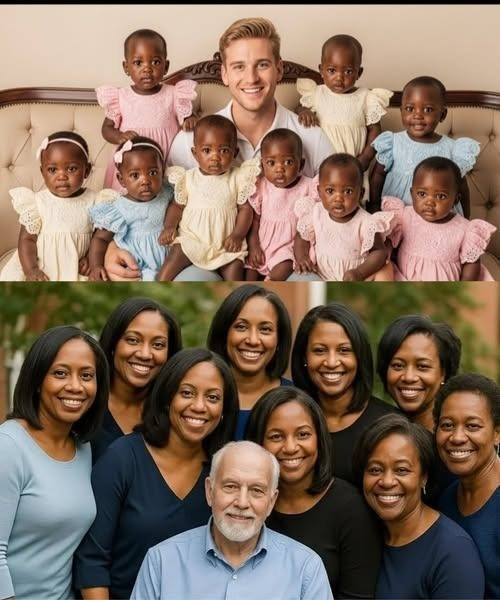
In 1979, Richard Miller’s world shattered with the sudden loss of his wife, Anne. Their shared dream of a house filled with children seemed to die with her, leaving behind a silence that was deafening. Friends urged him to move on, but he clung to Anne’s final wish: “Don’t let love die with me. Give it somewhere to go.” That plea became his compass, leading him on a path he never could have planned. It led him, on a rain-lashed night, to the doors of St. Mary’s Orphanage, where fate had gathered nine abandoned girls who had nowhere else to go.
The social workers were pragmatic; the girls would likely be split up to find homes. But seeing their frightened faces huddled together, Richard knew in his soul that separating them would be another abandonment. Against all practical advice, he made a decision that defied logic. “I’ll take them,” he said. “Each and every one.” In that moment, a grieving widower became a father to nine daughters overnight. The world outside met his choice with a mix of skepticism and outright prejudice, questioning everything from his sanity to his motives as a white man raising nine Black girls.
Undaunted, Richard began the work of building a family. He sold possessions, took on extra work, and with his own hands built nine cribs that lined the rooms of his home. His life became a blur of late-night feedings, skinned knees, and braiding hair by the kitchen light. The struggles were immense—financial strain, societal whispers, and the sheer exhaustion of single parenthood multiplied by nine. Yet, in the chaos, he found a profound new purpose. The love he thought was lost with Anne began to flow anew, directed at Sarah, whose laughter was infectious, Naomi, the spirited adventurer, and Leah, with her boundless empathy.
As the years unfolded, that love forged an unbreakable bond. Richard was not a perfect father, but he was a constant one—their protector, cheerleader, and anchor. He watched with quiet pride as his daughters grew into strong, distinct women, becoming teachers, nurses, and mothers. They carried with them the lessons of their childhood: that resilience is born from love, and that family is defined by commitment, not coincidence. Their successes were his triumphs, a testament to the life he had chosen to give them.
Now, decades later, Richard’s home is filled with the sound of his daughters and their children. He looks around at the vibrant legacy surrounding him and sees the miracle Anne asked for, brought to life. The love he feared had died was merely transplanted, growing into a beautiful, sprawling tree with nine strong branches. His story is a powerful reminder that the most extraordinary families are not found, but built—one choice, one sacrifice, and one act of unconditional love at a time.