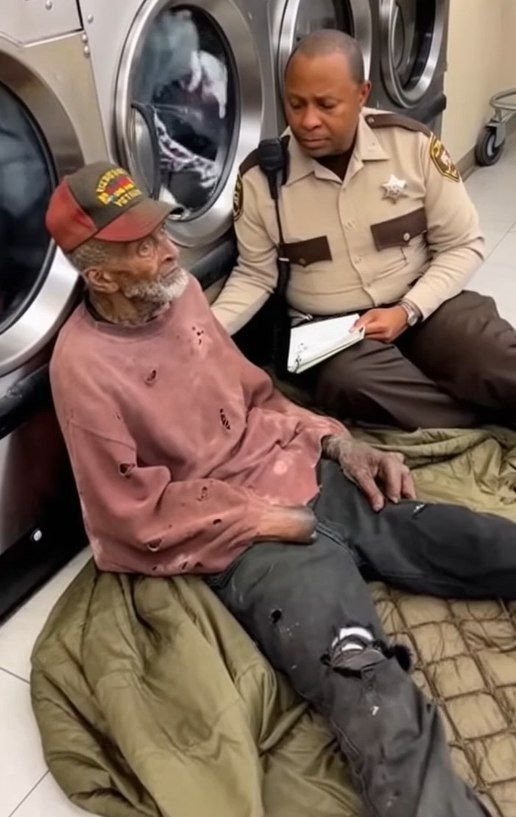
On a winter night so cold the air felt brittle, the fluorescent glow of a local laundromat became the stage for an act of profound humanity. Inside, amidst the rhythmic hum of spinning machines, an 88-year-old man named Elijah lay curled on the linoleum floor. His refuge was the residual heat from a row of commercial dryers; his blanket, a thin, worn jacket. A veteran of the Vietnam War, Elijah was a man society had quietly filed away and forgotten, his service a distant memory to everyone but himself.
The call that reached Deputy Carter was a routine one: a report of a vagrant trespassing in a business. Carter expected another standard, disheartening interaction. But the moment he stepped inside and saw the faded “Vietnam Veteran” cap resting near the elderly man’s head, the script changed. This wasn’t a nuisance call; it was a moment of reckoning. Carter saw the deep exhaustion etched into Elijah’s face, the quiet dignity persisting beneath layers of hardship. The deputy was faced with a choice: enforce the letter of the law or honor a deeper covenant.
Carter chose the floor. He knelt down, then sat beside Elijah, shoulder to shoulder against the warm dryer. He didn’t lead with authority, but with presence. “It’s warm here, sir,” Carter offered softly. Elijah’s reply was a quiet testament to a life of displacement: “It’s the only warm place I got. Been to a lot of beds, officer. None felt like home.” For twenty minutes, Carter simply listened as Elijah spoke of war, loss, and the lonely decades that followed his return to a country that moved on without him.
That conversation, held on hard flooring, became a bridge. When Elijah was ready, Carter helped him to his feet. But they didn’t walk to a patrol car for processing. They walked out together toward something better: a warm meal and a proper bed at a veteran’s shelter. Carter’s act wasn’t about grand gestures; it was about the power of seeing someone, truly seeing them, and choosing compassion over procedure. He reminded a forgotten hero that he still mattered, and in doing so, reminded us all of the quiet power of human connection.