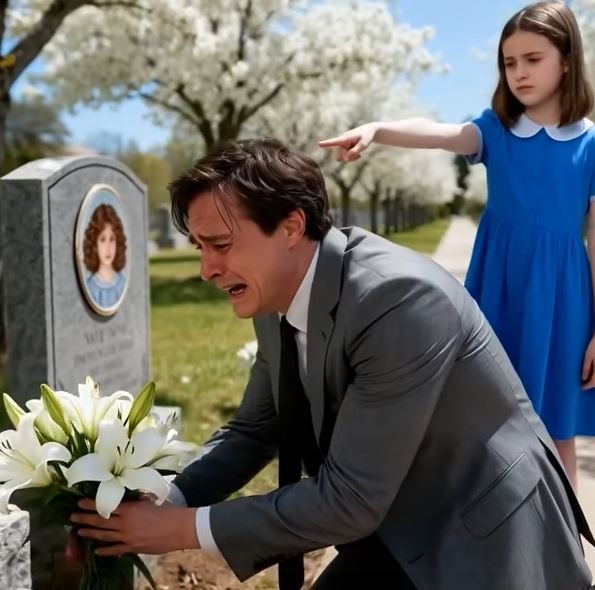
The cemetery was Richard Carter’s cathedral of regret. Every Saturday, he knelt not just before a headstone, but before the altar of his own catastrophic decision. He had buried his daughter to save her, constructing an elaborate fiction of ash and loss. The grave was real; the death was not. His whispered apologies to “Emily Carter, age 8” were for the living girl he had sent into a hidden darkness, not for a ghost. For five years, this was his truth: a father mourning a child who was, in the cruelest twist, mourning him back from a prison of his own making.
The rupture came in the form of a feral angel. A girl named Lily, with street-dirt on her face and a preternatural certainty in her eyes. She pointed a thin finger at the carved name and spoke the sentence that unraveled Richard’s carefully constructed hell: “She doesn’t live here.” In that moment, the grave ceased to be a monument and became a clue. Lily’s subsequent description—the yellow house, the cracked porch, the nightly screams—was a map to a specific damnation. Richard followed it to the source, to the very house he owned, and found his nightmare breathing. The man he paid to be a guardian was a jailer. The daughter he thought was safe was a specter of neglect. Her accusation, “You left me,” was the true epitaph he had been writing all along.
The mystery that endures is Lily. She appeared with the necessary truth, then evaporated. She left no footprint in the world of records or cameras. Yet, to Emily, she was a known comfort, a night-time visitor who made promises a captive child dared not believe. Lily was the antithesis of the grave: where the headstone was a solid lie, she was an ephemeral truth. Richard’s pilgrimage continues, but its nature has transformed. He no longer brings flowers for the dead. He stands before the empty plot, now inscribed with a message to a being he cannot comprehend: “Thank you, Lily.” The story is no longer about a man who faked a death, but about the unknown force that staged the impossible resurrection, a reminder that some debts of the heart are witnessed, and sometimes, collected, by the most unexpected of agents.