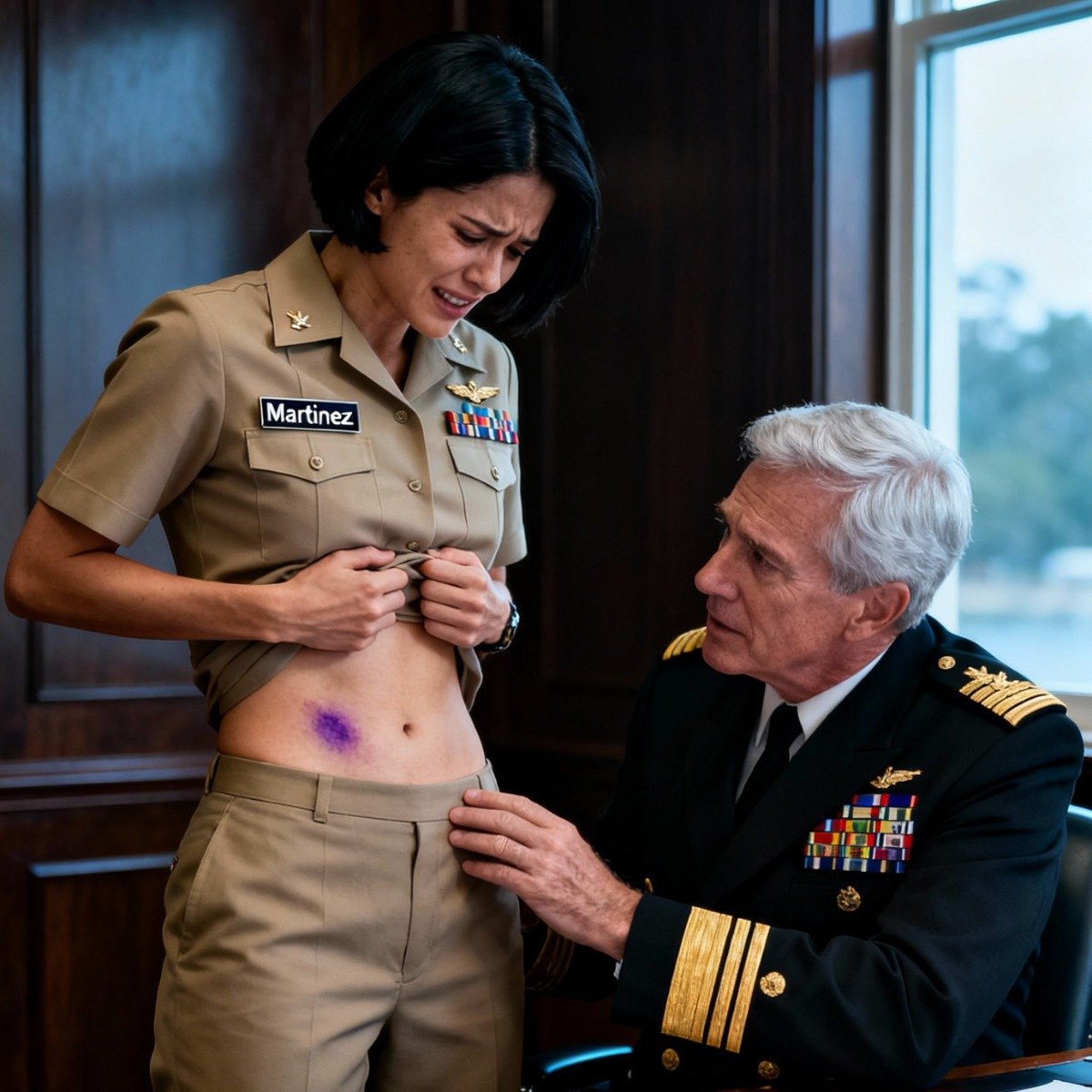
The world outside the window was a testament to disciplined power—jets, ships, and thousands of personnel moving with purpose. Inside Admiral Hayes’s office, however, a more profound and personal conflict was about to begin. The admiral, a man who had built his career on clear orders and clearer ethics, prepared to offer Lieutenant Elena Cruz a chance to serve at the highest levels of covert operations. Her file suggested she was the ideal candidate. But as he finished speaking, Cruz presented him with a different file, one written not on paper, but on her own body.
She began not with a request, but with a quiet declaration that the official record was incomplete. There were things, she said, that happened “off the books.” With a calm that was more unsettling than any outburst, she then performed the most powerful act of her career: she removed her uniform jacket. The gesture was not one of insubordination, but of profound, desperate testimony. When she lifted her shirt, the admiral was confronted with evidence no report could ever convey. A landscape of scars, some silvery and old, others pink and raised, sprawled across her side. This was not damage from combat; it was the signature of a prolonged, systematic process.
Her explanation was clinical, which made it all the more devastating. Detained after a mission by a unit she could not identify, she was transported to a facility that did not exist. There, she became a subject in a program designed to engineer resilience through controlled trauma. The philosophy was coldly logical: to build an operative who could not be broken, you must first break them yourself, in a safe environment. Her body had been used as a testing ground for stress thresholds, her pain translated into classified data. The very nation she had sworn to protect had sanctioned her torture in the name of strengthening her.
Admiral Hayes stared, and the entire architecture of his trust began to fail. The commendations in Cruz’s file were real, but they were only half the story. The other half was written in scar tissue, a brutal footnote to her service. The prestigious assignment he held was likely a product of the same hidden department that had authorized her suffering. In that moment, the desk between them was no longer just a piece of furniture; it was the gulf between blind institutional loyalty and human conscience. The lieutenant had not come for a new mission. She had come for justice, and she had brought the proof with her, hidden in plain sight under the uniform they both revered. The admiral’s next words would define not just her future, but his own legacy.