There is a unique powerlessness that comes with being a parent. You can command armies, but you cannot command the world to be kind to your child. My daughter, Maya, lost her mother and her mobility in one cruel instant. For three years, she fought to build a new, independent life at university. I, a man who plans national security strategy, made a personal pact: to respect her strength by staying in the background. I broke that pact the day I saw three students decide that her wheelchair made her their afternoon entertainment.
It began with arrogant posturing and invasive taunts. From my vantage point, I saw Maya shrink into her seat, a familiar fear gripping me. Then, it escalated beyond words. They took physical control of her chair, her sanctuary of mobility, and turned it into an instrument of torment. The “spin cycle” was a phrase they shouted with laughter; it was a nightmare of disorientation and terror for Maya. As they spun her faster, her cries grew faint. The crowd of fellow students watched, a silent audience of smartphones. My sprint felt like moving through glue, every fraction of a second an eternity of her suffering.
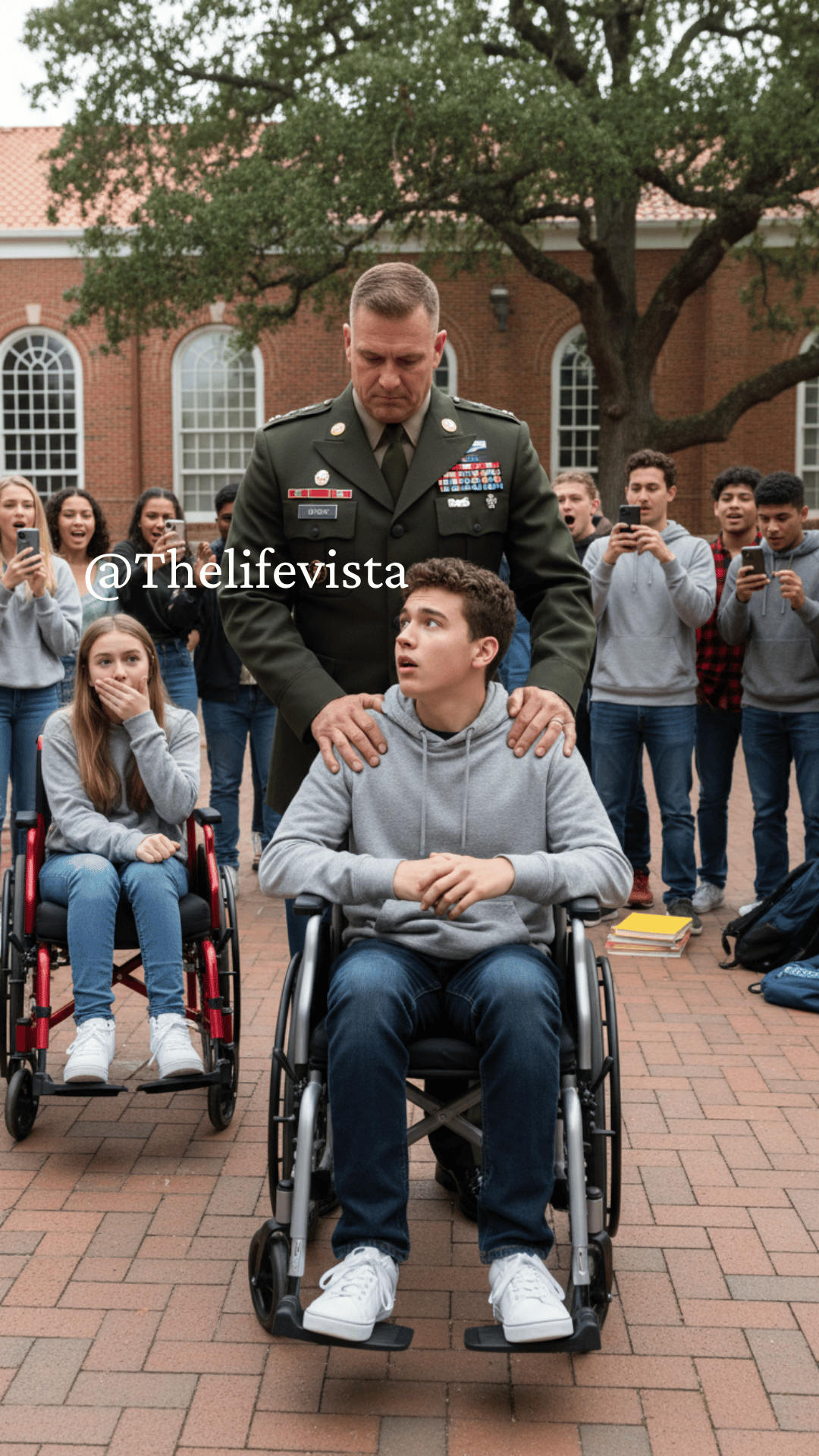
The silence that fell when I reached them was profound. Halting the chair, I saw my daughter breathless and ghostly pale. My focus then shifted to the young men. The transformation in their demeanor was immediate and total. The swagger evaporated as their eyes traveled from my combat ribbons to the four stars on my shoulders. The reality of their actions crashed into them. This wasn’t a campus scuffle; they had assaulted a general’s family. My security detail’s rapid arrival, a scene of military efficiency on the academic lawn, cemented their new reality. This was no longer about campus rules.
The real challenge emerged with the dean, who arrived wringing his hands over donor relations and public image. He spoke of “internal handling” and “misunderstandings,” treating a violent assault as a conduct violation. I presented him with a strategic choice: facilitate proper legal channels, or I would initiate actions that would cripple the university’s federal standing. The threat was not personal; it was procedural, and it was effective. The local police were called. Yet, the privilege the boys enjoyed did not vanish quietly. Their families leveraged wealth and connections to wage a media war, attempting to paint me as the aggressor.
Our victory was secured not by my authority, but by Maya’s courage and the evidence captured by bystanders. She chose to speak, sharing the unedited videos that laid the truth bare for the public. The social media tide turned irresistibly in her favor. At the university hearing, stripped of their narrative, the boys faced the consequences: expulsion and a recommendation for hate crime prosecution. As we left the campus, Maya spoke not of fear, but of change—of redesigning inaccessible ramps. The men who sought to diminish her had instead ignited a fiercer version of the woman she already was. They targeted what they saw as a weakness, never realizing they were provoking the full force of a father’s devotion and a daughter’s indomitable spirit.