The day my wife scattered my clothes across the driveway like trash, the sun was still high enough to make everything look honest.
That’s the cruel trick of daylight. It exposes the scene without offering mercy.
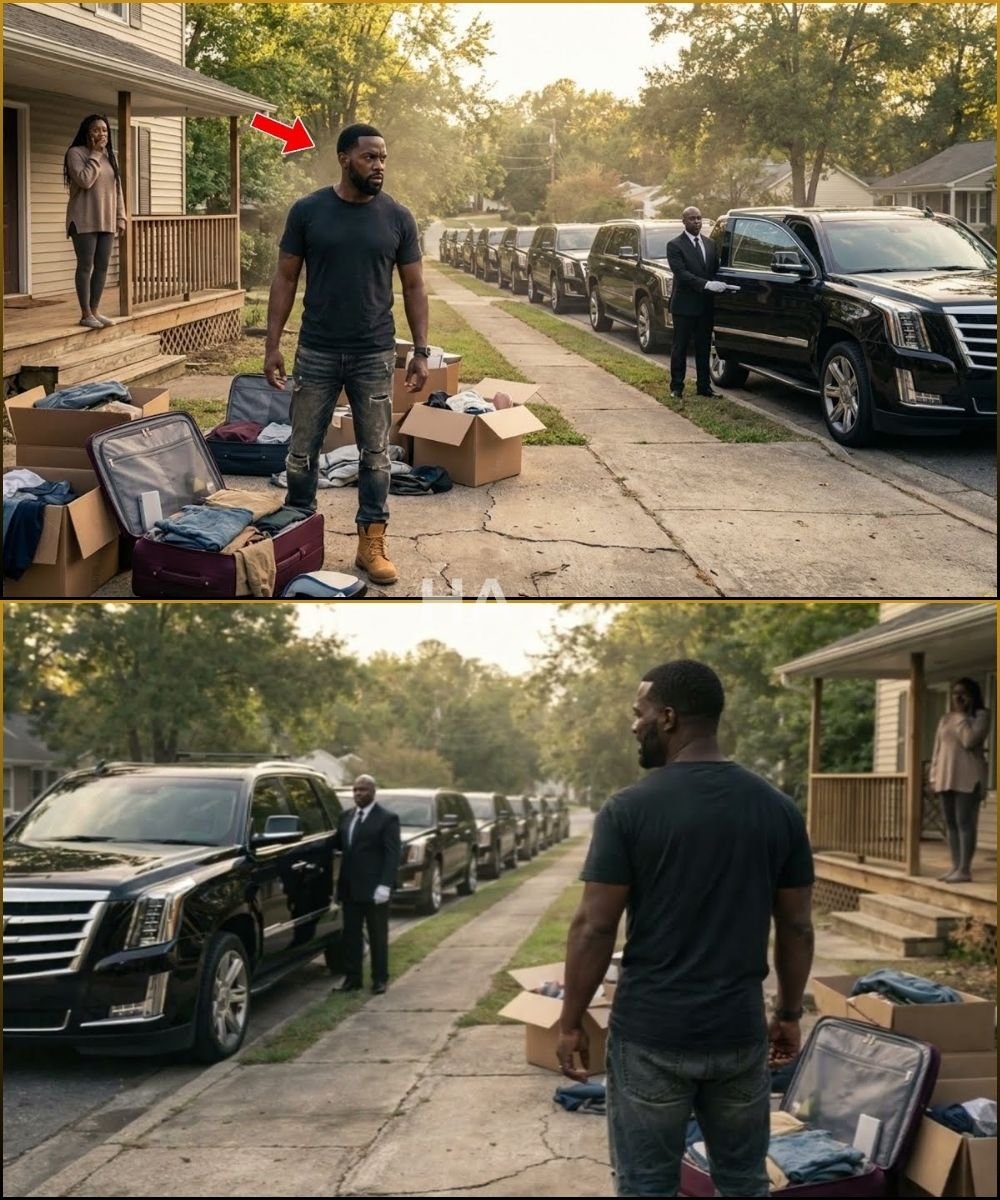
The first suitcase hit the concrete and split open like it couldn’t hold the weight of what we’d been pretending. Shirts slid out. A belt snapped loose and curled like a dead question mark. Socks tumbled across the driveway as if they’d been evicted too. A framed photo followed, landing face down near the curb like even our wedding picture couldn’t stand to watch.
Cars slowed. Not the kind of slow that means caution. The kind of slow that means entertainment.
Curtains shifted. Phones rose behind glass. Humiliation attracts an audience faster than success ever does.
My wife stood on our porch with her arms folded, chin lifted, posture tall the way people stand when they need to believe they’re taller than their fear. Her voice carried down the street like she was announcing a parade.
“You hear me?” she snapped. “I’m done. I’m tired of pretending. I’m tired of being married to… this.”
She didn’t say my name. She pointed at the driveway like I was one of the items that didn’t belong.
I wore a black t-shirt, worn jeans, the same scuffed boots she’d once laced for me when we were younger and still believed we were building something sacred. I stood in the center of the mess and watched the neighborhood turn into a theater.
Disrespect doesn’t start in public. It starts in private, small and sour, like milk you keep sniffing because you don’t want to waste it. It grows quietly until one day it spills in front of witnesses and dares you to swallow it anyway.
Her name was Camille. She used to laugh like she had room in her chest for joy. Lately, her laughter had become sharp, something she used to slice distance between us.
“I gave you years,” she continued, voice rising. “Years of my life. And what do I have? A house that looks like every other house, an old truck, a husband who disappears for ‘work trips’ and comes back like he’s been hauling rocks.”
Across the street, a woman stepped onto her porch and didn’t even try to disguise her stare.
A few houses down, a man pretended to water his lawn. He hadn’t moved the hose in thirty seconds, but he kept it angled like he could water judgment itself.
Camille thrived on an audience. She’d always been good at performance, even when she called it honesty.
She stepped down from the porch, heels clicking like punctuation marks. She came closer and jabbed a finger toward the street.
“Get out before I call the police. I’m not living like this anymore.”
Living like what? I wondered. Like stability? Like quiet? Like a life without bragging?
But I didn’t ask it out loud.
Silence is a strange weapon. People expect anger because anger makes the script familiar. Silence makes them feel like they’ve misread the scene. Camille wanted tears. She wanted me to beg, to crumble, to prove that I was what she said I was.
Instead, I bent down, picked up a photograph that had slid into the grass, and brushed a bit of dirt off the corner.
Second anniversary. Camille smiling so wide her eyes looked brighter than they do now. I remembered that day not because we spent money, but because we spent time. We’d eaten takeout on the floor of our half-furnished living room and toasted with cheap wine because we were too broke to buy glasses but too happy to care.
Somewhere along the way, “building” stopped being enough.
Her friends had husbands who posted watches and vacations like receipts of worth. Camille began to measure our life in likes and labels. Quiet became suspicious. Simplicity became embarrassing. Privacy became weakness. And the mystery of me, the parts I didn’t explain, became an insult she couldn’t forgive.
She kicked a cardboard box farther down the driveway, hard enough that papers fluttered out: tax forms, old letters, a folder labeled “Holdings” in a plain file tab.
She didn’t notice it.
She did notice the neighbors, though. Camille glanced left, right, gauging the crowd like a singer checking if the audience is listening.
Then she delivered the line she’d been saving.
“You’ll always be nothing,” she said loudly. “And I’m tired of carrying you.”
I looked at her and felt the odd, weightless calm that comes when a door inside you finishes closing.
Not hatred. Not vengeance.
Clarity.
Camille’s eyes narrowed. My stillness irritated her more than shouting ever could.
“Say something,” she demanded. “For once, say something real.”
I almost did.
But before I could, the universe decided to speak first.
A low hum began at the far end of the street. Not aggressive. Not loud. Organized. Like an orchestra warming up before the conductor raises the baton.
Neighbors turned their heads before Camille did. The man with the hose stopped pretending.
Then Camille turned.
Then I turned.
Ten black SUVs rolled into our street in perfect alignment, sunlight sliding across their polished hoods like liquid metal. They moved slowly, intentionally, the way things move when they don’t need permission.
The convoy approached without rushing, without hesitation. Authority doesn’t hurry. It arrives.
Camille’s voice caught mid-breath.
“What… is that?” she whispered, and for the first time that afternoon, she sounded like she wasn’t sure of the stage.
The SUVs lined the curb in front of our house one by one. Engines idled. Doors remained shut.
Silence fell over the entire street, thick enough to swallow gossip.
Phones lifted higher. Neighbors stepped out, no longer pretending this wasn’t their business.
Camille tried to regain her posture, tried to turn confusion into annoyance.
“Who are you people?” she called out, voice cracking on the last word.
The first SUV door opened.
A tall man stepped out in a tailored black suit, gloves on his hands, posture straight as if he’d been trained by gravity itself. He didn’t scan the neighborhood. He scanned the driveway.
His eyes found me immediately.
He walked forward, stepping around my scattered clothes, around the boxes, past Camille as if she were a lamp post. He stopped in front of me and lowered his head respectfully.
“Sir.”
The word didn’t echo. It detonated.
Camille blinked, her expression sliding from anger to confusion to something close to fear. Neighbors leaned forward like they were watching a magic trick and couldn’t figure out where the rabbit went.
The suited man spoke softly, professionally.
“Your schedule requires immediate departure.”
Camille laughed once, a nervous, broken sound. “What is this? Who are you?”
Another SUV door opened. Then another. Men and women stepped out, all in tailored suits, moving like a trained unit.
One woman began picking up my shirts from the driveway as if they were delicate fabric instead of cotton.
Another collected my documents with careful hands, stacking them neatly.
Another gathered the photographs from the grass, wiped the glass of each frame, and slipped them into protective sleeves.
They didn’t rush. They didn’t speak. Their silence was louder than Camille’s insults.
Camille stepped backward slowly, the performance draining out of her body like water leaving a cracked cup.
Her eyes fixed on me.
“What… what is going on?” she asked, voice smaller than the street.
I didn’t answer immediately. I watched her face as it recalculated everything she thought she knew.
People fear what they can’t measure, and Camille had spent months trying to measure me with the wrong ruler.
The suited man gestured toward the lead SUV. The rear passenger door opened.
Inside, the leather was stitched so precisely it looked like it had been sculpted, not sewn. Ambient lighting glowed softly along the interior. Privacy glass turned the world into a suggestion.
Camille stared like she was looking at a doorway into a life she’d only ever watched from the outside.
A security officer placed my final suitcase gently into the vehicle.
Camille stepped closer, not to insult this time, but to understand. Her voice softened, cautious, as if loudness might break whatever was happening.
“Why are they calling you sir?”
I finally spoke, quietly enough that only she could hear.
“You shouldn’t throw away what you never understood.”
Her face went pale.
The suited man leaned toward me again, the way someone delivers a reminder without forcing it.
“The board is waiting.”
Board.
Waiting.
Those words hit Camille like cold water.
A woman in a tailored suit approached and handed me a tablet. The screen showed a live conference room filled with executives around a massive table. Behind them, a logo was displayed in crisp white letters: HAYES GLOBAL SYSTEMS.
Camille’s mouth opened. Her voice didn’t.
She knew that name.
Everyone did.
Hayes Global was one of those companies that exists like a shadow behind modern life. The software you don’t think about. The infrastructure you assume is just there. The invisible skeleton holding up entire industries.
Camille had read about it in business magazines in waiting rooms. She had scrolled past headlines about it while looking at vacation photos posted by her friends.
She had never, not once, imagined it had anything to do with the man standing in worn jeans on a cracked driveway.
The suited man spoke again, calm as a clock.
“The shareholders require confirmation of your arrival.”
Camille began apologizing mid-breath, words tumbling out like they were trying to outrun consequences.
“I didn’t know, I swear I didn’t know. I was upset. I didn’t mean it like that. I was just… I was joking, okay? I was joking.”
But her voice didn’t carry conviction anymore.
It carried fear.
Fear doesn’t sound like a scream. It sounds like bargaining.
I stepped toward the SUV.
Neighbors parted slightly as if the driveway had become sacred ground. Phones recorded every angle of Camille’s collapse.
Camille reached for my arm, fingertips barely touching my sleeve like she was afraid I would vanish if she grabbed too hard.
“Please,” she whispered. “Donovan… I’m sorry.”
She used my name now.
She had said “nothing” minutes earlier.
I looked at her, and my voice stayed gentle because cruelty is easy. Control is harder.
“The problem isn’t that you didn’t know,” I said. “It’s how you treated me when you thought I had nothing.”
Camille’s knees weakened. I saw her posture fold in small increments, like a building finally realizing its foundation is gone.
Behind me, the suited team finished gathering the mess she’d made. My wedding photo was placed in a protective sleeve like it mattered.
Respect isn’t expensive.
It’s rare.
The door remained open, waiting.
I lowered myself into the backseat of the lead SUV.
The air inside felt completely different from the air in that driveway. Outside was noise and shock and the smell of public humiliation. Inside was calm, controlled power. The door closed softly and sealed off the street like it no longer existed.
Through the tinted window, I watched Camille stand barefoot at the edge of the driveway, stunned, breathing unevenly. She looked like a person who had thrown a rock at a window and finally heard the glass break.
The driver didn’t ask where we were going.
He already knew.
The convoy moved in unison, gliding away from the curb like a silent statement.
In the side mirror, Camille shrank in the distance, still frozen, still trying to understand how quickly humiliation had reversed direction.
My tablet buzzed.
The boardroom screen was still active. Twenty faces waited. Executives from different cities, states, countries. People who moved billions with calm voices.
They had seen everything.
Not because I planned to expose Camille, but because my life didn’t pause for personal drama. When you lead an empire, your timing doesn’t care about your heartbreak.
A senior board member leaned forward. Naomi Chen. Sixty-two. Sharp eyes. Reputation for dismantling billion-dollar mistakes without raising her voice.
She didn’t ask if I was okay.
She asked, “Are you ready?”
That was leadership. Emotion acknowledged silently. Responsibility continues.
I nodded once.
Naomi said, “The acquisition vote is in twelve minutes.”
I watched charts on the screen. Markets. Proposals. Risk models. A takeover that would shift entire sectors. The kind of move analysts would call bold and competitors would call ruthless.
Camille had thought she was throwing out a broke man.
She had no idea she was pushing away the controlling shareholder of a multinational technology conglomerate valued above forty billion dollars. She had no idea I held majority stakes in infrastructure companies, energy grids, defense contracts, and real estate across three continents.
She saw worn boots and assumed limitation.
She mistook restraint for scarcity.
The convoy exited the highway and merged into downtown traffic. Vehicles moved aside without knowing why, as if the city itself recognized authority even when it couldn’t name it.
We entered a private underground garage beneath a glass tower that cut into the skyline like a blade. Gates opened automatically. Cameras tracked our approach with quiet compliance.
The suited man from the driveway opened my door.
“Welcome back, Mr. Hayes,” he said.
Back.
Not up.
Not lucky.
Back.
The elevator doors opened before we reached them. Access granted without a badge, without a pause. Inside, mirrored walls reflected a man most people had never truly seen.
Not because I hid.
Because they never looked beyond appearances.
On the fiftieth floor, the boardroom doors opened. Twenty executives rose simultaneously. Not dramatic, not ceremonial. Just respect.
Naomi gave a small nod. “We’re ready.”
I walked to the head of the table. Screens displayed global markets, currency fluctuations, strategic timelines. Millions of lives would shift with decisions made in this room. Thousands of employees, entire supply chains, innovation pipelines.
The vote began, one by one.
“Approve.”
“Approve.”
“Approve.”
Each voice steady, precise.
Then silence fell when my turn arrived.
The kind of silence that weighs more than noise.
I spoke one word.
“Approved.”
The room exhaled. Not loudly. Collectively.
Billions shifted on that single syllable. Markets adjusted. Competitors recalculated. The world moved forward without ever knowing about my driveway.
As the meeting transitioned into logistics, my phone vibrated on the table.
Message from Camille.
Then another.
Then another.
Apologies. Panic. Regret.
I didn’t open them, not because I wanted revenge, but because clarity requires space.
When the meeting ended, Naomi approached me quietly.
“Press interest is increasing,” she said. “We’ll need you at the podium by nine.”
I nodded, and she hesitated slightly.
“Also… your wife’s father requested a meeting.”
I let the word settle in my mind.
Wife.
For now.
“Schedule it,” I said.
Not because I craved confrontation, but because closure prevents lingering noise.
That afternoon, her parents arrived at a neutral conference room. Their posture looked different from the porch confidence I remembered. Pride had drained out of them like color leaving a bruise.
Her father spoke first, voice softer than I’d ever heard.
“I misjudged you,” he said. “I laughed. I shouldn’t have.”
Her mother’s eyes were red. “I’m sorry,” she whispered. “I didn’t think… I didn’t know.”
Camille’s brother stared at the table, cheeks tight. “I’m sorry too.”
Apology deserves acknowledgement.
But acknowledgement doesn’t require restoration.
I listened without interrupting. When they finished, I said something simple.
“The issue wasn’t the driveway. The issue was the mindset behind it. If your respect depends on someone’s bank account, then it was never respect.”
Her father nodded slowly like the sentence hurt because it was true.
They asked if the marriage could survive.
I answered honestly.
“Trust once broken publicly rarely rebuilds privately.”
The meeting ended without drama. Reality doesn’t need shouting.
That evening, Camille returned to the penthouse.
Not in heels. Not in a red dress. No performance. No audience.
She stepped out of the private elevator with her hair tied back and her face bare, eyes swollen from crying. She looked smaller, not physically, emotionally. Like someone who had been holding up a mask and finally dropped it because her arms gave out.
She didn’t rush toward me. She didn’t throw herself into apologies. She simply stood in the quiet wealth and tried to understand what she’d been living beside.
“I never imagined this,” she said softly.
I stood by the window looking down at the city. Glass towers glittered like frozen lightning.
“You never asked,” I replied.
Those three words landed harder than any insult. Because they revealed the real fracture: we weren’t undone by poverty or wealth.
We were undone by distance.
Camille swallowed. Her fingers twisted together nervously.
“I started resenting you months ago,” she admitted. “Not because you were cruel. You weren’t. But I felt… insecure. My friends, their husbands…” She exhaled sharply, ashamed. “They were loud about success. And you were quiet. You made me feel… like we were behind.”
She paused, then said the name I’d expected, the name that smelled like flash and temptation.
“Marvin.”
I didn’t react. I didn’t need to.
Camille’s voice cracked. “He represented everything visible. The kind of success people applaud. I let that… cloud everything.”
She looked at me, tears heavy.
“I’m ashamed,” she whispered, “not because you’re wealthy… but because I realize I would’ve treated you better if I’d known.”
And there it was.
The confession that revealed her heart more clearly than any driveway performance.
I turned toward her slowly.
“If your respect depends on my bank account,” I said, “then it was never respect.”
Her shoulders shook. She cried without drama, without bargaining this time, just grief for what she’d revealed about herself.
She wiped her face and asked, “Why didn’t you tell me? Why didn’t you ever say who you were?”
The answer came without effort because it had always been true.
“Because I wanted to be loved for who I am. Not what I own.”
Camille shut her eyes, regret carving deeper.
Then she asked the question she needed to ask, even if it hurt.
“Is there any way back?”
I poured two glasses of water and handed her one.
She held it like it was something fragile.
“Rebuilding requires foundation,” I said. “And our foundation cracked the moment you chose public humiliation over private conversation.”
She nodded because she knew it was true.
“I’m not angry,” I added. “Anger would mean you still have power over who I become. You don’t.”
That wounded her more than shouting ever could, and I watched her understand it.
Camille’s phone vibrated. Marvin again. She glanced at it, then powered it off.
The gesture mattered.
But awareness doesn’t erase consequences.
We spoke for another hour. Not about money. About character. About loneliness. About how people chase applause when they’re terrified of silence.
At the end, Camille placed the untouched water glass on the table, straightened her shoulders, and apologized again. This time, not like a plea. Like ownership.
“I’m sorry,” she said. “For who I became.”
She walked to the elevator. Halfway there, she stopped and looked back once, not expecting rescue. Just memorizing the moment.
The doors closed gently behind her.
The penthouse returned to silence.
The next morning, the news broke at 9:00 a.m.
ACQUISITION COMPLETED. HAYES GLOBAL FINALIZES MULTI-BILLION DOLLAR EXPANSION.
My face appeared on business channels, calm and steady, speaking about long-term vision, global impact, responsibility. Analysts debated my strategy. Investors praised the timing. Stock prices climbed.
No one mentioned a driveway.
The world records outcomes, not emotions.
But back in that neighborhood, the story spread differently. Neighbors circulated videos they’d filmed: the convoy, the suits collecting clothes with care, the word “sir” hanging in the air like a verdict.
Someone searched my name. Someone connected the press conference. Someone realized the quiet man they watched get thrown out owned a corporation worth tens of billions.
And like wildfire, perception changed.
Camille’s family became the subject of whispers. The porch that once held her performance now held her absence. The driveway that once held my clothes now held a legend.
A week later, the divorce was finalized quietly, efficiently, without spectacle. I structured the settlement so Camille could rebuild without being able to perform wealth. Enough for stability, not applause.
Money wasn’t her punishment.
Reality was.
Months passed. My company expanded further. We launched philanthropic projects in underfunded communities. Scholarships funded. Infrastructure repaired. Wealth used strategically, not displayed recklessly.
Camille rebuilt too, but not with glamour.
She pursued independent work. She studied financial literacy. She volunteered with programs teaching young women not to tether their identity to someone else’s status.
It wasn’t redemption as performance.
It was redemption as discipline.
One day, before I relocated international operations permanently, I returned to that suburban neighborhood.
Not with a convoy. Just one car. Simple.
The cracks in the driveway were still there. Same house, same porch, same mailboxes, but the energy was different. The neighborhood no longer felt like a stage.
Camille stood outside watering plants.
When she saw me, she froze. The hose kept running, water spilling onto concrete like time refusing to pause.
We stood a few feet apart.
No anger. No longing.
Just adults facing the ruins of a choice.
“I replay that day,” she said quietly. “Over and over. The suitcase hitting concrete. The things I said. The way I laughed.” Her eyes glistened. “I don’t recognize myself.”
“Growth begins with discomfort,” I said.
She nodded. “How were you so calm? Why didn’t you destroy me? You could have.”
I looked at the street, at the same neighbors who once filmed like vultures and now stood behind curtains with softer curiosity.
“Because I refuse to let your behavior reshape my character.”
Camille swallowed hard. Then she said something heavier than any apology.
“I will never measure a person by appearance again.”
That was the real proof of change. Not tears. Not begging.
A lesson rooted.
I extended my hand, not romantically, not ceremonially.
Respectfully.
She took it.
A handshake. Closure without bitterness.
As I walked back to my car, Camille remained standing in the driveway, watching not as a wife losing a husband, but as a human learning what dignity costs.
Before I got in, she called out softly.
“One thing,” she said. “The convoy… was it… because of me? Because of what I did?”
I turned and answered honestly.
“No. It was scheduled before you ever threw the first suitcase. The board meeting was always that morning.”
Camille blinked, and I watched the realization land: the universe hadn’t sent revenge.
It had sent timing.
Her humiliation wasn’t orchestrated by me.
It was self-inflicted, illuminated by coincidence.
Sometimes life doesn’t need revenge.
It needs exposure.
Years later, at a philanthropic summit about generational wealth and identity, I saw Camille again across a room of chandeliers and polished glass. She looked different, not glamorous, not broken.
Balanced.
She introduced herself formally, not as my former wife, but as director of a community entrepreneurship program funded by one of our subsidiaries.
The irony didn’t need a spotlight.
Camille spoke with calm confidence about teaching young entrepreneurs to build quietly, to resist the trap of visible status, to measure success by stability instead of applause.
She didn’t hide her lesson.
She carried it.
After her session, she approached me and said, “Thank you.”
“For what?” I asked.
“For restraint,” she said simply. “For letting the lesson follow me instead of a scandal.”
We spoke briefly, not about the past, but about strategy, impact, the kind of building that doesn’t need witnesses.
When the summit ended, she extended her hand, firm and steady.
I shook it.
No dramatic goodbye. No cinematic closure.
Just mutual understanding.
Outside, black SUVs waited.
Only two.
Efficiency replaces spectacle when ego dissolves.
As I got into the car, the city lights glittered across the river like a constellation laid on steel. I thought about how quickly perception can distort reality, how easily pride can blind someone, how powerful patience becomes when it’s paired with integrity.
The driveway wasn’t the twist.
The convoy wasn’t the twist.
The billions weren’t the twist.
The twist was this:
Character is revealed in private before it’s confirmed in public.
And the man she called nothing was never trying to be seen.
He was building something too large to be shaken by insult.
Quietly.
Steadily.
Unshaken.
THE END