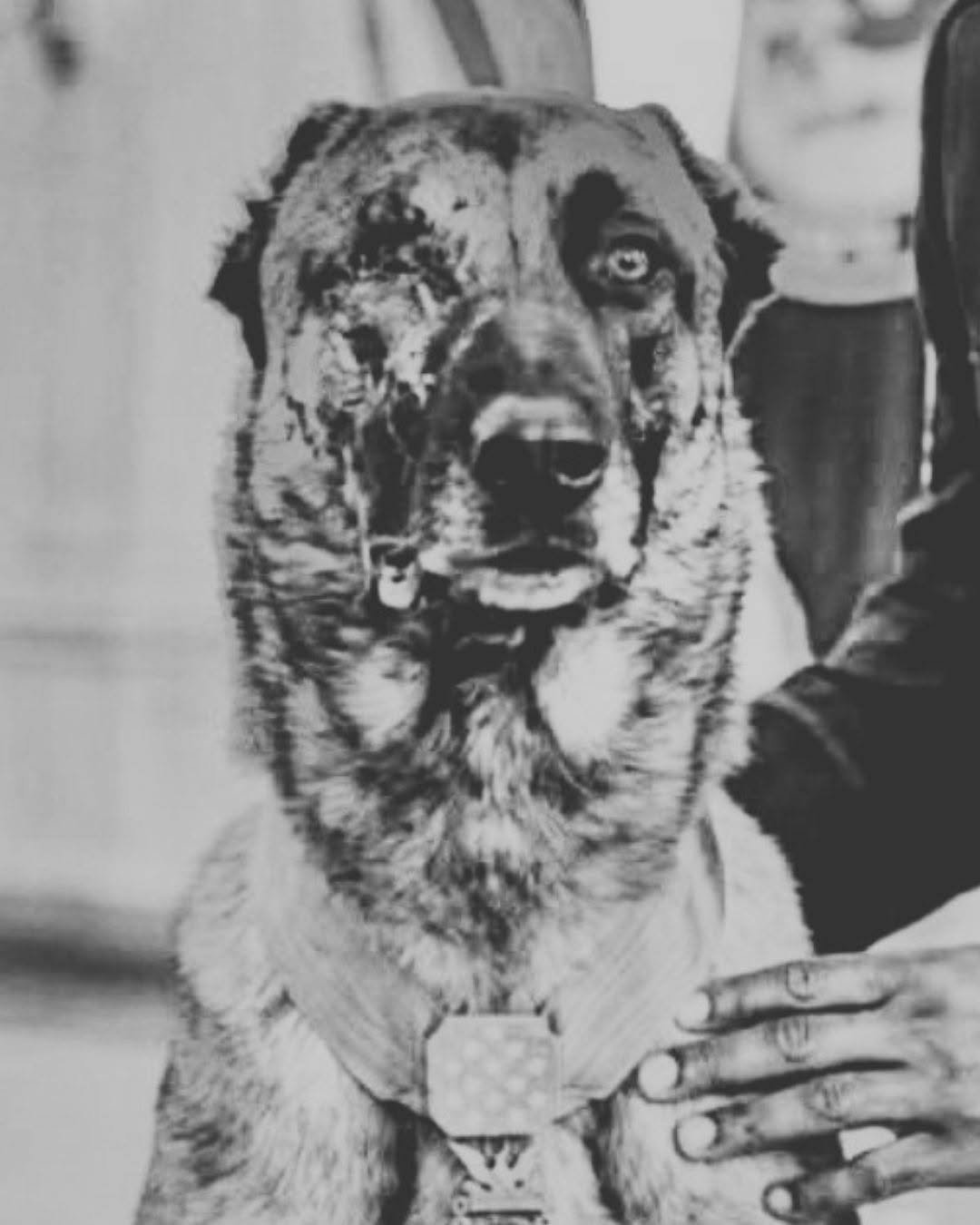
In every generation of military history, there are stories that spread not because they are written in official reports, but because they are repeated by those who witnessed them. The story of K9 Valor belongs to that category, a narrative built on courage, instinct, and a bond between human and animal that defies easy explanation. According to those who served alongside him, Valor was more than a working dog. He was a presence on the battlefield that seemed to understand danger before it arrived, moving with a precision and focus that saved lives in situations where hesitation meant loss. Over time, his name became associated with extraordinary actions: intercepting threats, detecting hidden explosives, and standing between danger and the soldiers he was trained to protect. What makes his story endure is not just the number of missions attributed to him, but the sense of unwavering loyalty that defined every account. He did not operate with awareness of medals, recognition, or legacy. He operated with instinct and training, guided by a single relationship that mattered above all others: his handler. In the chaos of conflict zones, where sound, movement, and uncertainty merge into constant pressure, Valor represented something rare and stabilizing. He was the point of focus in moments where everything else fractured. Even those who never saw him directly came to speak of him as if he were a symbol rather than just a dog, a living reminder of what absolute commitment looks like when stripped of language and ego. In that sense, K9 Valor became more than a name. He became a story soldiers told when they needed to remember that courage can take forms beyond human expectation.
The Battlefield Role of Military Working Dogs
Military working dogs like Valor operate in environments that most people will never experience firsthand, environments defined by unpredictability and constant risk. Their role is not ceremonial or symbolic; it is operational and essential. They are trained to detect explosives, identify hidden threats, and move through unstable terrain where human senses alone are not enough. In many missions, these dogs are the first line of defense, entering spaces that could be rigged with traps or occupied by hostile forces. Their training emphasizes responsiveness and obedience, but what makes them extraordinary is not simply discipline—it is their ability to process complex environments with speed and confidence that even advanced technology sometimes cannot replicate. Handlers often describe an unspoken communication that develops over time, a trust built through repetition, shared danger, and reliance on one another in life-threatening conditions. The dog watches the handler, and the handler watches the dog, each reading subtle cues that signal safety or danger. In this dynamic, hesitation is replaced by instinctive coordination. Valor, according to those who served with him, embodied this relationship at its highest level. He did not pause when situations became unclear. He moved with purpose, as if the mission itself was embedded in his behavior. In combat zones, where seconds determine outcomes, such reliability becomes invaluable. Military dogs do not interpret bravery the way humans do, yet their actions often align with what people later describe as heroic. They do not weigh risk against reward. They respond to training, trust, and connection. That simplicity is what makes their contribution both powerful and difficult to fully articulate.
The Moment Everything Changed
Every combat story has a turning point, a moment where routine operation transforms into survival. For K9 Valor, that moment came during a mission where threats were no longer hidden in uncertainty but actively present in the environment. According to accounts shared by those familiar with similar operations, Valor detected and neutralized multiple dangers over the course of engagements that escalated rapidly. In close-quarters situations, he was said to have engaged threats with decisive movement, giving his unit critical seconds to respond. But the defining moment of his story was the final act attributed to him—the instant where instinct and loyalty converged into sacrifice. A suicide bomber approached within range of the team, and in that split second, Valor reportedly placed himself between the explosion and his handler. The blast that followed caused catastrophic injuries, destroying part of his face and leaving permanent damage that would require extensive medical intervention. In that instant, the abstract concept of duty became physical and irreversible. What remained afterward was not the sound of action, but silence filled with aftermath. Those who were present described the shock of realizing what had happened, not only in terms of operational consequence but emotional weight. The dog that had been part of so many successful missions had now become the reason those missions were not losses of life. In military environments, such moments are often described in clinical terms, but those who witness them rarely experience them clinically. They experience them as something deeply personal, because the bond between handler and working dog is built on trust that feels closer to family than to equipment. Valor’s final action in that moment became the defining point of his legacy.
Survival, Recovery, and the Cost of Loyalty
After the explosion, K9 Valor was evacuated for emergency medical care, beginning a recovery process that reflected both the severity of his injuries and the commitment of the medical teams treating him. Reports describe devastating trauma to his face, including the loss of an eye and ear, along with extensive damage that required reconstructive surgery. He was transported to specialized facilities in Germany, where veterinary surgeons worked to stabilize and rebuild his injuries in a process that was as delicate as it was urgent. Each procedure represented an attempt not just to repair physical damage, but to preserve quality of life for a dog who had already endured conditions few beings ever experience. Recovery in such cases is not measured solely in physical healing but in resilience—the willingness of the animal to continue responding, trusting, and engaging with the world after trauma. For handlers and medical staff alike, working with injured military dogs often carries an emotional burden that is difficult to separate from professional responsibility. These animals are not anonymous units; they are individuals whose personalities, habits, and relationships are well known to those around them. Valor’s recovery therefore became more than a medical case. It became a shared effort among those who understood what he had given. Every stage of treatment reflected both scientific precision and emotional gravity. The effort to rebuild his face symbolized something larger than anatomy—it represented respect for service that had already exceeded expectation. In military culture, where sacrifice is often discussed in human terms, cases like Valor’s challenge the boundaries of how courage is recognized and how loyalty is honored when it comes from a non-human companion.
Recognition at the Highest Level
When K9 Valor was later honored at a formal ceremony, the atmosphere reportedly shifted in a way that even seasoned military personnel found difficult to describe. The recognition was not framed as spectacle, but as acknowledgment—an institutional pause to honor a life that had operated in silence and service. In the room, the presence of a decorated military working dog carried a weight that transcended rank and hierarchy. Soldiers, officers, and officials stood together, not as observers of protocol, but as witnesses to something that felt fundamentally human despite its non-human subject. The standing ovation that followed was not brief. It stretched on for minutes, an extended moment in which applause became less about celebration and more about release—an outlet for emotions that military culture often contains rather than expresses. Valor’s injuries were visible reminders of the cost behind the story, but what moved people most was not only what he had survived, but what he had chosen to do in the moment of crisis. There are few contexts in military life where silence carries more meaning than words, and this was one of them. Those present did not need detailed explanation of missions or statistics to understand what had occurred. The symbolism was immediate and universal: a life spent protecting others had reached its most extreme expression. In that space, Valor was not viewed as equipment or asset, but as a partner whose service had reached a level that demanded recognition beyond routine commendation. The ceremony became less about formality and more about collective acknowledgment of sacrifice that defies conventional categories of honor.
The Unspoken Bond Between Handler and Dog
At the center of every military working dog story is a relationship that cannot be replicated by training alone: the bond between handler and animal. This connection is built through repetition, shared danger, and a mutual dependence that forms under conditions of extreme pressure. Handlers learn to read their dogs not just as tools of detection, but as living beings with instincts that often anticipate human awareness. Dogs, in turn, learn to interpret subtle cues from their handlers, responding to tone, movement, and presence in ways that create a synchronized partnership. In environments where communication must often be silent, this bond becomes essential. K9 Valor’s actions, as described in accounts of his service, reflected this kind of relationship at its most intense. His focus was not abstract duty but immediate connection—to the handler who represented safety, trust, and direction. In moments of danger, that bond can become the difference between hesitation and action. Military working dogs do not conceptualize heroism, but their behavior often aligns with what humans define as its highest expression: the willingness to face danger without retreat when another life is at stake. For handlers, the loss or injury of such a partner carries emotional weight that is rarely discussed openly within military culture. These animals are present during moments of extreme vulnerability, witnessing fear and survival alongside the people they serve. That shared experience creates a form of loyalty that is difficult to translate into words but impossible to ignore in practice. Valor’s story, whether viewed as literal history or symbolic narrative, reflects that deeper truth about partnership under pressure.
A Legacy Written in Silence and Sacrifice

The story of K9 Valor ultimately endures not because of medals or formal citations, but because it represents a kind of courage that is both simple and absolute. In narratives of military service, human bravery is often framed through decision, intention, and reflection. For working dogs, however, courage is expressed through consistency—through showing up again and again in environments that demand total focus without expectation of recognition. Valor’s legacy, as told through those who speak of him, is rooted in that consistency. He did not seek meaning in his actions; he embodied it through them. His injuries, recovery, and recognition form a sequence that highlights the cost of loyalty when taken to its extreme limit. Yet beyond the physical and ceremonial aspects of his story lies something more enduring: the reminder that service is not defined by species, but by action. Military working dogs occupy a space where instinct meets training, and where trust becomes a matter of survival. In that space, Valor became a symbol of what it means to give everything without hesitation. His story continues to be shared not only as tribute but as reflection, prompting those who hear it to reconsider the boundaries of courage and the forms it can take. In the end, K9 Valor represents a truth that needs no embellishment: that some forms of devotion are so complete they leave language behind entirely, existing instead as memory, silence, and respect carried forward by those who were there to witness it.