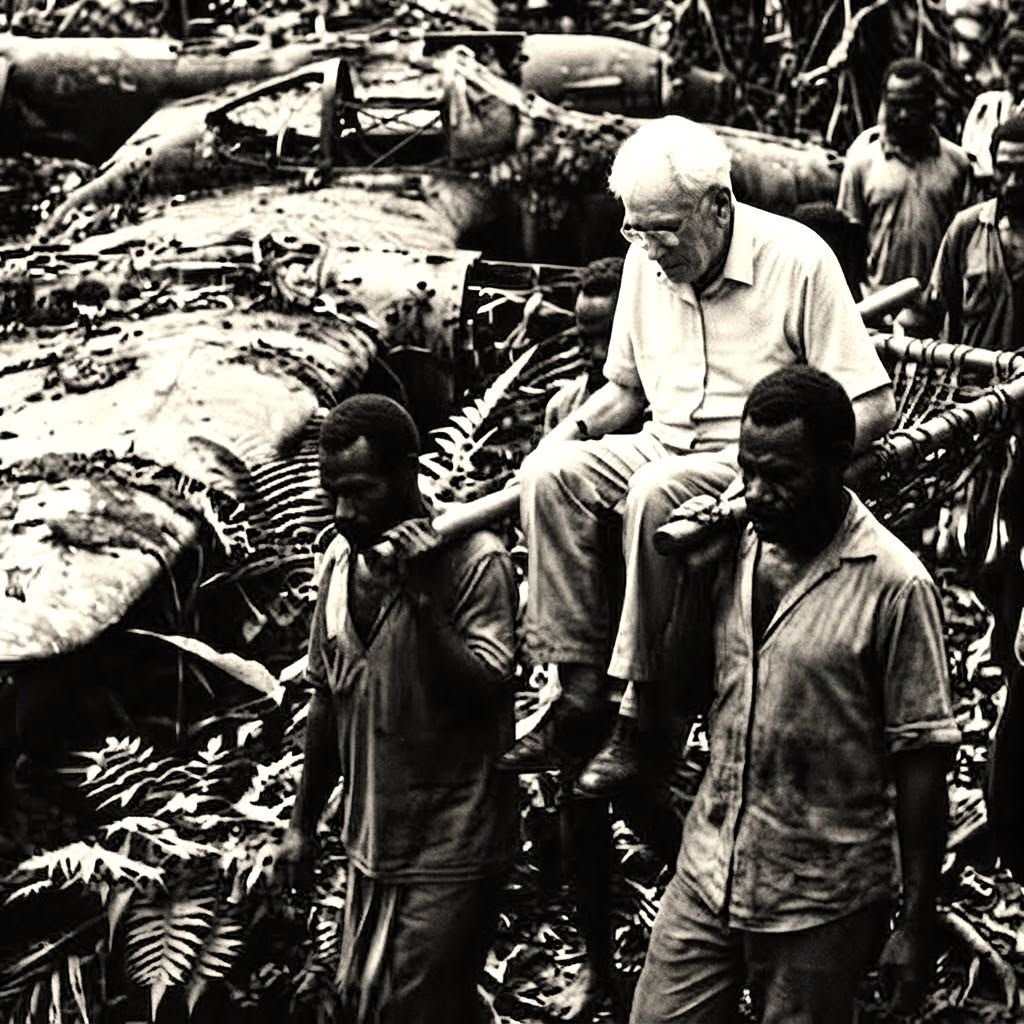
The American Pilot Who Fell Into Enemy Territory
In the summer of 1943, 27-year-old American pilot Fred Hargesheimer was flying a photo-reconnaissance mission over New Britain, an island in the southwestern Pacific.
World War II was raging across the region. Japanese forces occupied much of the island, and Allied aircraft faced constant danger from enemy fighters and antiaircraft defenses.
Fred’s mission was to gather intelligence, photographing territory that could help Allied commanders understand Japanese positions.
But during the flight, everything went wrong.
A Japanese fighter attacked his aircraft, leaving him with no choice but to abandon it.
He parachuted toward the dense tropical rainforest below.
There was no rescue team waiting. No friendly airfield nearby. No guarantee that anyone would ever learn where he had landed.
When his parachute finally carried him into the jungle, Fred found himself alone in one of the most dangerous environments imaginable.
Japanese soldiers were searching for Allied airmen. The jungle was filled with insects, disease, difficult terrain, and unfamiliar vegetation.
He had survived the destruction of his aircraft.
Now he had to survive the island itself.
For approximately a month, Fred wandered through the rainforest, trying to remain hidden.
He drank water from streams and struggled to find enough food to stay alive. His strength deteriorated as hunger and illness took their toll.
Every unfamiliar sound could mean danger.
Every movement through the trees could signal an approaching patrol.
As the days passed, his chances of surviving appeared increasingly remote.
He had no way of knowing that the people who would save his life were living somewhere beyond the trees.
And that their kindness would change the course of his entire future.
The Strangers Who Refused to Leave Him Behind
After weeks of struggling through the jungle, Fred heard voices.
His immediate reaction was fear.
He knew that Japanese forces were operating in the area, and capture could mean imprisonment or death.
Weak and exhausted, he had little ability to escape.
But the people emerging from the forest were not Japanese soldiers.
They were local Nakanai villagers.
What they encountered was a desperately ill American stranger, far from home and barely able to care for himself.
The villagers had every reason to avoid becoming involved.
Helping an Allied serviceman in Japanese-occupied territory was extraordinarily dangerous. Discovery could bring severe punishment or even death.
They could have walked away.
Instead, they chose to help.
The villagers brought Fred into their community, where they began caring for him and hiding him from Japanese patrols.
It was an act of compassion that required more than offering a meal or a place to rest.
By protecting him, they were placing themselves and their families in danger.
They did not know whether Fred would survive.
They did not know whether he would ever be able to repay them.
They simply recognized that another human being needed help.
In a world divided by war, language, nationality, and military allegiance, the villagers made a choice rooted in humanity.
And that decision gave Fred his first real chance of surviving.
The Young Mother Who Shared What Little She Had
Fred’s condition was extremely serious.
He was suffering from malaria and dysentery, illnesses that could be deadly without adequate treatment, especially for someone already weakened by starvation.
His body had deteriorated so badly that ordinary food was difficult for him to tolerate.
The villagers did what they could, but his recovery was far from certain.
Then a young mother named Ida became part of his survival story.
Ida was nursing her own baby at the time.
According to accounts attributed to Fred, she also breastfed him when he was desperately ill, providing nourishment that he could tolerate during his weakened condition.
It was an unusually intimate and selfless act of care.
She was already responsible for feeding her infant, yet she extended that care to a stranger who had arrived in her village with almost nothing.
For Fred, Ida’s kindness became one of the most unforgettable memories of his rescue.
Her help was part of a wider effort by the community.
Other villagers provided shelter, protection, food, and assistance as his health gradually improved.
The entire village became involved in keeping him alive.
When Japanese patrols approached, villagers warned him so he could move into hiding.
They understood the consequences if their secret was discovered.
Still, they continued.
Fred was no longer simply a foreign pilot who had fallen from the sky.
He had become someone the community was determined to protect.
The village children even gave him a nickname.
Unable to pronounce his name easily, they called him “Mastah Preddi,” a local rendering of Master Freddie.
The name would remain with him long after the war.
For Fred, it represented something extraordinary.
He had arrived as a stranger.
Yet the villagers had made room for him in their lives.
And they were risking everything to ensure that he would have a future.
Seven Months of Secrecy, Fear, and an Extraordinary Rescue
For roughly seven months, Fred remained under the protection of the villagers.
His survival depended on their willingness to keep helping him and their ability to avoid detection.
Japanese patrols continued operating in the region.
The danger was not imaginary.
Throughout the Pacific War, civilians who assisted Allied personnel in occupied territory could face violent reprisals.
The villagers therefore had to balance the needs of their own families with their determination to protect Fred.
As his health improved, Fred gradually regained strength.
But recovery did not mean freedom.
He was still trapped in enemy-controlled territory, thousands of miles from home.
Then, in early 1944, an opportunity finally emerged.
Australian scouts operating in the region helped establish contact that made an evacuation possible.
Arrangements were made for Fred to reach an American submarine offshore.
After months of depending on the villagers for his survival, the moment had arrived for him to leave.
The departure was dangerous and emotional.
Fred made his way toward the coast and traveled by canoe toward the waiting submarine.
For the villagers, the American they had sheltered was finally returning to his own people.
For Fred, leaving meant saying goodbye to the individuals who had saved him when almost every possibility of survival seemed lost.
He could not have known whether he would ever see them again.
But one thing was certain.
He would never forget what they had done.
As he left New Britain, he carried something far more important than his military experience.
He carried a debt of gratitude that would shape the rest of his life.
Sixteen Years Later, the Man They Saved Came Back
Fred survived World War II and eventually returned to the United States.
He settled into civilian life in Minnesota, married, raised a family, and built a life far removed from the dangers of the Pacific jungle.
To those around him, he was a veteran who had returned home after a remarkable wartime escape.
But Fred knew his survival had depended on much more than luck.
It had depended on the courage of villagers who had protected a stranger despite the risks.
He thought about them often.
He remembered their generosity, the danger they had accepted, and the extraordinary care he had received when he was too weak to save himself.
Most of all, he wondered what had become of them.
Had they survived the war?
Were the children who had called him Mastah Preddi still living in the village?
Was Ida, the woman who had helped nourish him when he was gravely ill, still alive?
For sixteen years, those questions remained.
Then, in 1960, Fred finally returned to New Britain.
The journey brought him back to the place where he had once believed his life was ending.
But this time, he was not a frightened young pilot hiding from enemy soldiers.
He was a man returning to thank the people who had given him a second chance.
The villagers welcomed him warmly.
They still remembered their Mastah Preddi.
The reunion was deeply emotional.
Fred was overwhelmed to discover that the bonds formed during those desperate months had endured across the years.
He also reunited with Ida and met the son she had been nursing when she helped care for him.
The baby was now a young man.
For Fred, seeing them again brought the past into focus.
These were not distant figures from a wartime memory.
They were real people whose lives had continued long after he had returned to America.
And he began to understand that simply expressing gratitude would never feel sufficient.
He wanted to do something meaningful for the community.
Something that would last.
The School That Fell From the Sky
During his return visit, Fred learned that the community needed better educational facilities.
Children faced limited opportunities to attend school, and the lack of resources made education difficult.
Fred began thinking about what he could do.
He could not undo the dangers the villagers had faced in 1943.
He could not repay every sacrifice they had made.
But perhaps he could help create opportunities for their children.
When he returned to Minnesota, he began raising money.
He appealed to churches, friends, community members, and other supporters.
The contributions were not necessarily large.
Many came from ordinary people who were moved by the story of a village that had risked everything to save an American pilot.
Fred explained what had happened to him and why he felt compelled to help.
Gradually, donations accumulated.
In 1963, he returned to New Britain and helped establish the Airmen’s Memorial School.
The project represented something remarkable.
An American airman had fallen into the jungle during a war.
Local villagers had saved his life.
Two decades later, that same airman had returned to help provide education for their children.
The school became associated with the touching description “the school that fell from the sky.”
It was a fitting expression.
What began with an aircraft falling from the heavens had eventually brought a lasting gift to the community.
But Fred did not regard the school as the end of his responsibility.
He continued working to improve educational opportunities in the region.
He and his wife, Dorothy, eventually spent several years living in New Britain, helping teach children and supporting the community.
Their decision was extraordinary.
Instead of remaining comfortably at home and remembering the village from a distance, they chose to share part of their lives with the people Fred considered his rescuers.
Over the years, Fred also supported additional educational and community projects, including schools, a library, and medical facilities.
His gratitude had become a lifelong commitment.
And the people who had once saved one man’s life were now seeing opportunities created for future generations.
A Lifetime of Gratitude That Outlived the War
Fred’s relationship with the Nakanai people continued for decades.
He returned to New Britain repeatedly, maintaining friendships and supporting projects that benefited the community.
The bond was no longer simply between a former pilot and the people who had rescued him.
It had become a relationship spanning generations.
In 2000, the Nakanai honored Fred by recognizing him as a chief and giving him the title “Suara Auru,” commonly translated as Chief Warrior.
For a man who had arrived in their homeland as a frightened stranger, the honor carried extraordinary meaning.
He had first depended on the community for survival.
Now, many years later, they were recognizing the lasting relationship he had built with them.
In 2006, at the age of 90, Fred made a final journey back to New Britain.
By then, the world had changed almost beyond recognition.
The Second World War belonged to history.
The young villagers who had sheltered him had grown old, and new generations had been born.
Yet the story of Mastah Preddi remained part of the community’s memory.
Fred Hargesheimer died in 2010 at the age of 94.
His life had stretched across nearly a century, but the experience that defined so much of it began during seven desperate months in 1943.
The schools and community projects associated with his efforts became lasting expressions of gratitude.
His story reminds us that kindness can produce consequences far beyond the moment in which it is offered.
When the Nakanai villagers first discovered Fred in the jungle, they could not have known what the future would bring.
They did not rescue him because they expected money, schools, recognition, or international attention.
They helped because he needed help.
And Fred never forgot.
He once explained the motivation behind his decades of service by asking how he could ever repay the people responsible for saving his life.
It was a question he spent the rest of his years trying to answer.
Perhaps there was never a way to repay such a gift completely.
A human life cannot be measured in money, buildings, or public honors.
But Fred understood that gratitude could be expressed through action.
The villagers had given him the chance to return home, raise a family, and live a long life.
In return, he worked to give their children opportunities for a better future.
In 1943, an entire village risked its future to save one stranger. Decades later, that stranger devoted his life to helping the village build its own future.
The war brought them together through fear and suffering.
Compassion made them family.
And gratitude ensured that their extraordinary connection would never be forgotten.