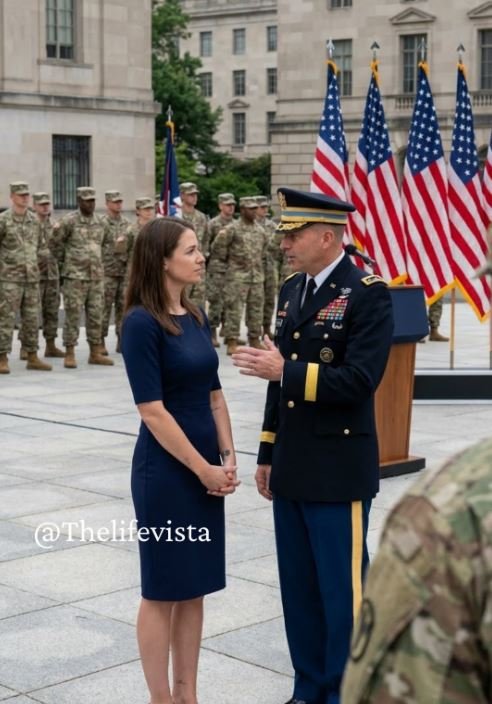
It was a proud mother’s moment: Madison Clarke, sitting in the bleachers at Naval Amphibious Base Coronado, watching her son Logan graduate from the brutal Basic Underwater Demolition/SEAL (BUD/S) training. To everyone there, she looked like any other supportive parent. But when Commander James Rodriguez, a SEAL legend himself, spotted the faded tattoo on her forearm during the ceremony, he stopped his speech mid-sentence. The medical insignia and unit markings were unmistakable. They belonged to “Doc” Harrison, a legendary Navy corpsman whose heroism in Iraq had saved his life and many others.
Commander Rodriguez approached the bleachers, asking Madison to stand. As she did, her sleeve revealed the full tattoo. “Ladies and gentlemen,” he announced to the stunned crowd, “meet Hospital Corpsman First Class Madison Clarke, United States Navy, retired.” He identified her as “Doc Harrison,” a name whispered with reverence in SEAL circles. Her son, Logan, standing in formation, was shocked. He knew his mother was a veteran and a nurse, but not this.
Commander Rodriguez proceeded to share the story of a 2006 ambush in Ramadi, Iraq. Under heavy enemy fire for four hours while wounded herself, Doc Harrison had treated eight critically injured SEALs, saving every life. For this, she had received the Navy Cross, the service’s second-highest award for valor. She had also earned two Purple Hearts and the eternal respect of the special operations community—all while her son grew up knowing only the quiet, hardworking single mother who raised him.
At the commander’s invitation, Madison addressed the new graduates. She spoke not of glory, but of the core ethos: the commitment to the person next to you. Her presence transformed the routine graduation into a profound passing of the torch, linking a new generation of warriors to a quiet hero who had walked the hardest path before them. For Logan, it was the day he truly understood the depth of his mother’s strength and the legacy he now joined.