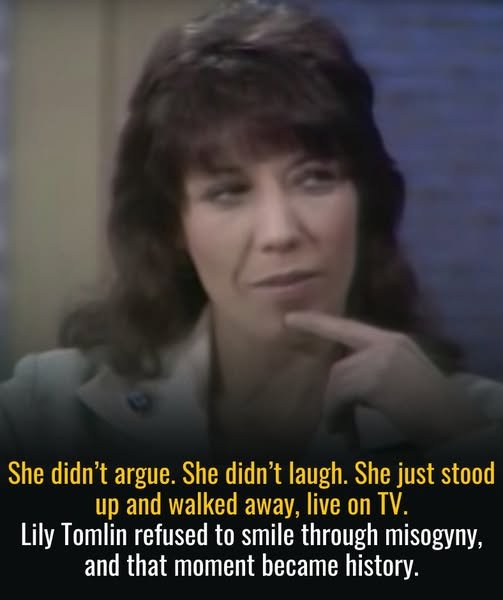
In the history of television, few gestures have been as quietly powerful as the one Lily Tomlin made on a March evening in 1972. Appearing on a popular talk show, she found herself seated next to an actor who, in a moment of casual cruelty, referred to his wife as “the most beautiful animal I own.” The audience shifted uncomfortably, and the host offered a chance to reconsider. But the comment stood, hanging in the air as a stark reminder of the everyday sexism women were expected to politely endure. In that instant, Tomlin faced a choice: to smile and let it pass, or to act. Without a word of protest, she simply stood up and walked off the stage. That silent exit became a roar heard for decades, a perfect example of how principled refusal can be more impactful than any shouted argument.

This moment was not an anomaly but the essence of Tomlin’s career. Born in Detroit, she cultivated a unique comedic voice that saw the world through a lens of both absurdity and acute social awareness. Moving to New York to pursue performance, she worked tirelessly, honing a style that was intellectual, observational, and deeply human. Her breakthrough on Rowan & Martin’s Laugh-In allowed her to introduce America to characters like the snorting telephone operator Ernestine and the philosophical little girl Edith Ann. These were not just gag machines; they were subtle vehicles for commentary, proving that humor could dissect power structures and societal norms while making audiences laugh.

Tomlin’s path was that of a quiet radical. In an era when women in comedy were often sidelined, she carved her own space entirely. She refused to rely on conventional beauty standards or play the supporting role. Instead, she centered her sharp wit and unparalleled character work, earning prestigious awards and headlining projects on her own terms. Her success was a quiet revolution, demonstrating that women could be the main event, that their humor could be both intellectually rigorous and wildly popular, and that they need not conform to a narrow set of expectations to win an audience.
Perhaps her most culturally resonant work came with the 1980 film *9 to 5*, where she starred alongside Jane Fonda and Dolly Parton. The comedy about office workers overthrowing a tyrannical, sexist boss struck a national nerve. Tomlin’s character, Violet, was the capable, frustrated heart of the film, and the movie’s massive success showed that stories about women’s workplace struggles could be both commercially viable and culturally transformative. It used humor as a tool for critique and solidarity, amplifying the conversations of the feminist movement to a mainstream audience and cementing Tomlin’s role as an artist engaged with the world around her.
Decades later, Tomlin would once again defy expectations by co-starring in Grace and Frankie, a groundbreaking series about women in their seventies rebuilding their lives. In her portrayal of the free-spirited Frankie, she challenged the industry’s neglect of older women and proved that creativity and relevance have no expiration date. Lily Tomlin’s legacy, therefore, is a tapestry woven from threads of impeccable comedy and courageous conscience. She taught us that defiance can be silent, that growing older can mean growing more expansive, and that the most powerful statement is sometimes made not by shouting, but by choosing, calmly and definitively, to walk away.