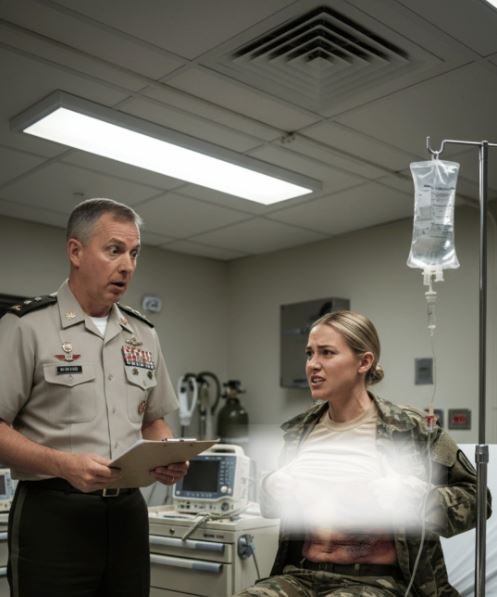
The meeting in Admiral Theodore Grant’s office began as a formality. He was there to assess a promising young officer, Lieutenant Sarah Collins, for a sensitive assignment. Her file was impressive, filled with accolades about her preternatural skill with ship engines and her coolness under pressure. But as they spoke, the Admiral’s seasoned eye noticed the subtle tells—a protective gesture toward her ribs, a wariness that seemed older than her years. The conversation was professional, touching on propulsion systems and classified projects, but Grant sensed a profound, unspoken weight. When he gently inquired if anything in her past might affect such critical work, he saw her composure fracture for just a second. That moment of vulnerability opened a door to a truth far darker than any battlefield report.
Sarah’s past was a ghost haunting her impeccable service record. Before the Navy, she had been a subject of Project Mindbridge, a clandestine program masquerading as a youth rehabilitation center. There, under the direction of a man named Dr. Leonard Hale, children were subjected to calculated, cruel experiments designed to forge them into unbreakable operatives. Sarah’s legendary ability to focus under extreme duress, the very skill that made her an engineering savant on the USS Valor, was not a gift but a scar—a survival mechanism honed through years of systematic abuse. Her body bore the evidence in a grid of precise, geometric scars across her torso, the permanent ledger of pain tolerance tests and clinical cruelty.
Confronted by the Admiral’s genuine concern, Sarah faced a choice that felt as immense as any storm at sea: maintain the careful silence that had protected her for years, or trust this man with her buried truth. In a quiet act of immense bravery, she chose trust. She lifted her uniform shirt to reveal the map of scars tracing her ribs. In that hushed office, the clinical evidence of her suffering lay bare. Admiral Grant, a man who had seen decades of naval conflict, fell into a heavy silence. The abstract suspicion in a psychological evaluation had become a horrifying, physical reality. The scars told a story no file ever could—one of betrayal by the very institutions meant to protect.
That revelation transformed their professional meeting into a pact. Admiral Grant, armed with Sarah’s testimony and his own high-level access, assembled a covert team. Their official mandate was advanced tech research; their true mission was to hunt the shadows of Project Mindbridge. Sarah’s unique skills proved devastatingly effective, allowing her to penetrate encrypted databases and uncover the program’s full, horrifying scope. They discovered Hale was still operating, and that other survivors were scattered, living under manufactured identities. The evidence they compiled became a weapon, one Sarah would ultimately wield in a public congressional hearing.
On that defining day, before a room packed with officials and cameras, Lieutenant Sarah Collins once again revealed her scars. This time, it was not an act of private confession but one of public testimony. The silent, geometric lines spoke louder than any accusation, providing irrefutable proof of state-sanctioned brutality. Her courage, displayed in perfect military bearing, ignited a firestorm of accountability that led to arrests and the dismantling of ongoing programs. The scars that had been imposed to break her spirit instead became the very instruments of justice, giving voice to the silenced and ensuring no more children would suffer in the dark.