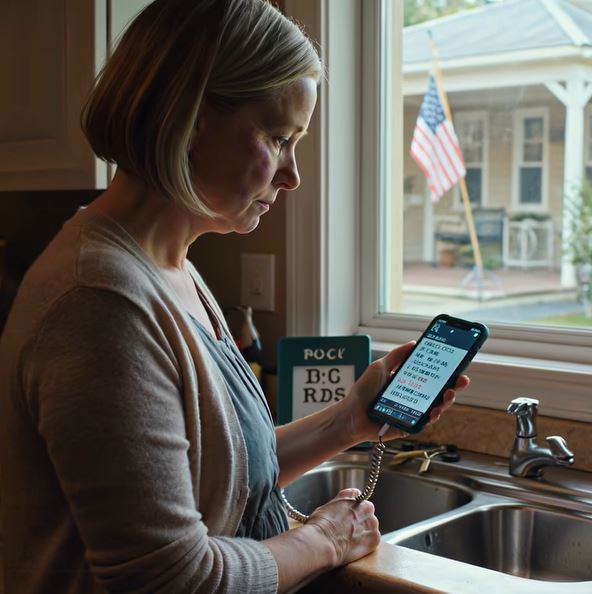
After my daughter told me to “stay away from us,” my only response was a simple, “Okay.” The word was a quiet promise to myself as much as it was a reply to her. I hung up, placed my phone on the kitchen table, and made a different call—the one to my mortgage company. With calm finality, I instructed them to cancel all automatic payments on the house I owned but she lived in. The house I had bought for her family with my pension and savings. The house where, hours earlier, she had shoved me hard enough to send me stumbling to the floor before delivering her ultimatum. I went to bed that night with the phone silenced, a dull ache in my hip and a deeper one in my heart. When I woke in the morning, the screen glowed with the evidence of a panic I had anticipated: thirty missed calls.
It had begun with a request to “talk about the house.” I drove over, hopeful, thinking maybe they were finally ready to discuss taking over the payments. Instead, my daughter Sarah, flanked by her silent husband, presented not a plan for responsibility, but a demand for ownership. She wanted me to sign the deed over to them—a gift of a home worth nearly half a million dollars. When I gently refused, explaining that this asset was my sole security for a fragile retirement, her demeanor shifted from entitled to venomous. My caution was labeled “dramatic.” My lifetime of support was dismissed as “your choice.” The conversation I had envisioned about partnership curdled into a negotiation where I was the obstacle to their comfort.
The true fracture came not from the financial ask, but from the physical one. As I tried to reason, her frustration boiled over. She stepped forward and pushed me—a hard, two-handed shove to the chest. I stumbled back, my hip cracking against the coffee table before I fell to the floor. The shock was more stunning than the pain. Looking up from the hardwood, I saw not my child, but a stranger glaring down, ordering me to get out of her home. That moment, lying on the floor of the property I legally owned and financially sustained, was my clarity. The love that had fueled my sacrifice was being met with contempt, and the bank of mom was permanently closed.
So, I said “okay.” And I meant it. My “okay” was the sound of a boundary being cemented. It was the end of my enabling and the beginning of their consequence. The cancelled mortgage payments were not an act of revenge, but the inevitable outcome of their choice to violently sever the arrangement. They had confused my generosity with weakness, my love with a limitless line of credit. By telling me to stay away, they had, perhaps unintentionally, given me the permission I needed to stop setting myself on fire to keep them warm.
The flurry of calls that lit up my silent phone was the echo of that consequence arriving. It was the sound of a reality check, of a free ride screeching to a halt. My story isn’t about vengeance; it’s about the painful education that sometimes must occur between parent and adult child. It’s about learning that the ultimate act of love can sometimes be to stop giving, and to allow the people we cherish to stand on their own, even if they stumble at first. The silence after my “okay” was the loudest lesson I ever had to teach.