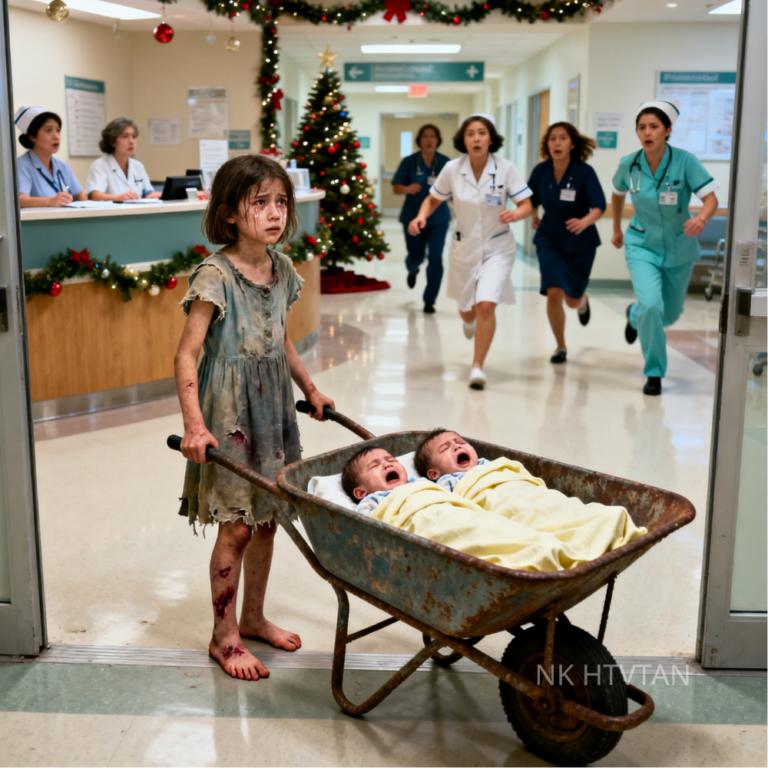
The sight that greeted the hospital receptionist seemed like something from a dream, or a nightmare. A small girl, no more than seven, stumbled through the automatic doors on bare, bloodied feet. In her trembling hands, she pushed a rusted, groaning wheelbarrow across the polished floor. Inside, wrapped in a soiled yellow sheet, lay two newborn infants, still and silent as dolls. “Help,” the girl croaked, her voice raw. “My little brothers… they won’t wake up.” The emergency room, a place accustomed to chaos, fell into a stunned hush. Nurses rushed forward, lifting the cold, limp babies. Their tiny bodies were dangerously chilled, their lives hanging by the faintest thread. When asked where her mother was, the girl, Lily, could only whisper, “My mommy has been sleeping for three days.”
Lily’s own condition told a story of unimaginable ordeal. Her feet were cracked and bleeding from a miles-long walk over rough terrain. Her palms were blistered from gripping the wheelbarrow’s wooden handles. Dehydration had chapped her lips. Yet, in her swollen eyes was a determination far beyond her years. She had followed the only instruction she had: her mother once told her that if anything ever happened, she should go to the hospital for help. So she did, pushing her twin brothers in the only conveyance she could manage, choosing their survival over her own terror and exhaustion. As doctors fought to stabilize the infants, the truth of her mission settled heavily on the staff. This child had undertaken a solitary pilgrimage to save her family.
The police, armed with Lily’s vague description of “the blue house by the tall tree, past the broken bridge,” found a scene of quiet despair. The remote shack was dark and fetid. Inside, on a mattress on the floor, lay Lily’s mother, Carme, unconscious and ghostly pale from a severe postpartum hemorrhage that had gone untreated for days. Beside her were empty bottles and signs of a desperate, losing battle. But they also found a notebook. Its pages, filled with a fading hand, detailed her rapid decline and her agonizing love. “I feel I cannot do more,” one entry read. The final note was a heartbreaking message to Lily, thanking her and telling her to take the babies to safety. Carme had silently suffered, isolated and without recourse, her body failing as her spirit fought to hold on.
Miraculously, against all odds, both chapters of this tragedy turned toward hope. The twins, warmed and rehydrated, survived. Their mother, rushed into emergency surgery and transfusions, also pulled through. When she awoke, her first whispered words were, “My children?” Assured they were all safe, she finally surrendered to relief. The reunion between mother and daughter was wordless, a flood of tears that washed away days of silent fear. Carme’s apology was met with Lily’s fierce, forgiving hug—a child finally able to release the immense burden she had carried.
The story did not end at the hospital doors. It sparked an outpouring of community support, shining a light on the hidden struggles of poverty and the gaps in care for vulnerable mothers. Donations and offers of help arrived, providing the family with a foundation they had never known. Lily, now older, carries the resilience of that journey within her, a quiet strength forged in an impossible moment. Her wheelbarrow, preserved in a local museum, stands not as a relic of sorrow, but as a powerful testament to a love that moved mountains, or at least, pushed a heavy load down a long, dusty road to salvation.