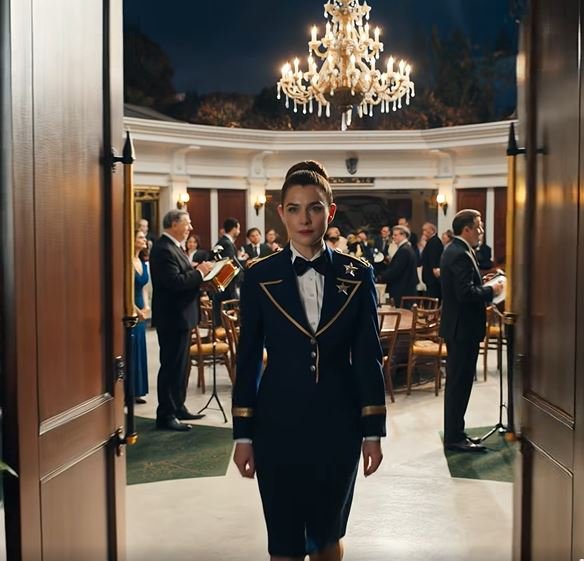
The Grand Dominion Country Club was a temple to old money and older egos, shimmering under crystal chandeliers that seemed designed to highlight every insecurity. I stood apart in my simple black dress, a deliberate wallflower at my father’s diamond jubilee. He was Lieutenant Colonel Victor Ross, retired for twenty years but still wearing his uniform like a second skin, holding court with stories of a faded glory. To him, rank was everything, the sole measure of a person’s worth. My family saw me not as a guest, but as a blemish on their perfect evening. A spilled glass of wine—no accident—soaked my dress and became their excuse to banish me. “Go sit in the parking lot,” my father commanded, his voice a mix of disgust and embarrassment. I was ruining the aesthetic.
I walked out into the cool night, the laughter from the ballroom fading behind me. But I didn’t go to my car to sulk. I went to change. For fifteen years, I’d let them believe I was a lowly government clerk, a paperwork pusher. It was easier than the truth. The truth was waiting in my trunk, folded in a heavy garment bag. It was my Army Blue Mess uniform, the most formal attire a soldier can wear. And on its shoulders weren’t the oak leaves of a lieutenant colonel, but the two silver stars of a Major General.
I changed right there under the moonlight, the weight of the jacket a familiar and powerful anchor. The gold braid, the medal-laden chest, the sharp crease of the trousers—this was no costume. It was the evidence of a career lived in shadows, away from their dismissive gaze. My father worshipped the chain of command. He was about to meet it, face to face. With a calm that precedes decisive action, I turned and walked back toward the glowing windows of the club.
My re-entry stopped the party cold. The music died mid-note as every head turned. The uniform commanded a silence that my presence never had. I descended the stairs, the crowd parting without a word. My father, spotting what he thought was the expected four-star general, began a sycophantic smile. It died on his lips as he recognized my face beneath the stars. His confusion was palpable, then replaced by a dawning, horrifying comprehension. His failed daughter outranked him by three full grades.
The arrival of the actual four-star general, Marcus Sterling, sealed the spectacle. He didn’t greet my father. He walked directly to me and offered a crisp, respectful salute—a public affirmation that shattered their narrative forever. The hierarchy my father revered now demanded he salute his own child. Watching his trembling, humiliated hand rise to his brow was a reckoning decades in the making. I returned the salute with cool detachment and walked out, leaving their perfect party in ruins. The weight of their approval, which I had carried for a lifetime, was finally gone, dropped on that ballroom floor.