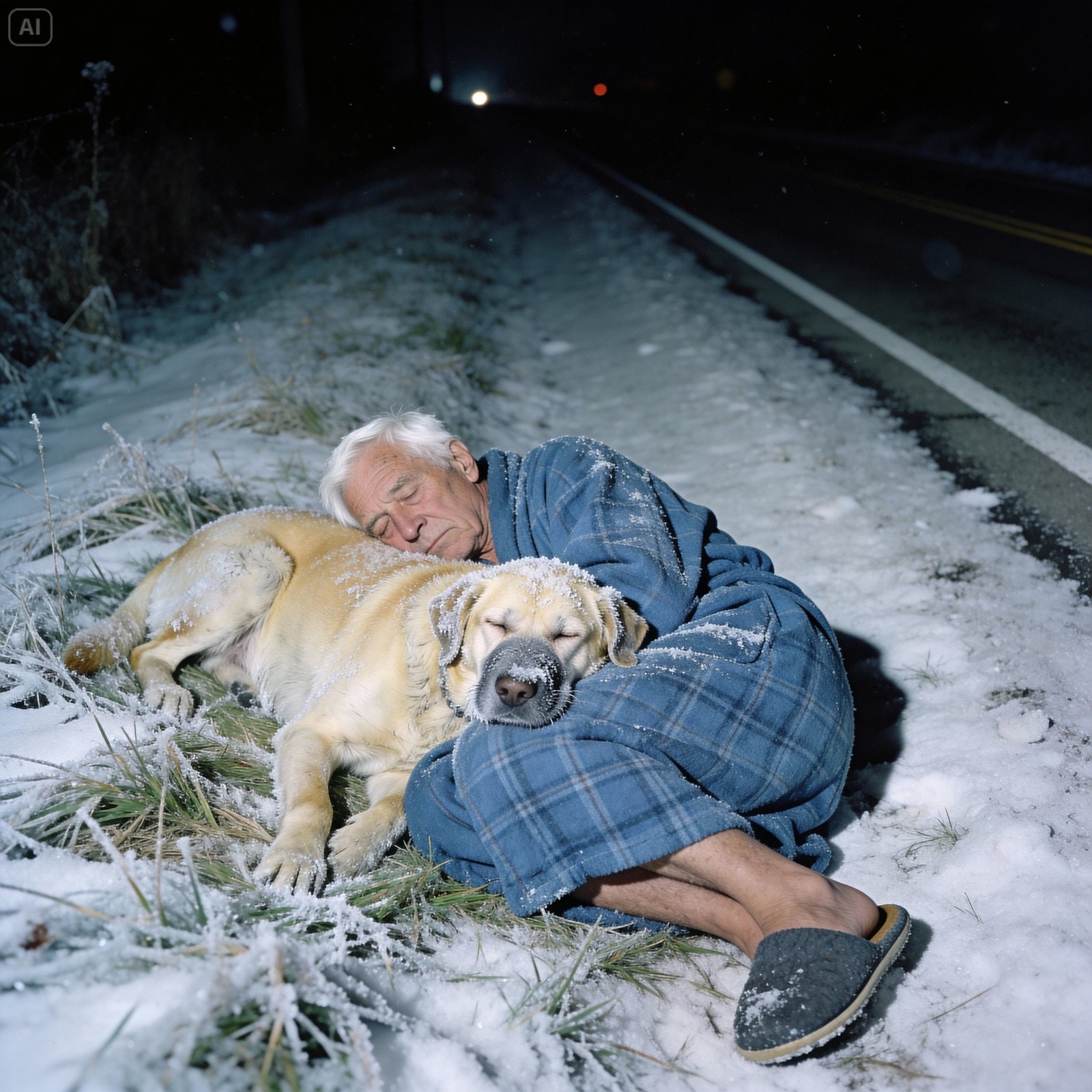
In the deepest cold of a Wisconsin winter, a man with dementia wandered out into the night. His wife, Eleanor, awoke to an empty bed and an open door. Arthur, her husband of fifty years, was gone, and so was Barnaby, their sixteen-year-old yellow Lab. Following their tracks in the snow, Eleanor found a sight that would define love for her forever. Arthur was curled in a frozen ditch, his lips blue. And lying squarely on top of him, using his own body as a living blanket, was Barnaby. The old dog was shivering violently, sacrificing his own warmth to protect his person.
Getting them to safety was a superhuman struggle, but Eleanor managed. At the hospital, doctors were stunned. Given the sub-zero temperatures and exposure time, Arthur’s survival was a medical miracle. When a doctor asked what kind of insulation had kept him alive, Eleanor, holding an empty leash, could only whisper, “It wasn’t a what, Doctor. It was a who.” The truth was both simpler and more profound than any blanket.
Barnaby, exhausted and in shock from giving his all, was rushed to a vet. He had poured his life’s last energy into that ditch. Understanding the bond, Eleanor and a compassionate vet brought the dying dog to Arthur’s hospital room for a final goodbye. Reunited, Arthur, in a moment of clarity, told his old friend, “Shift’s over. You can rest now.” Barnaby passed peacefully, his mission complete.
Weeks later, grieving and exhausted, Eleanor found a notebook in Arthur’s garage. In its pages, written years earlier as his mind began to fade, was a heartbreaking pact. Arthur had sat Barnaby down and given him a job: “Be my brain when I lose mine. Never let me die alone.” Barnaby’s constant shadowing, which Eleanor had sometimes found frustrating, was a loyal soldier following orders. That night in the snow wasn’t an accident; it was a promise kept. The story reminds us that the purest love often speaks without words, and that the greatest heroes sometimes have four legs and a tail.