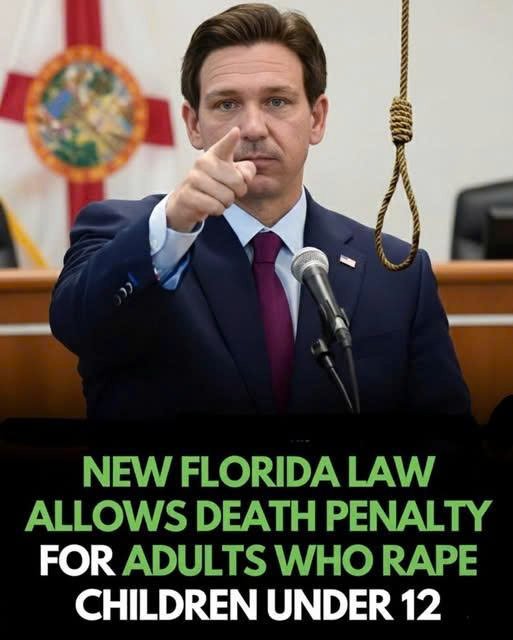
In a move that has sent shockwaves through the American legal landscape, Florida has enacted a law that stands as one of the nation’s most severe child protection measures. The legislation, signed by Governor Ron DeSantis, authorizes the use of the death penalty for adults convicted of sexually assaulting children under the age of twelve, even in cases where the victim does not die. This dramatic escalation places Florida in uncharted territory, directly challenging decades of established legal precedent and igniting a fierce national debate over justice, punishment, and constitutional boundaries.
The law represents a stark departure from the legal norms in all other states. Historically, capital punishment in the United States has been reserved for crimes involving homicide. Florida’s new statute deliberately crosses this line, framing the sexual abuse of young children as a crime of such profound and permanent harm that it warrants the ultimate penalty. Supporters argue this is a necessary moral stand, a reflection of society’s absolute condemnation and a powerful deterrent. They emphasize the lifelong trauma inflicted on victims, contending that existing sentences, even life imprisonment, fail to match the severity of the crime.
However, the law immediately collides with a significant Supreme Court ruling. In the 2008 case Kennedy v. Louisiana, the Court explicitly found that imposing the death penalty for the rape of a child where the victim does not die violates the Eighth Amendment’s prohibition on cruel and unusual punishment. Florida lawmakers are not unaware of this conflict; many openly acknowledge it. This has led critics to view the legislation less as an enforceable statute and more as a political statement or a deliberate attempt to provoke a legal challenge that could eventually bring the issue back before a transformed Supreme Court.
Legal scholars and civil rights organizations warn of serious unintended consequences. A primary concern is that the threat of execution could deter victims and their families from reporting abuse, especially in cases where the perpetrator is a family member. The fear of triggering a death sentence might silence victims, ultimately leaving children in danger. Furthermore, capital cases are fraught with risk, including the potential for wrongful convictions. Expanding the death penalty into this emotionally charged arena, critics argue, increases the chance of an irreversible mistake based on complex and difficult testimony from traumatized children.
As legal challenges mount and courts are expected to block the law’s enforcement, its most immediate impact may be symbolic. It has forcefully reopened a painful national conversation about how to protect children, balance retribution with justice, and define the limits of state power. Whether it ultimately changes legal precedent remains to be seen, but it has undeniably solidified Florida’s position at the forefront of a contentious and deeply emotional national debate over crime, punishment, and the values that shape our justice system.