When I was fifteen, my father pushed me out the front door into a howling October storm. He didn’t just ask me to leave; he yelled it with a finality that shattered my world. “Get out of my house. I don’t need a sick daughter,” he said. His words were a lie fed to him by my older sister, but in that moment, they were his absolute truth. I stood on the porch, the rain soaking through my clothes in seconds, with nothing but a school backpack. I had no coat, no phone, no money. The door shut, the lock clicked, and I was alone in the gale. Three hours later, the police called him. By the time he answered that call and learned what had happened to me, his face went pale as a ghost. But the damage was already done, irreversible.
That night is etched into my memory with perfect, painful clarity. I had come home from school an ordinary teenager, thinking about homework and weekend plans. The air inside was thick with a tension I didn’t understand. My father stood there, shaking with rage, holding cash and empty pill bottles I’d never seen. My sister, Karen, stood behind him wearing a mask of perfect, devastated concern. She had spent the day weaving a story about me—that I was a thief, a drug user, a problem he needed to remove. He believed every word without question. My explanations died in the freezing air as he dragged me to the door and expelled me from his life.
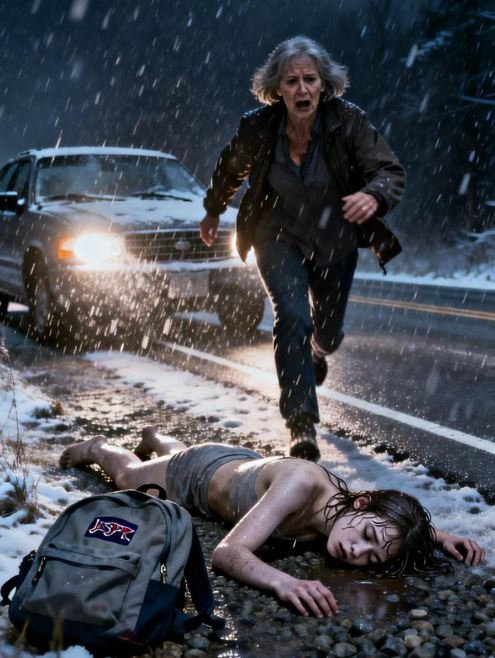
What followed was a seven-mile walk of pure survival. My grandmother’s house was my only haven, but getting there meant trudging down a dark, flooded highway in canvas sneakers. The cold seeped into my bones, and the rain felt like needles. Cars sped past, their drivers oblivious to the shivering girl on the shoulder. Hypothermia is a quiet, deceptive killer; it makes you want to stop, to rest, to just close your eyes for a moment. I fought that urge until my body gave out, collapsing against a mailbox miles from safety. I don’t remember the fall, just the grey nothingness that followed.
My salvation came from a stranger. A retired social worker named Gloria found me, a heap of wet denim in the storm’s path. She wrapped me in a thermal blanket, called for help, and followed the ambulance to the hospital. She became my first defender. When my father and sister arrived, expecting to find a disgraced child, they walked into a different scene. I was surrounded by Gloria, a police officer, a current caseworker, and my grandmother, who had raced there with fire in her eyes. My grandmother, a force of nature herself, placed herself between me and my father and declared the war over. I was leaving with her.
The investigation that unfolded exposed the cruel architecture of my sister’s lie. It was all for money—my inheritance from our late mother. The evidence, from ATM footage to pharmacy records, proved her guilt and my innocence in stark detail. In court, the truth stripped away every pretense. My father was condemned for his blind cruelty, my sister for her calculated malice. I left the courthouse with my grandmother, stepping into a new life she built for me with love and fierce protection. The man who threw me out and the sister who orchestrated it were left in the past, where they belonged.