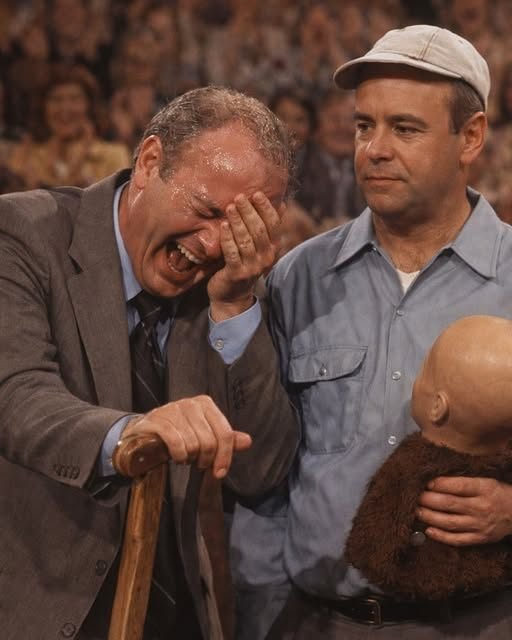
The very best moments in comedy often happen when everything goes perfectly according to plan—except, of course, when they don’t. For Harvey Korman and Tim Conway, legendary stars of The Carol Burnett Show, the secret ingredient to their genius was a delightful refusal to stick to the script. Their partnership was built on a foundation of masterful skill, but it was brought to life by spontaneous chaos. Korman, the impeccable straight man with flawless timing, was the perfect, steady anchor for Conway, the gleeful agent of comedic anarchy who treated rehearsed sketches as mere suggestions. Together, they didn’t just perform comedy; they invented it live, in the moment, to the helpless delight of audiences.
Their dynamic was a high-wire act of trust and talent. Harvey Korman once said the most terrifying part of working with Conway was that he never did what was rehearsed. Conway would arrive at a taping with a new, absurd line or an inexplicable piece of business that defied all logic. Korman’s job, then, was not just to act, but to survive—to process the unexpected while staying in character, often resulting in a visible struggle that was funnier than any written joke. The audience wasn’t just watching a sketch; they were witnessing the genuine, unrepeatable reaction of one comedic master being ambushed by another.
Some of the most iconic bits in television history sprung from these unscripted moments. In famous sketches like the dentist office or the old man shuffling across a living room, Conway’s improvisations—a mumbled aside, an impossibly slow movement—would detonate the scene. The camera would often cut to Korman, whose face would flicker from professional focus to bewildered disbelief before dissolving into uncontrollable, shoulder-shaking laughter. These weren’t breaks in character; they became the character, a meta-performance about the joy of surprise itself.
This approach required immense mutual respect. Korman had to have complete faith that Conway’s chaos would lead to comedy gold, not just a derailed sketch. Conway, in turn, relied on Korman’s rock-solid technique to ground his wildest flights of fancy. Their partnership was a symbiotic comedy engine: Conway provided the unpredictable spark, and Korman provided the structure that made the explosion so brilliantly contained and hilarious. It was a dance where one partner kept inventing new steps, and the other had to follow instantly, seamlessly.
The legacy of Korman and Conway is a testament to the power of playful spontaneity. In an age of tightly controlled television, they proved that the magic of live performance—the risk, the surprise, the genuine human reaction—was the most valuable commodity of all. They left behind not just a collection of funny sketches, but a masterclass in partnership, reminding us that the loudest laughter often comes from the place we least expect.