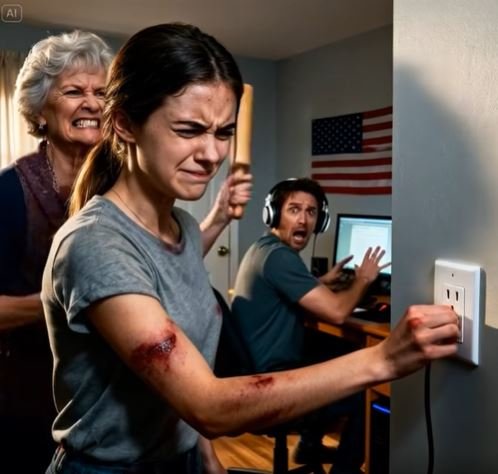
Life in the small apartment had settled into a tense, predictable rhythm. That afternoon, the rhythm shattered. Emily’s husband, Mark, was lost in his computer world, headphones sealing him in silence. Just feet away, a very different scene unfolded. Her mother-in-law, Patricia, advanced with a rolling pin, her face contorted in rage. The first strike against Emily’s arm was a shocking, solid pain. “That’s what you get for not taking out the trash!” Patricia yelled, swinging again. Emily raised her arms to shield herself, backing into the kitchen counter. She knew arguing would only fuel the fire, so she endured, waiting for the storm to pass.
The assault felt endless, but eventually, Patricia’s anger spent itself. She stood there, breathing heavily, the rolling pin now hanging loosely at her side. Emily, her body throbbing, felt an eerie calm wash over her. Reacting with emotion had never worked. Instead, she needed a different kind of language, one that someone in the room might finally understand. Slowly, deliberately, she pushed off the counter and walked toward the wall. Her target was simple: the power outlet feeding Mark’s entire computer setup.
Patricia’s eyes followed her, and understanding dawned instantly. Her panic was immediate and visceral. “No, don’t… not that…” she screamed, her terror no longer directed at Emily but at the threat to her son’s prized electronics. That shrill cry was the key that finally unlocked Mark’s attention. He pulled off one headphone, turning just in time to see his wife standing by the wall and his mother frozen in fear. The room fell into a strained silence, heavy with the unspoken violence of the past few minutes.
Mark’s confused “What’s going on?” was met with competing truths. Patricia accused Emily of trying to sabotage his computer. Emily simply showed the darkening bruises on her arm and stated the fact: “She hit me. Repeatedly.” Mark stared, processing the collision of these two realities. His mother had always been difficult, but this was a line he never imagined she would cross. His hesitation spoke volumes about the denial he had been living in. Emily looked at him and understood a painful truth: his ignorance was a choice. He hadn’t known because he hadn’t wanted to know.
In the end, Emily announced she was leaving for the night. She needed space, and they needed to decide what kind of home this would be. As she walked out into the cooling evening air, she felt a profound shift. The act of nearly unplugging his world had, in a way, plugged her back into her own agency. She didn’t have all the answers about the future, but she had taken the first, crucial step of changing the narrative. The silence she left behind was no longer oppressive; it was charged with a reckoning that could no longer be avoided.

