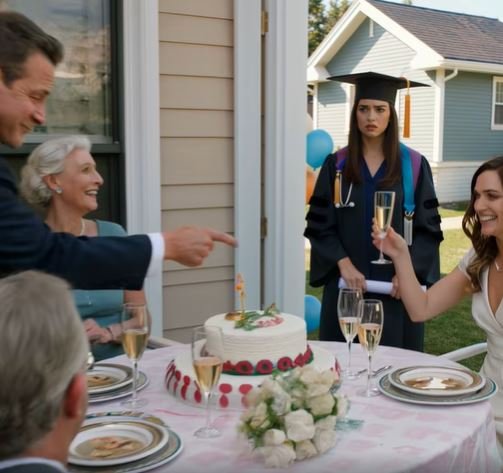
I had reserved twelve seats. On the morning I was to become a doctor, I stood outside the auditorium in my regalia, calling each of those twelve people. The phone just rang. By the time I walked across the stage, the hollow echo of my own footsteps had already begun to tell me a story I’d refused to hear for twenty-six years. The polite applause from strangers was my only fanfare. My name was Meredith Callaway, and I graduated alone.
The explanation, when I finally drove to my parents’ house, was a scene of brutal clarity. Every car I’d expected at the ceremony was in the driveway. In the backyard, my entire family was toasting my younger sister’s surprise engagement. Streamers, champagne, a cake. I stood at the edge of the patio in my doctoral hood, a costume at the wrong party. My mother’s greeting was a masterpiece of deflection. “You’re here! Come celebrate! Paige is getting married.” When I stated the obvious—“My graduation was today”—she waved it away. Paige had needed them. The ceremony would have been boring. I was always so independent.
In that moment, the final veil lifted. This wasn’t a one-time oversight; it was the definitive act in a lifelong pattern. I was the reliable one, the high achiever, the daughter whose needs were perpetually quiet enough to ignore. Paige was the emergency, the drama, the sun around which our family orbited. My achievements were silent landmarks they passed without seeing. Standing there, the physical weight of my degree around my neck, I finally understood. I had spent my life begging for scraps from a table where I was never meant to be a guest.
I said very little. I turned, walked to my car, and drove away. The next morning, I began the process of erasing Meredith Callaway. The legal name change was a mundane bureaucratic act, but it felt like a baptism. I chose Walker. I would walk away. I moved to Boston for my residency, changed my number, and vanished. The silence from my family lasted for months, until the messages began—not apologies, but demands for me to stop causing drama and apologize. They were searching for the daughter who had accepted neglect, not the woman who had left.
Years later, a letter from my father, delivered posthumously, acknowledged what he’d lacked the courage to say in life: he saw the imbalance, he felt the guilt, but he chose peace over me. It wasn’t enough, but it was an echo. I built a full life—a career, a marriage, a daughter of my own—on a simple, hard-won principle: family is defined by who shows up. The empty seats that day didn’t break me. They showed me the door. And walking through it was the first, and best, decision of my life.

