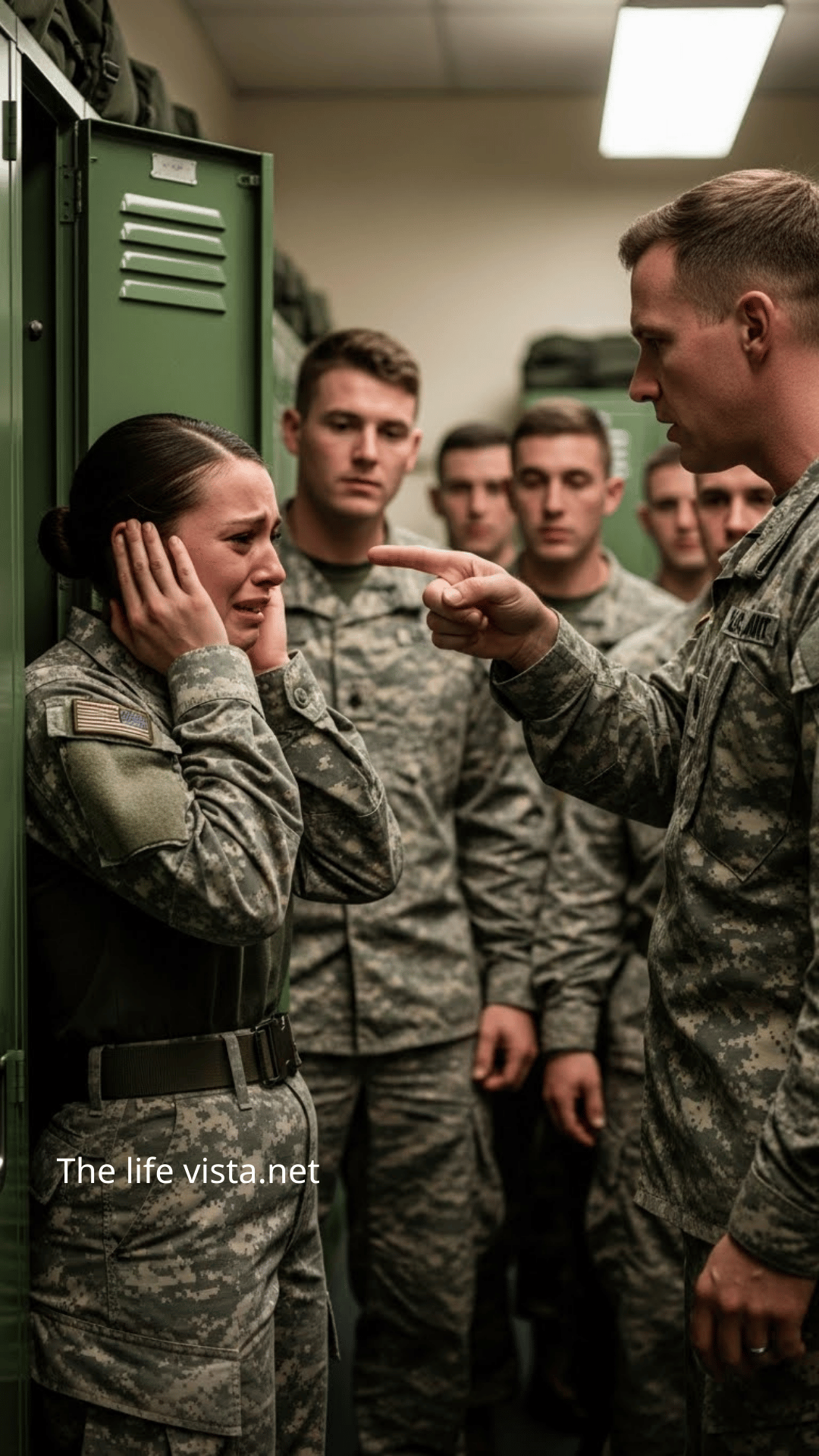
The bustling military mess hall was a world of its own, a sea of uniforms and controlled noise. Abigail Carter moved through it quietly, a civilian contractor focused on getting a meal. Her path was blocked by three sailors, their leader, Petty Officer Matthews, radiating a cocky disdain. What began as verbal harassment—demanding her ID and mocking her clearance—escalated when he snatched the card from her hand and grabbed her arm. To him, she was just another outsider to intimidate. To the room, it was an ugly spectacle of bullying. Abigail, however, remained unnervingly calm, her posture steady and her gaze analytical, assessing the situation not as a victim, but as a trained professional.
Across the hall, Gunnery Sergeant Miller watched the scene with growing disgust. The sailors’ behavior was a disgrace, but it was a common enough brand of foolishness. Then he saw it: a small, unassuming ribbon pinned to Abigail’s bag—the tricolor stripe of a Combat Action Ribbon, an award earned only in direct engagement with the enemy. His blood ran cold, then hot. A name from a legendary after-action report surfaced: Sergeant Abigail “Dozer” Carter, a combat engineer whose valor under fire was the stuff of barracks legend. This was no ordinary civilian. With a single, deliberate motion, Miller set down his fork and stood up. The Marines at his table followed, then, like a silent wave, every Marine in the hall rose to their feet, their collective gaze a wall of silent, formidable judgment.
Before Matthews could process the sea of standing camouflage, the main doors burst open. Major Phillips, alerted by a rapid text from Miller, strode in with a master sergeant at his flank. He ignored the sailors completely, walking directly to Abigail and snapping into a perfect, reverent salute. “Sergeant Carter,” he declared, his voice cutting the silence. He then turned his fury on Matthews, detailing Abigail’s heroic service—the ambush she’d suppressed while wounded, the lives she’d saved. The petty officer’s arrogance crumbled into ash under the weight of the truth. The sailors were escorted out to face the consequences of their actions, their careers effectively over.
In the days that followed, the base instituted mandatory conduct training. A week later, a humbled Matthews approached Abigail in the exchange. Stripped of his bravado, he offered a stammering, genuine apology. Abigail accepted it not with vengeance, but with a charge: to stop others from making the same mistake. The story became a quiet legend, a reminder that respect isn’t demanded by a uniform, but earned by character and sacrifice. The true lesson wasn’t about punishing a bully, but about recognizing that heroes often wear the most unassuming faces, and that integrity, once awakened in a group, is the most powerful force in any room.