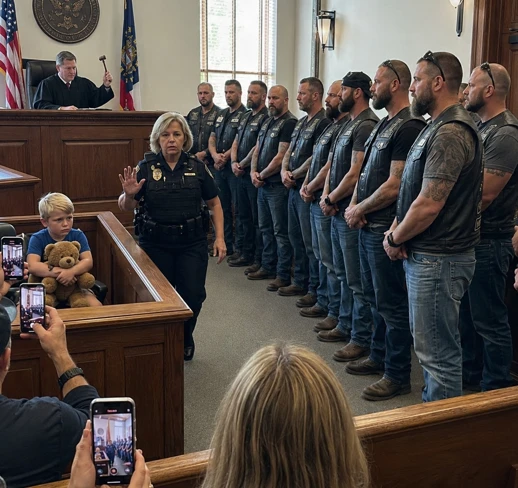
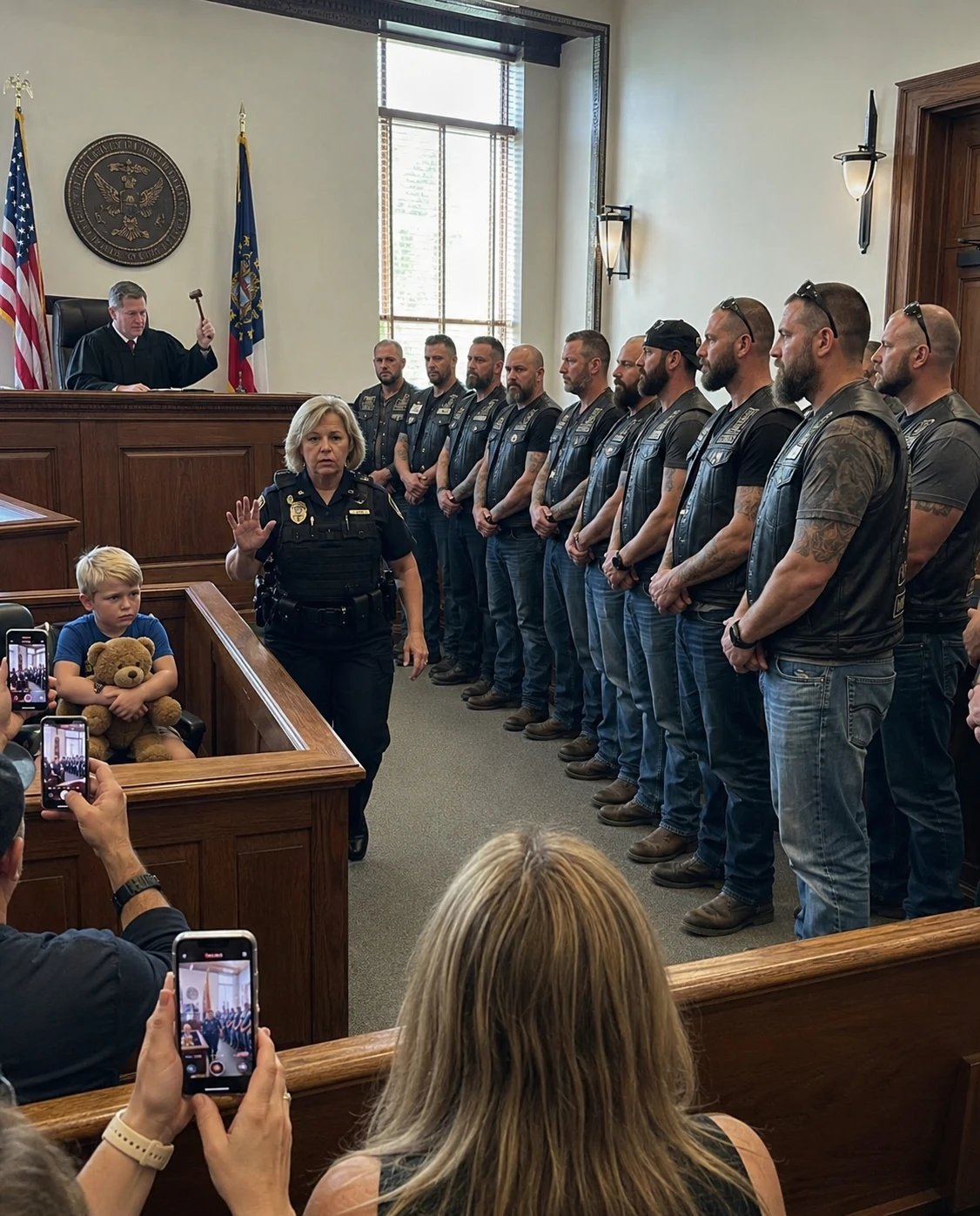
They rose in unison and turned their backs to the judge—leather vests facing the bench, chains clinking softly—while a frightened child clutched a teddy bear on the witness stand. Why would they do that?
It was 10:12 a.m. on a gray Tuesday in Franklin County Courthouse, Ohio. Fluorescent lights hummed overhead. The air smelled faintly of old wood polish and burnt coffee drifting from a vending machine down the hall.
Courtroom 3B was packed.
Local reporters. Social workers. A few law students scribbling notes. Parents holding tissues too tightly. The kind of crowd that gathers when a case is too heavy to ignore.
At the center sat a small boy in an oversized sweater, sneakers not touching the floor. Eight years old. Pale. Quiet. A stuffed brown bear tucked under his arm like armor.
He wasn’t supposed to be brave today.
He was supposed to be heard.
Across the aisle, the defendant stared at the table—jaw tight, eyes hollow, suit too stiff on his shoulders. The charges were read in a voice that tried to stay neutral and failed.
The boy flinched at every word.
Behind him, his foster mother whispered reassurance that sounded thinner each time. A victim advocate knelt nearby, soft voice, steady presence.
Still, the room felt too large for someone so small.
A cough echoed. Papers shuffled. Someone’s chair creaked too loud.
And then the doors opened.
Heads turned.
Bootsteps.
Measured. Heavy. In sync.
One man entered first. Tall. Broad. Sleeveless leather vest. Arms marked by faded ink. Beard threaded with gray. Expression unreadable.
Then another.
And another.
Until a line formed along the back wall.
Fifteen bikers.
No talking. No gestures. Just presence.
The bailiff frowned. A reporter leaned sideways for a better angle. A woman near the aisle whispered, “Oh no…”
The judge glanced up briefly, irritation flickering.
Motorcycle jackets didn’t belong in child abuse hearings.
Or so it seemed.
The boy noticed them last.
His fingers tightened around the teddy bear.
Fear doesn’t care about context.
It reacts to silhouettes.
The bikers stood still, eyes forward, hands folded low. Not defiant. Not friendly.
Just there.
And when the prosecutor began describing the evidence—
Every biker slowly stood.
Chairs scraped the floor in a jagged chorus.
Then, without a word—
They turned their backs on the courtroom.
Gasps rippled.
A reporter muttered, “Unbelievable.”
Someone hissed, “Show some respect!”
But the bikers didn’t move.
Didn’t look back.
Didn’t explain.
They simply faced the doors—
Like they refused to watch what was happening inside.
The reaction was immediate.
“Sit down!” the bailiff barked.
“Order!” the judge snapped, gavel striking wood with sharp authority.
But the line of bikers remained still—backs to the bench, shoulders squared, heads slightly bowed.
To most eyes, it looked like protest.
Or contempt.
Or worse—mockery.
A journalist whispered, “They’re making a statement.”
Another said, “This is intimidation.”
Phones shifted. Pens moved faster. Assumptions formed instantly.
The foster mother’s face tightened. “Why would they do this now?” she murmured.
The little boy turned halfway in his seat, confused. Watching the backs of strangers instead of the people meant to protect him.
Security moved toward the wall.
Hands hovered near belts.
“Gentlemen,” the bailiff warned, “you will face the court.”
No response.
One biker—older, thicker build, vest worn soft with age—slightly adjusted his stance so his shadow no longer fell across the child.
A small move.
Easily missed.
The judge’s patience thinned. “You are disrupting proceedings.”
Still nothing.
No raised voices. No gestures. No signs.
Just quiet refusal wrapped in discipline.
That silence unsettled the room more than shouting would have.
Because anger is loud.
Conviction is not.
A woman in the gallery leaned toward her neighbor. “They must be supporting the defendant.”
Another shook her head. “Or trying to pressure the jury.”
The defendant finally glanced back.
His expression changed.
Not relief.
Not pride.
Something closer to dread.
One biker reached slowly into his vest pocket.
Security stiffened.
“Hands visible!” a deputy ordered.
The biker paused—then pulled out a folded pair of reading glasses. Nothing more. He slipped them on calmly.
Tension didn’t drop.
It shifted.
The judge exhaled sharply. “Remove them if they refuse to comply.”
The bailiff stepped forward. “Sir, you need to turn around.”
The lead biker—taller, graying beard, steady posture—tilted his head slightly but did not face the bench.
“We’re not disrupting,” he said quietly.
To some, it sounded defiant.
To others, rehearsed.
The bailiff frowned. “Then what do you call this?”
A pause.
Long enough for discomfort to grow.
“We won’t watch,” the biker replied.
Murmurs surged.
The phrase landed wrong.
Like condemnation of the court.
Like disrespect for the law.
The judge leaned forward. “This is a courtroom, not a theater.”
The biker didn’t respond.
He stood there—still as stone—while the prosecutor continued reading statements no one wanted to hear.
The boy’s shoulders trembled.
A juror wiped tears.
The room carried the weight of something too heavy for protocol.
And the bikers—
Still turned away.
Still silent.
Still refusing to witness.
Outside, distant thunder rolled across the city.
Inside, tension pressed against every wall.
And no one yet understood
why the men in leather
would not look.