The message was short.
Sent without urgency.
Delivered like a quiet signal placed into a wider system.
Daniel slipped the phone back into his vest and returned his hands to his sides. No dramatic stance. No attempt to command attention. He simply stood facing the river, boots planted on damp concrete, shoulders squared against the cold.
Behind him, murmurs thickened.
Speculation feeds on silence.
And Daniel gave them plenty.
A mother pulled her daughter closer. A man crossed his arms tighter across his chest. The reporter lowered her voice but not her microphone.
“What’s he waiting for?” someone whispered.
The officers exchanged a look. Not hostile. Not friendly. Just trained caution.
“Sir,” one said evenly, “we can’t have you lingering at an active scene.”
Daniel nodded once. “Understood.”
But he didn’t move.
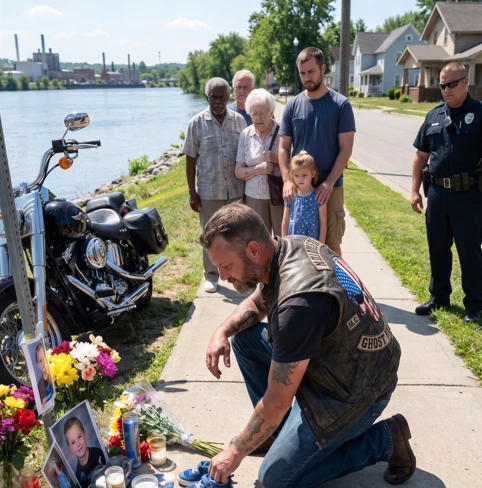
The river slid past in a slow, indifferent current. Sunlight strained through thinning clouds, catching the surface in fractured silver. The memorial fluttered gently—ribbons, flowers, photos trembling in the breeze like memories trying to stay visible.
Daniel’s eyes stayed on the water.
Not defensive.
Not confrontational.
Just present.
And that presence, steady and unmoving, began to feel like resistance.
“Are you refusing to comply?” the second officer asked.
“No, sir,” Daniel said calmly. “Just waiting.”
“For what?”
A pause.
The kind that forces people to project their own answers.
“You’ll see.”
Not a threat.
Not a promise.
Just a sentence spoken with quiet certainty.
A man in the crowd scoffed. “That’s not how this works.”
Another muttered, “Always something with these guys.”
Leather. Tattoos. A motorcycle parked alone.
To many, that was already enough context.
The first officer exhaled slowly. “Sir, if you’re involved in this situation in any way, now’s the time to say it.”
Daniel’s jaw tightened, then released.
“I was there,” he said.
The words landed heavier than volume.
“Where?” the officer asked.
Daniel looked toward the bend in the river—where currents deepened and rocks vanished under dark water.
“Downstream. When it happened.”
A few heads turned. A murmur rippled outward.
“Then you need to come with us,” the officer said.
Daniel nodded again. No protest.
But before he stepped forward, he glanced once more at the small blue shoes resting by the memorial.
Wind tugged the laces gently.
He held that image for a moment—a still frame in a day moving too fast.
Then, faintly at first, a vibration rolled through the pavement.
Low. Distant. Familiar.
Daniel didn’t smile.
Didn’t straighten.
Didn’t react at all.
But the officers noticed.
“So did the crowd.
Engines.
More than one.
Approaching in measured rhythm.
And the waiting—already tense—tightened into something sharper.
The engines didn’t roar.
They arrived like weather.
Gradual. Layered. Inevitable.
Heads turned toward Riverside Drive as a line of motorcycles eased into view, chrome catching pale daylight in brief flashes. No revving. No aggressive throttle. Just a disciplined procession moving with quiet intention.
One bike became five.
Five became twelve.
Twelve became a column stretching beyond the bend.
The crowd shifted instinctively. Some stepping back. Others lifting phones higher. A few retreating toward parked cars as if distance could simplify what they were seeing.
The officers stiffened—but didn’t reach for their belts.
This wasn’t chaos.
It was order.
The riders pulled in along the curb with precise spacing, engines cutting almost in unison. Helmets came off. Tucked beneath arms. Faces calm. Eyes forward.
No one spoke.
They didn’t surround Daniel.
Didn’t crowd the memorial.
Didn’t challenge authority.
They simply formed a line behind him.
Shoulder to shoulder.
Boot to pavement.
A wall of quiet solidarity.
The first officer glanced at Daniel. “You call them?”
Daniel answered plainly. “Yes, sir.”
“For what purpose?”
Daniel’s gaze stayed on the river. “Witnesses.”
The word shifted the air.
Not defense.
Not intimidation.
Witnesses.
A middle-aged rider stepped forward slightly—salt-and-pepper beard, denim shirt under his vest, hands visible.
“We were riding the east route,” he said evenly. “Heard the splash. We stopped.”
Another rider nodded. “He went in first.”
Phones lowered.
Conversations thinned.
A reporter blinked, recalibrating her script mid-sentence.
The officer’s voice softened. “Went in?”
Daniel didn’t turn. “Current was stronger than it looked.”
The second rider continued. “Kid was already drifting. Daniel reached him before any of us.”
A woman near the front covered her mouth.
“He held the boy up,” the rider said. “Yelling for a rope. For anything.”
Wind carried the river’s hush across the pavement.
No one moved.
No one interrupted.
The officer asked quietly, “Were you trained?”
Daniel shook his head. “No, sir.”
“Then why jump?”
A long pause.
Because some questions don’t have short answers.
“Because he was a kid.”
Nothing heroic in the tone. No performance. Just a fact placed gently in the open.
Another rider spoke. “Paramedics took over. Daniel stayed until they called it.”
Silence widened.
The officer looked toward the memorial. The shoes. The photo of the smiling boy.
“And the shoes?” he asked.
Daniel finally turned.
Eyes tired. Voice steady.
“His were lost in the water.”
The sentence fell softly—but landed everywhere.
A mother exhaled shakily. The man in the baseball cap removed it. The reporter lowered her mic.
Perspective tilted.
What had looked suspicious now felt sacred.
What had felt intrusive now felt necessary.
No announcement marked the change.
But everyone felt it.
Judgment loosening its grip.
And Daniel—still standing where he’d been all along—didn’t step forward to claim anything.
He just looked at the river.
Like he was still listening for a splash that had already faded.