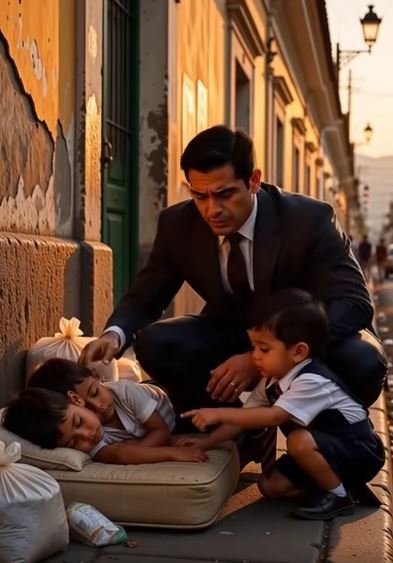
Eduardo Fernández’s life was a monument to controlled success. A sprawling mansion, a thriving business, and a single son, Pedro, were the pillars of his carefully constructed world. That world shattered during an unplanned detour, not by a financial crash, but by a small, compassionate act from his five-year-old.
Pedro stopped, tugging his father’s hand. “Look, Dad.” There, nestled in a pile of discarded refuse, two small children slept on a filthy mattress. While Eduardo’s instinct was to hurry past, Pedro knelt, his small hand reaching out to gently wake them.
The boy who opened his eyes had hair the color of roasted chestnuts. But it was his eyes—a shade of warm honey—that stole the breath from Eduardo’s lungs. They were his own eyes. They were Pedro’s eyes.
A dizzying sense of impossible recognition took hold. The children, Miguel and Daniel, were five. The same age as Pedro. As they spoke—of a mother named Lucía who had passed, of a father who was a rich man who would never look for them—the devastating puzzle clicked into place. Lucía had been his secretary. A brief, regretful affair six years prior, buried under guilt and a generous severance package. He never knew she was pregnant. He never knew she’d given birth to twins.
In that grimy alley, the billionaire’s polished existence crumbled. The man who negotiated million-dollar deals was rendered speechless by two simple questions: “Do you have food?” and “Are you going to feed us every day?” Their needs were so basic, their hope so fragile, it exposed the hollow luxury of his life.
What followed was not a simple rescue mission, but a profound reconstruction. Eduardo brought Miguel and Daniel home, ignoring the outrage of his family and the scandalized whispers of his circle. The real work began in the quiet moments: treating their malnutrition, soothing their nightmares, patiently earning their trust. They hoarded bread under their beds, terrified the abundance would vanish. Pedro became their bridge, accepting them as brothers with an uncomplicated love that shamed the adults’ reservations.
Eduardo’s transformation was internal. He sold assets not for expansion, but to fund a foundation for street children. He learned to make breakfast, valuing the chaotic morning table over solitary power lunches. Society called him a hypocrite, but he was no longer listening to that audience. The only opinions that mattered were those of the three boys calling him “Dad.”
The most piercing lesson came from Miguel himself, years later. “Why did you save us?” he asked. “There were so many children. Why us?” Eduardo’s honest answer was painful: “Because your brother made me see you. And when I saw you, I saw myself. I don’t know if I would have stopped for a child who didn’t look like me. That’s my failure to live with.”
This story isn’t about a wealthy man’s redemption. It’s a stark reminder that family is not a title you are given, but a commitment you choose every day. Eduardo’s greatest fortune was no longer his wealth, but the devastating, beautiful detour that taught him to see. In saving the sons he never knew, he was ultimately saved from a life of profound, unrecognized poverty.