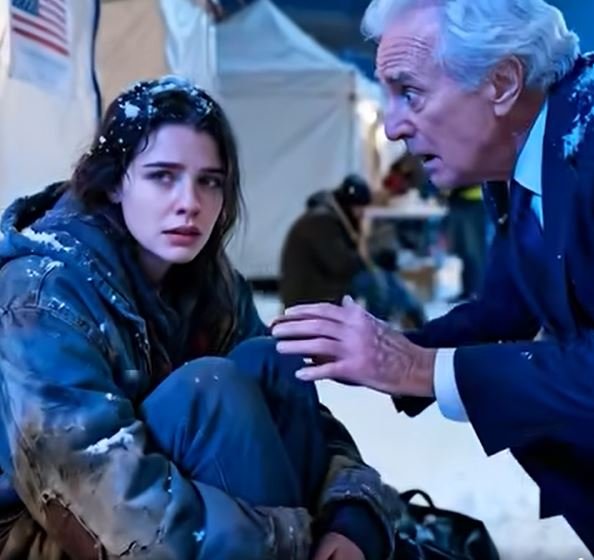
The winter donation tent smelled of hope and desperation in equal measure—steaming broth, damp wool, and the sterile scent of hand sanitizer. I sat huddled on a folding chair, cradling a paper cup of soup, trying to blend into the crowd of faces marked by hardship. That’s when I saw him. My grandfather, Philip, moving through the volunteers with a box of coats, his sturdy frame and work boots as familiar as home. When his eyes met mine, the box slipped from his arms. Coats spilled across the floor, and his voice, thick with disbelief, cut through the hum of the tent: “Where did my apartment and my one million dollars go?”
In that moment, the carefully constructed wall between my two lives crumbled. The life I was supposed to have—one of stability, secured by a trust fund and a downtown apartment my grandfather set up for me—and the life I was actually living, rotating through shelters and warming centers in an Indianapolis winter. The question hung in the heated air, and every pair of eyes turned to me. I was no longer just another person seeking warmth; I was a walking scandal, a mystery wrapped in a donated coat. The shame was instant and searing.
The story began six months earlier, on my twenty-fifth birthday. That was the day I was supposed to inherit the future my grandfather had meticulously planned. Instead, a phone call to the bank revealed a devastating truth: the trust was nearly empty, drained by “authorized withdrawals.” The associated apartment was in foreclosure. The authorized parties were my parents, Brian and Cynthia, the co-trustees. When I confronted them, I was met with evasion, then weak justifications about their own financial hardships. They spoke of “family loyalty” while my own loyalty to survival led me to a friend’s couch, then to emergency shelters when I overstayed my welcome.
Navigating the system was a crash course in humility. I learned the schedules of soup kitchens, the best times to secure a bed, and how to layer clothing from donation bins against the Midwest cold. I took temporary jobs that paid in cash, my life reduced to a series of logistical calculations. But amidst the struggle, a cold clarity formed. With the help of my best friend, Pamela, I gathered evidence—bank statements, foreclosure notices, a paper trail of my parents’ choices. The betrayal wasn’t a single mistake; it was a sustained campaign, with my future funding their comfort.
The confrontation at my parents’ suburban home was a study in polite devastation. Sitting at their familiar kitchen table, I laid out the documents. Their denials wilted under the evidence, morphing into a defense of “temporary” borrowing and misplaced good intentions. They asked for family loyalty while demonstrating none. Walking away, I knew the only person who could enact real change was the one who had created the trust in the first place. And so, in a twist of fate, my path to justice led me to a winter aid tent, where my grandfather found the granddaughter he thought he had protected living the very nightmare he sought to prevent.
What followed was a legal and emotional reckoning. My grandfather, with a quiet, ferocious resolve, engaged a lawyer. The court case was not about revenge, but about naming a wrong. The judge’s ruling was unequivocal: a breach of fiduciary duty. My parents were ordered to repay what was taken. The victory was hollow in many ways; it couldn’t restore the lost months or the shattered trust. But it restored something fundamental: my agency. Today, I am rebuilding. The experience taught me that family is not a title that excuses harm, but a bond defined by action. And sometimes, the bravest action is to hold accountable those who forgot the meaning of the word “trust.”