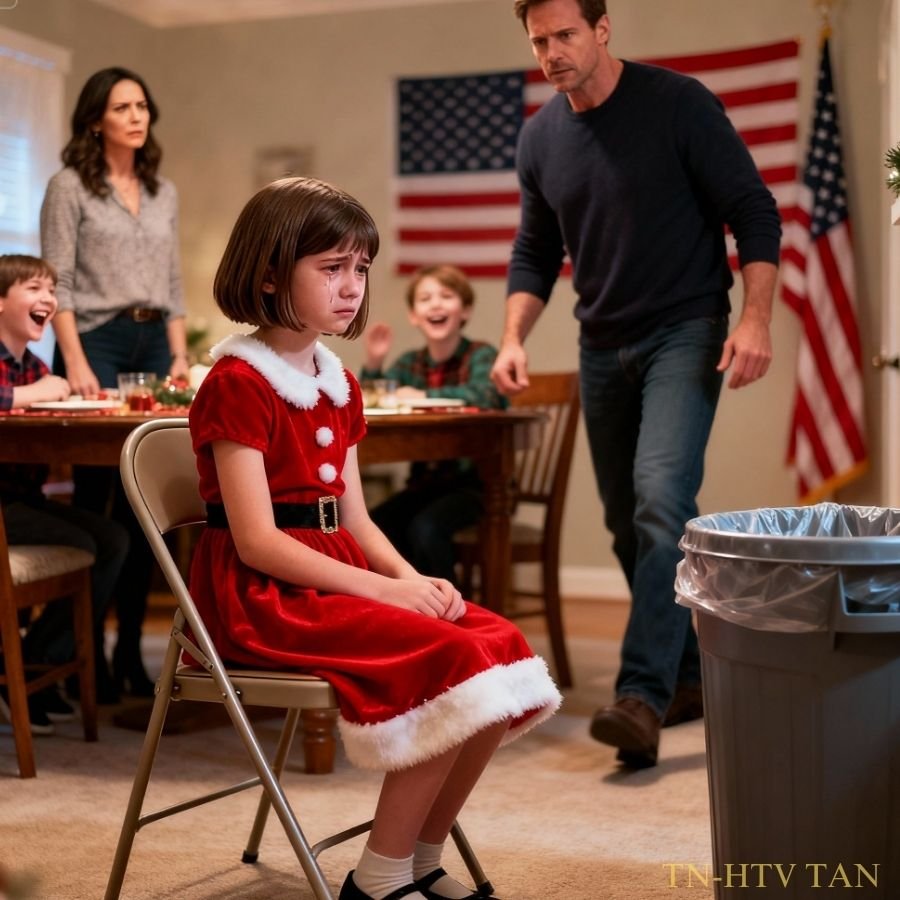
The warm glow from my parents’ house windows spilled onto the snowy lawn, and the sound of laughter promised a festive evening. I was late, still in my work uniform, a flush of embarrassment on my cheeks as I hurried up the porch steps. But the moment I opened the front door, the laughter died. The room fell into a stiff, unnatural silence. Forks were frozen mid-air, and all eyes turned to me with a mix of pity and discomfort. My own eyes scanned the room, looking for my nine-year-old daughter, Lily, in her bright red holiday dress. She wasn’t with her cousins at the children’s table. She wasn’t at the main table, either.
I found her tucked away in the corner by the kitchen door, seated on a wobbly folding chair placed squarely next to the large trash bin. Discarded wrapping paper and empty bottles surrounded her. Her hands were clenched tightly in her lap, her head bowed as if trying to disappear. The sight was a physical blow. No one had saved her a seat. No one had spoken up. The holiday cheer continued around her as if she were part of the scenery. My sister offered a casual, cruel explanation about Lily needing to learn manners, and my mother dismissed my concern with a wave of her hand. But the truth was in Lily’s eyes when she finally looked at me.
She slipped off the chair and came to me, her small shoes quiet on the floor. She leaned close, her voice a fragile whisper only I could hear. “Mom… can you do what you said you’d do if I ever felt sad again?” Months before, after a smaller but similar hurt, I had made her a solemn promise. I had told her that if they ever made her feel small again, I would not stay quiet. I crouched down and asked her if she was sad right now. She nodded, a hard, definite movement that shattered any remaining hesitation in my heart. Years of biting my tongue, of smoothing things over for the sake of family peace, ended in that instant.
I walked into the center of the dining room, feeling the weight of every stare. I told them that if humiliating a child was their Christmas tradition, then I would keep my promise to my daughter. My mother sneered, expecting more of my usual compliance. Instead, I went to my purse and pulled out a thick white envelope I had carried for months, hoping never to use it. I placed it on the table amidst the china and the roast turkey. Inside was the unvarnished truth: years of bank statements, paid invoices, and transfer receipts proving I had been managing my parents’ finances entirely since my father’s illness. Secrets my mother had sworn me to keep.
As the documents spilled out, confusion and then dawning anger spread around the table. My sister demanded to know what it all meant. I looked only at my mother and said these were all the things I had handled, all the burdens I had carried in silence. The room erupted in gasps and whispers. My mother’s face went white. Then I presented the final paper: the official notice terminating all my financial support and transferring everything back to them. Her scream was immediate, sharp, and filled with panic. I took Lily’s hand, and we walked out into the clean, cold night, leaving the chaos behind us.
The next morning, in the quiet of our own home, the phone buzzed relentlessly with demands and drama. I ignored it. I made messy pancakes, and Lily’s giggles filled our kitchen with a real, unpolluted joy. That Christmas, I learned that the most important family tradition isn’t one you inherit; it’s one you create. By choosing my daughter, I gave us both the gift of peace. I kept my promise, and that matters more than any holiday dinner or false harmony. Our new Christmas had finally begun.